
You’ve likely stood in front of two different mirrors—one in your bathroom, another at a department store—and wondered: Why do I look slimmer in one and wider in the other? It’s not just you. The way we appear in mirrors can vary dramatically depending on the mirror’s shape, angle, lighting, and even its mounting position. These variations aren’t magic or flaws—they’re rooted in optics, geometry, and perception. Understanding why your reflection changes across mirrors helps demystify everyday optical illusions and empowers you to interpret what you see more accurately.
The Science Behind Mirror Reflections
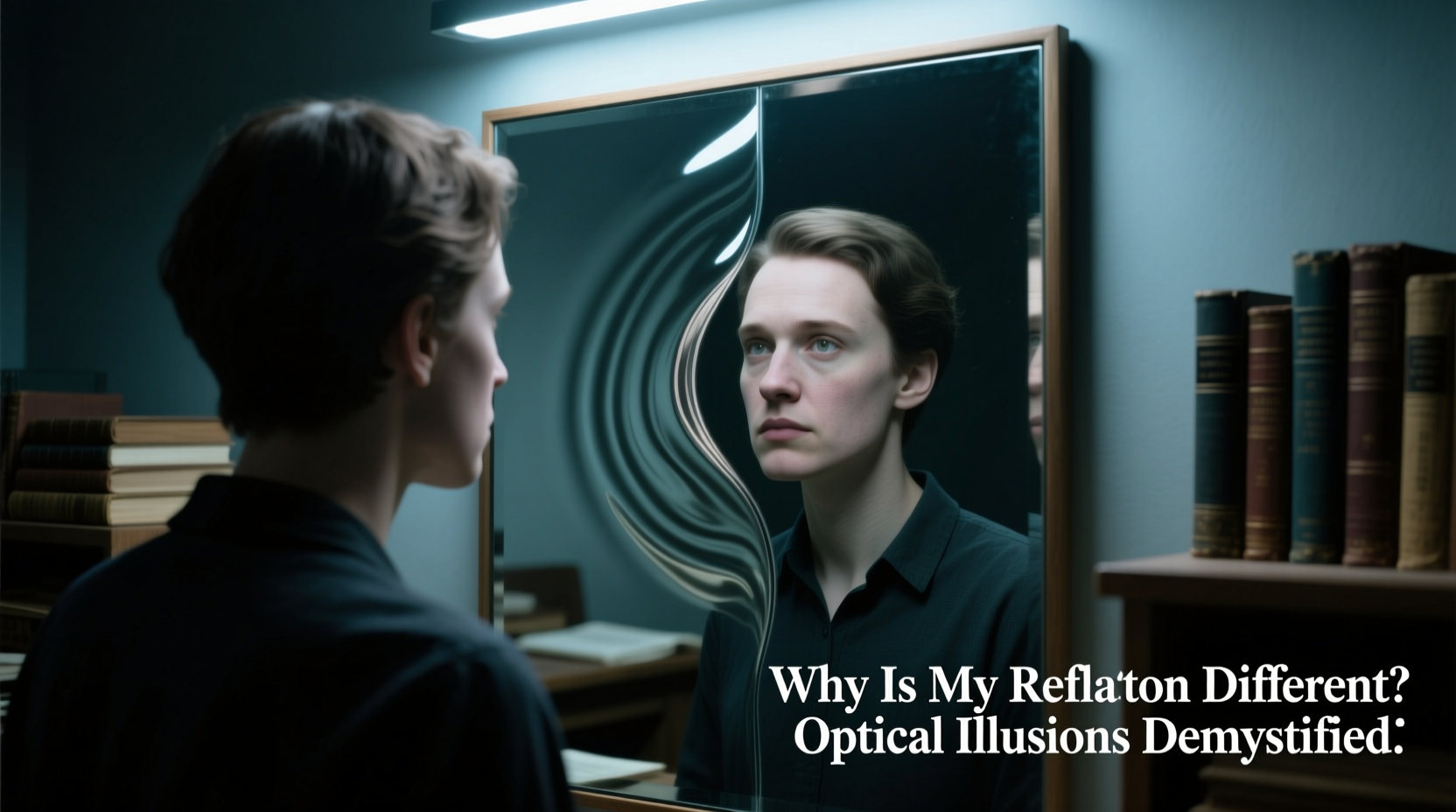
All flat mirrors reflect light according to the law of reflection: the angle at which light hits the surface equals the angle at which it bounces off. In theory, this should produce a perfect, undistorted image. But in practice, few mirrors are perfectly flat, uniformly mounted, or placed in ideal lighting. Even microscopic warps in glass or slight tilts in installation can alter your reflection.
Mirrors labeled “flat” may still have subtle curvature due to manufacturing imperfections or long-term stress on the glass. Over time, large mirrors can bow slightly under their own weight, especially if poorly supported. This minute curvature acts like a funhouse mirror—subtly stretching or compressing parts of your image without being obvious to the eye.
Additionally, reflections depend on the viewer’s distance and perspective. A mirror viewed from an angle introduces parallax, distorting proportions. For instance, standing close to a vertically mounted mirror makes your head appear larger relative to your feet—an effect known as perspective distortion.
Types of Mirrors and Their Visual Effects
Not all mirrors are created equal. The type of mirror significantly influences how your body appears. Here's a breakdown of common mirror types and their perceptual impact:
| Mirror Type | Surface Shape | Visual Effect |
|---|---|---|
| Flat Mirror | Planar (flat) | Accurate proportions; minimal distortion when properly installed |
| Convex Mirror | Curved outward | Wider field of view; shrinks appearance, making you look smaller |
| Concave Mirror | Curved inward | Magnifies central areas; can stretch or bulge middle of body |
| Tilted Mirror | Angled up or down | Alters perceived height and posture; upward tilt makes legs appear longer |
| Dual-Angle Mirrors | Combination of curves | Used in retail; often subtly widen hips or slim waistlines for flattering effect |
Retail stores frequently use dual-angle or slightly convex mirrors in dressing rooms. These are intentionally designed to enhance customer satisfaction by creating a more flattering image—making clothes appear to fit better and bodies look leaner. This isn’t deception; it’s applied psychology and optics working together to influence perception.
Lighting: The Hidden Architect of Appearance
If mirrors shape reflections, lighting sculpts them. The direction, color temperature, intensity, and diffusion of light dramatically affect how skin tone, facial features, and body contours appear.
- Overhead lighting casts shadows downward, accentuating jawlines but deepening under-eye hollows.
- Side lighting emphasizes texture and curves, highlighting muscle definition or cellulite depending on angle.
- Front-facing soft light, such as ring lights, minimizes shadows and creates a smoother, more even complexion.
- Cool white light (5000K–6500K) reveals fine details and blemishes, while warm light (2700K–3000K) softens edges and adds a golden glow.
A mirror in a well-lit boutique with diffused front lighting will show a smoother, more balanced version of you than a dimly lit bathroom with harsh fluorescent strips casting unflattering shadows. This discrepancy explains why makeup looks flawless in-store but uneven at home.
“Perception is not just about the mirror—it’s a collaboration between surface, light, and brain interpretation.” — Dr. Lena Torres, Vision Scientist, MIT Media Lab
How Your Brain Interprets Mirrored Images
Your brain doesn’t passively receive visual data—it actively constructs reality based on context, expectations, and prior experiences. When you look in a mirror, your brain combines the reflected image with stored self-perceptions, sometimes filling in gaps or smoothing inconsistencies.
This leads to cognitive biases such as the “mirror reversal effect.” Because mirrors flip images left-to-right, you see a version of yourself that others never do. Familiarity with this reversed image skews self-perception. Photos often feel “off” because they show your true, non-mirrored appearance—the same face others see daily.
Moreover, repeated exposure to flattering mirrors (like those in gyms or clothing stores) conditions your brain to associate that version of you with confidence and attractiveness. When you return to a neutral mirror, the contrast can trigger surprise or dissatisfaction—even though the latter may be more accurate.
Mini Case Study: The Dressing Room Dilemma
Sophia visited her favorite clothing store to try on a tailored blazer. In the dressing room mirror, she looked sharp—the cut emphasized her shoulders and tapered her waist. Pleased, she bought it. At home, however, the same blazer seemed boxy and unflattering in her hallway mirror.
Upon closer inspection, she noticed key differences: the store mirror was slightly convex and tilted forward at the top, elongating her torso and narrowing her hips. Her home mirror was flat and mounted straight. The garment hadn’t changed—only the reflective environment had.
After adjusting her mirror alignment and adding soft ambient lighting, Sophia found the blazer actually fit well. She realized the store’s optics were enhancing the product, not altering her body.
Step-by-Step Guide to Evaluating Your Mirrors
To ensure you're seeing an accurate reflection, follow this practical evaluation process:
- Check for Flatness: Hold a straight edge (like a ruler) against the mirror surface. Look for gaps indicating curvature.
- Assess Mounting Angle: Use a level app or physical bubble level to confirm the mirror is vertically aligned.
- Test Perspective: Step back to at least six feet and observe changes in your proportions compared to close-up viewing.
- Evaluate Lighting: Turn off artificial lights and rely on natural daylight near a window. Note differences in skin tone and contour visibility.
- Compare Multiple Sources: View yourself in different mirrors—bathroom, entryway, gym—to identify consistent vs. variable traits.
- Use Photo Verification: Take a photo from a distance with a high-resolution camera. Compare it to your mirror image to detect distortions.
Common Myths About Mirror Accuracy
Misconceptions about mirrors persist due to inconsistent experiences. Let’s clarify some myths:
- Myth: Store mirrors are always rigged to make you look better.
Truth: While many use flattering angles and lighting, not all are deceptive. Some aim for accuracy to improve fit assessment. - Myth: A mirror shows exactly how others see you.
Truth: Mirrors reverse your image. Others see your non-mirrored side, which may look subtly different due to facial asymmetry. - Myth: If a mirror feels “true,” it must be accurate.
Truth: Comfortable reflections are often preferred, but preference doesn’t equal precision. Familiarity biases judgment.
Checklist: Ensuring Honest Reflections at Home
Use this checklist to optimize your personal mirrors for truthful representation:
- ✅ Install full-length mirrors on stable, flat walls
- ✅ Use a level during installation to avoid tilting
- ✅ Choose LED lighting with 4000K color temperature for balance
- ✅ Position lights on both sides of the mirror to reduce shadows
- ✅ Replace warped or aged mirrors showing ripples or blur
- ✅ Avoid placing mirrors opposite windows causing glare
- ✅ Clean mirrors weekly to prevent smudges that scatter light
Frequently Asked Questions
Why do I look fatter in some mirrors?
This usually results from a concave curve or improper mounting. If a mirror bulges inward, it magnifies the center, making your midsection appear larger. Poor lighting that casts shadows along your sides can also create a widening illusion.
Can mirrors really make me look taller?
Yes. A mirror tilted slightly forward at the top extends the visible length of your legs by shifting the vanishing point. Vertical elongation is enhanced when combined with upward lighting and seamless flooring.
Is there such a thing as a “truthful” mirror?
The closest thing to a truthful mirror is a high-quality, frameless, flat mirror mounted vertically in balanced, neutral lighting. Some brands now market “accuracy mirrors” using reinforced glass and anti-distortion coatings, though results vary.
Conclusion: Seeing Yourself Clearly
Your reflection is not a fixed truth but a dynamic interplay of physics, design, and perception. Recognizing that mirrors can—and often do—alter your appearance allows you to approach self-image with greater objectivity. Whether choosing clothes, evaluating fitness progress, or simply getting ready for the day, understanding the variables at play helps you make informed decisions.
Instead of asking, “Do I look good in this mirror?” ask, “What is this mirror doing to my image?” That shift in mindset transforms passive observation into active awareness. Equip your space with honest optics, balanced light, and critical thinking. You deserve to see yourself clearly—not through the lens of illusion, but in the clarity of truth.




 浙公网安备
33010002000092号
浙公网安备
33010002000092号 浙B2-20120091-4
Comments
No comments yet. Why don't you start the discussion?