
You've likely stood in front of two mirrors—say, one in your bathroom and another in a department store dressing room—and wondered: Why do I look so different? One mirror makes you appear slimmer, taller, even more alert; the other distorts your features or casts unflattering shadows. It’s not just your imagination. Mirror reflections vary due to physics, design, and environmental factors. Understanding why helps demystify self-perception and guides you toward identifying which reflection comes closest to your \"true\" appearance.
The human brain relies heavily on visual input for self-recognition, yet we rarely consider that what we see in a mirror is already a curated version of reality. Mirrors don’t simply reflect—they interpret. The type of glass, coating, curvature, lighting, and viewing distance all influence how your image is rendered. This article explores the science behind mirror variability, evaluates common environments where distortions occur, and identifies conditions under which you can best assess your actual appearance.
The Science Behind Mirror Reflections
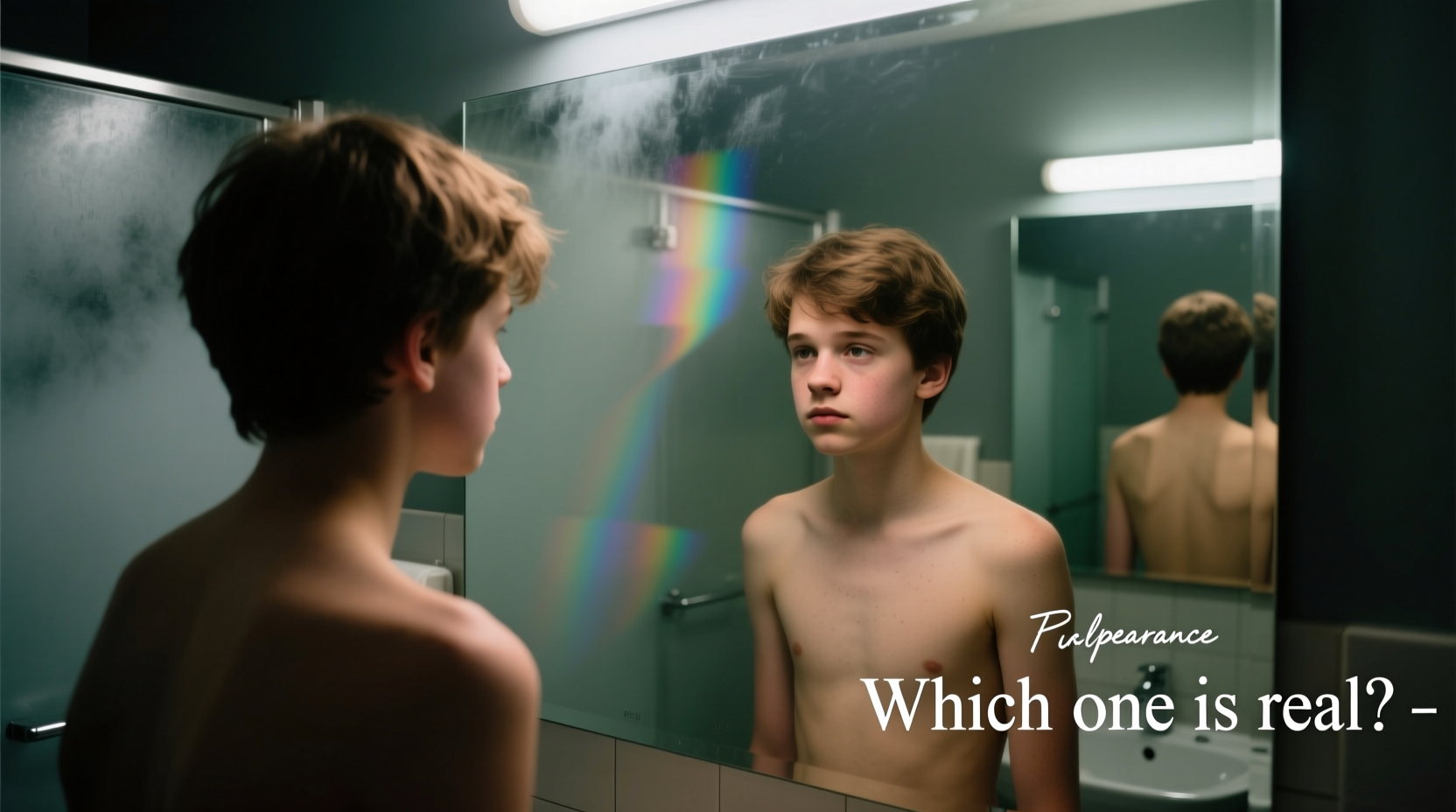
All mirrors work by reflecting light off a smooth, polished surface—typically silver or aluminum coated on the back of glass. When photons from ambient light hit your face and body, they bounce toward the mirror and return to your eyes, forming an image. In theory, this process should produce an accurate representation. But in practice, several physical variables introduce deviations.
First, **mirror flatness** plays a crucial role. Even slight warping—imperceptible to the naked eye—can stretch or compress parts of your reflection. Older mirrors, especially those mounted on wooden frames exposed to humidity, often develop subtle curves over time. These create convex or concave effects similar to funhouse mirrors, subtly altering proportions.
Second, **glass thickness and quality** matter. Lower-grade mirrors may have uneven surfaces or internal impurities that scatter light. High-quality first-surface mirrors (where the reflective layer is on the front) eliminate secondary reflections caused by light passing through glass twice—a phenomenon known as “ghosting.” Most household mirrors are second-surface, meaning light travels through the glass before reflecting, potentially causing minor distortion.
Third, **lighting direction and color temperature** dramatically alter facial perception. Overhead lighting emphasizes top-down shadows, deepening eye sockets and cheekbones. Side lighting sculpts contours but can exaggerate asymmetry. Warm light (yellowish) softens skin tones; cool light (bluish) enhances contrast and may highlight imperfections. A mirror in ideal lighting doesn’t just show you clearly—it shows you consistently.
Common Environments and Their Distorting Effects
Different settings expose us to vastly different mirror experiences. Each environment introduces its own set of optical biases.
Bathroom Mirrors
Often framed with fluorescent or LED strips, bathroom mirrors typically provide close-up views under bright, direct lighting. While convenient for grooming, many bathroom setups suffer from harsh overhead lights that cast shadows downward, making the nose appear longer and the chin recede. Some vanities use magnifying mirrors, which enlarge features but distort spatial relationships—fine for tweezing brows, poor for judging overall appearance.
Dressing Room Mirrors
Retailers are well aware that presentation affects sales. Many clothing stores install full-length mirrors tilted slightly forward at the top. This tilt creates a visual effect where the upper body appears closer and larger, while legs seem longer and leaner—an illusion that flatters posture and silhouette. Additionally, strategic spotlighting highlights fabric texture and drape, sometimes at the expense of accurate skin tone rendering.
“Retail environments manipulate perception—not deceptively, but strategically. The goal isn't realism; it's confidence.” — Dr. Lena Torres, Visual Psychologist, MIT Media Lab
Hallway or Entryway Mirrors
These tend to be older, possibly warped due to long-term mounting stress or temperature fluctuations. Because they’re often viewed from a distance, minor distortions go unnoticed until compared side-by-side with another reflection. They may also lack controlled lighting, relying on ambient room brightness that changes throughout the day.
Which Mirror Shows Your True Appearance?
If accuracy is the goal, no single mirror offers a perfect reflection—but some come closer than others. The ideal setup balances three key elements: optical fidelity, neutral lighting, and proper viewing geometry.
A high-quality, flat, full-length mirror placed vertically on a stable wall, illuminated by diffused daylight or full-spectrum artificial light (around 5500K), viewed from about 6 to 8 feet away, provides the most reliable self-image. Why this combination?
- Distance: At arm’s length, facial features appear exaggerated due to proximity. From 6+ feet, perspective normalizes, mimicking how others see you in conversation.
- Lighting: Natural daylight offers balanced color rendering. Artificial equivalents (like professional photography lights) replicate this without UV exposure.
- Mirror Quality: Look for low-iron glass with minimal green tint and a precision-backed coating. First-surface mirrors are best but expensive and fragile; for home use, optically flat second-surface mirrors suffice if properly maintained.
In contrast, phone cameras with front-facing screens, though digital, often reverse the image and apply software enhancements—making them worse for truthfulness than even flawed mirrors.
Mini Case Study: Sarah’s Wardrobe Dilemma
Sarah, a marketing executive, noticed her blazers fit differently depending on where she tried them on. At home, her bathroom mirror made her shoulders look broad and boxy. In-store mirrors made her appear sleek and tailored. Confused, she recorded herself wearing the same jacket in both settings using a tripod-mounted camera under consistent lighting. When she reviewed the footage, she saw that the store mirror was tilted forward and lit from below—creating a slimming effect. Her home mirror had cool-toned LEDs above, casting sharp shadows across her collarbones. Neither showed the full truth. Only the camera test, taken in neutral conditions, revealed that the jacket actually fit well but needed tailoring at the waist. By removing the mirror bias, Sarah made a confident purchase decision.
Step-by-Step Guide to Assessing Your True Appearance
Want to see yourself as closely as possible to how others perceive you? Follow this sequence:
- Choose the Right Mirror: Select a large, frameless, flat mirror mounted securely on a wall. Avoid curved edges or decorative bevels.
- Control the Lighting: Use two softbox lights or daylight-balanced lamps placed at 45-degree angles to the mirror—left and right, not above or behind you.
- Stand at Proper Distance: Position yourself 6 to 8 feet away. This replicates typical social interaction distance.
- Wear Neutral Clothing: Avoid bold patterns or extreme colors that draw attention away from facial structure and posture.
- Observe Multiple Angles: Turn slowly to view profile and three-quarter angles. Note proportions, not isolated features.
- Cross-Check with Photography: Take a photo with a rear-facing camera (less distortion than front-facing) from the same position and compare. Disable filters.
This method reduces perceptual noise and helps build a stable, realistic self-image—one less vulnerable to fleeting mirror tricks.
Do’s and Don’ts: Mirror Use for Accurate Self-Perception
| Do | Don’t |
|---|---|
| Use daylight-balanced lighting (5000K–6500K) | Rely solely on yellow-tinted bathroom bulbs |
| View yourself from 6–8 feet away | Judge your look from inches away in a magnifying mirror |
| Check reflections in multiple environments | Assume one mirror tells the whole story |
| Clean mirrors regularly with ammonia-free solutions | Allow smudges or streaks to remain—they blur details |
| Ensure the mirror is perfectly vertical | Accept a leaning or tilted mirror as accurate |
Frequently Asked Questions
Is the mirror image reversed? Does that affect how I look?
Yes, standard mirrors reverse the image horizontally. What you see is a flipped version of yourself—your left appears on the right. This reversal means you're accustomed to this mirrored version, while photos (which others see) show your non-mirrored appearance. This difference explains why people often feel \"off\" in photographs. Neither is inherently truer; both are valid perspectives. However, since others only see the non-reversed version, photos may better represent your public appearance.
Can mirrors make me look fatter or thinner?
Absolutely. Slight convex curvature (bulging outward) makes objects appear smaller and farther away; concave (inward curve) enlarges them. Tilting the top of a mirror away from the wall elongates the body, while tilting it forward shortens the torso. Poor lighting can also create slimming or widening illusions—side lighting carves shadows that suggest definition, while frontal lighting flattens contours.
Are there mirrors that show the “real” me?
No mirror shows a perfect replica, but infinity mirrors (two parallel mirrors facing each other with lighting between) or specialized non-reversing mirrors (using prisms or angled double mirrors) can display a non-flipped, life-like image. These are rare in homes but used in psychological studies and high-end fitting rooms. For practical purposes, consistency across multiple high-quality mirrors under neutral light offers the closest approximation of reality.
Final Checklist: How to Trust What You See
- ✅ Verify mirror flatness by checking straight lines (e.g., doorframes) in reflection.
- ✅ Install daylight-spectrum bulbs near the mirror (avoid warm or dim lighting).
- ✅ Keep viewing distance between 6 and 8 feet for holistic assessment.
- ✅ Compare reflections across at least two different mirrors in good condition.
- ✅ Use unfiltered photos taken in natural light as supplementary reference.
- ✅ Clean the mirror surface weekly to avoid haze and glare.
- ✅ Avoid making wardrobe or grooming decisions based on a single mirror check.
Conclusion: Seeing Yourself Clearly Starts With Awareness
Your reflection is not a fixed truth but a dynamic interplay of optics, environment, and psychology. Recognizing that mirrors differ—and understanding why—empowers you to move beyond momentary impressions and build a grounded sense of self-appearance. There is no single “true” mirror, but there are methods to approach accuracy. Prioritize consistency, control variables like lighting and distance, and cross-reference when in doubt.
In a world saturated with filtered images and distorted perceptions, cultivating honest self-viewing habits is an act of self-respect. Start today: adjust your lighting, clean your mirror, step back, and look—not to judge, but to understand.




 浙公网安备
33010002000092号
浙公网安备
33010002000092号 浙B2-20120091-4
Comments
No comments yet. Why don't you start the discussion?