
Have you ever stood in front of a mirror and noticed that your reflection doesn’t quite match what you expect? Perhaps your features appear subtly shifted, your posture seems off, or one side of your face looks more prominent than the other. You're not imagining things — and yes, the angle of the mirror might be part of the explanation. But there’s far more at play than just tilt or positioning. The way we perceive ourselves in mirrors involves a complex interplay of physics, psychology, and environmental factors.
This phenomenon affects nearly everyone at some point. Whether you're checking your appearance before an important meeting or simply brushing your teeth, small discrepancies in your reflection can trigger curiosity — or even self-doubt. Understanding the science behind these differences can help demystify the experience and offer practical solutions for achieving a more accurate self-view.
The Physics of Reflection: How Mirrors Work
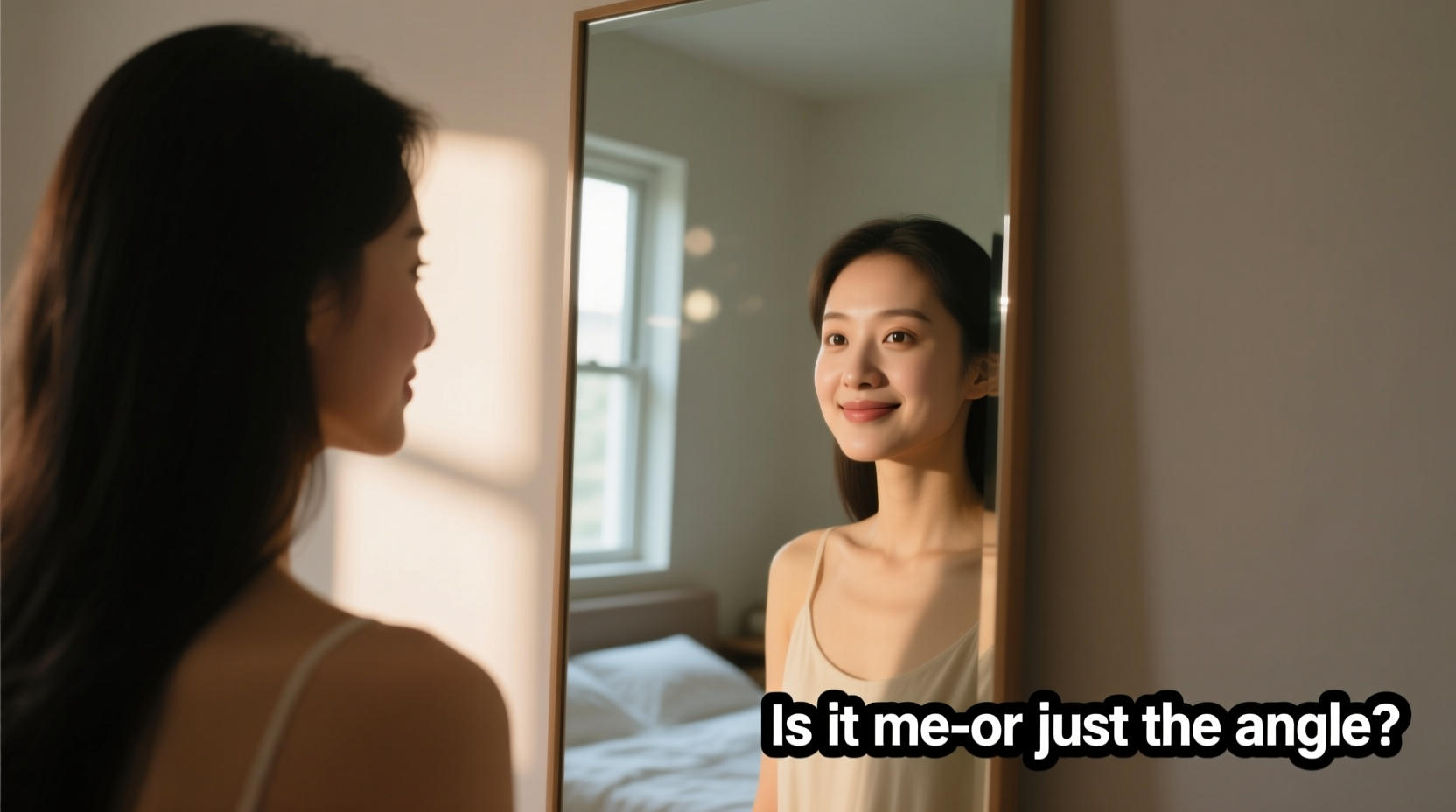
A mirror works by reflecting light rays in a predictable manner governed by the law of reflection: the angle at which light hits the surface (angle of incidence) equals the angle at which it bounces off (angle of reflection). In theory, this should produce a perfect, symmetrical image. However, real-world conditions rarely allow for ideal reflection.
Even slight deviations from perpendicular alignment between your body and the mirror surface can distort proportions. When a mirror is tilted forward or backward, or when you’re standing off-center, the reflected image undergoes geometric distortion. For example, if a full-length mirror leans toward you, your lower half may appear shorter while your upper body seems elongated. Conversely, a mirror leaning away can make your legs look disproportionately long.
Additionally, many household mirrors are not perfectly flat. Over time, especially with large wall-mounted units, mirrors can warp slightly due to temperature changes, humidity, or mounting pressure. This subtle curvature — known as \"mirror bowing\" — acts like a weak lens, magnifying or compressing parts of your image depending on where you stand.
How Viewing Angle Affects Your Reflection
The angle from which you view your reflection significantly influences how you see yourself. Most people don’t stand directly perpendicular to mirrors; instead, they approach at an oblique angle — especially in bathrooms or dressing rooms with limited space. This off-axis viewing introduces parallax effects, where depth cues become skewed.
Consider this: when you look into a mirror from the left side, the right side of your face is farther from the reflective surface than the left. Because light travels a longer distance from the distant side, the image arrives back to your eyes with a tiny delay — imperceptible, but enough to alter spatial perception. The brain interprets this disparity as asymmetry, making one cheekbone appear higher or your nose seem crooked, even if it isn’t.
This effect is compounded in wide mirrors where multiple reflections occur — such as those with side panels or in mirrored closets. Each panel reflects light at a different angle, creating conflicting visual inputs. Your brain tries to reconcile these mismatched images, often resulting in a composite impression that feels “off.”
“Mirror angle is one of the most underestimated factors in self-perception. Even a 5-degree tilt can shift facial balance in the mind’s eye.” — Dr. Alan Reyes, Optical Perception Researcher, MIT Media Lab
Lighting: The Invisible Distorter
While mirror angle plays a key role, lighting conditions are equally — if not more — influential in shaping how you appear in reflection. Uneven illumination creates shadows that accentuate certain features and obscure others. Harsh overhead lights, common in bathrooms, cast downward shadows under the eyes, nose, and chin, potentially making you look tired or gaunt.
In contrast, soft, diffused lighting placed at eye level — such as vanity bulbs around a medicine cabinet — produces balanced highlights and minimizes unflattering contours. Natural daylight from a nearby window offers the most accurate color rendering and three-dimensional clarity, closely matching how others see you in outdoor settings.
Moreover, the color temperature of light affects skin tone perception. Cool white LEDs (5000K–6500K) tend to emphasize blue undertones, sometimes giving skin a pallid or washed-out appearance. Warm incandescent bulbs (2700K–3000K), while cozy, can add yellowish tones that obscure blemishes but may dull overall vibrancy.
| Light Type | Color Temperature | Effect on Reflection |
|---|---|---|
| Daylight | 5500K–6500K | Most accurate representation; enhances detail |
| Cool LED | 4000K–5000K | Can appear harsh; emphasizes shadows |
| Warm Bulb | 2700K–3000K | Softens features; may distort skin tone |
| Fluorescent | Varies widely | Often causes greenish tint; uneven output |
The Brain’s Role in Self-Perception
Beyond optics and environment, cognitive psychology reveals that our brains actively reconstruct our mirror image based on memory, expectation, and emotional state. This mental model often diverges from physical reality.
Research shows that people tend to perceive their mirror image as less attractive than photographs taken from the same angle. Why? Because we’re accustomed to seeing our reverse image daily — the version only visible in mirrors — while others see the non-reversed version in photos. This discrepancy leads to what psychologists call the \"mere-exposure effect\": we prefer the familiar reversed face, even though it's technically not how we truly look.
Furthermore, mood impacts self-perception. On stressful days, individuals report seeing themselves as heavier, older, or more fatigued — even when no physical change has occurred. Anxiety amplifies attention to perceived flaws, turning minor asymmetries into major concerns.
Interestingly, studies using controlled mirror setups found that participants who viewed themselves at a slight upward angle (looking slightly up into the mirror) rated their attractiveness higher than those viewing themselves from above or straight-on. This suggests that both physical angle and psychological bias shape our final impression.
Real-World Example: Sarah’s Wardrobe Mirror Dilemma
Sarah, a marketing professional in Chicago, began noticing that her outfits looked different in photos compared to how they appeared in her bedroom mirror. She’d wear a tailored blazer and feel confident until seeing herself later in a team photo — where she looked slouched and disproportionate.
After ruling out clothing fit, she examined her full-length mirror. Mounted on the back of her closet door, it naturally swung open at about 15 degrees from vertical. When closed, it leaned slightly forward due to worn hinges. Using a spirit level, she confirmed a consistent 7-degree forward tilt.
She adjusted the hinges and repositioned the mirror to sit flush against the wall. The next morning, her reflection aligned much more closely with how colleagues described her appearance — poised and proportionate. A simple fix corrected months of distorted self-perception.
Sarah’s case illustrates how easily unnoticed structural issues can skew personal image — and how addressing them restores accuracy and confidence.
Step-by-Step Guide to Optimizing Your Mirror Setup
To ensure your reflection accurately represents your appearance, follow this practical sequence:
- Assess Mounting Stability: Check if the mirror wobbles or tilts when touched. Secure loose brackets or adhesive mounts.
- Level the Surface: Use a bubble level to verify the mirror is perfectly vertical (plumb) and horizontal (level).
- Position Yourself Centrally: Stand directly in front of the mirror, equidistant from both edges, to minimize angular distortion.
- Evaluate Lighting: Ensure light sources are positioned at eye level and on both sides of your face (e.g., sconces or a ring light).
- Test with Photos: Take a photo facing a neutral background and compare it to your mirror image. Note discrepancies and adjust accordingly.
- Repeat Monthly: Recheck alignment every few weeks, especially after moving furniture or seasonal humidity shifts.
Common Misconceptions About Mirror Accuracy
- Mirrors show the “true” you: False. Mirrors reverse left and right, showing a flipped image that differs from how others see you.
- All mirrors are equally accurate: Not true. Quality varies widely — cheaper mirrors may have inconsistent silvering or glass thickness, causing waviness.
- If I look good in the mirror, I’ll look good in photos: Often untrue. Cameras capture non-reversed images without parallax, leading to perceptual mismatches.
- Only large mirrors distort: Small mirrors can distort too, especially curved ones used in hallways or cars.
Frequently Asked Questions
Why does my face look lopsided in some mirrors?
This is typically due to a combination of viewing angle and lighting. Standing off-center causes one side of your face to be closer to the mirror, altering depth perception. Asymmetrical lighting can also deepen shadows on one side, exaggerating natural facial asymmetry — which nearly everyone has to some degree.
Can mirror angle affect how tall I look?
Yes. A mirror tilted backward makes you appear taller by shifting the vanishing point upward, stretching the lower body visually. A forward tilt shortens the torso and legs. For accurate height assessment, the mirror must be perfectly upright.
Is there a “best” type of mirror for seeing myself accurately?
Opt for a high-definition, low-distortion mirror with minimal frame warping. Trained professionals like optometrists and photographers often use “true view” mirrors — actually two mirrors joined at 90 degrees — that reflect your image without flipping it, showing you exactly how others see you.
Conclusion: Seeing Yourself Clearly Starts with Awareness
Your reflection is not a flawless replica of reality — it’s a dynamic interaction of angles, light, and perception. While the mirror’s physical orientation can indeed cause noticeable differences in how you appear, it’s only one piece of a larger puzzle. By understanding the roles of geometry, illumination, and cognition, you gain control over how you see yourself — and more importantly, reduce unnecessary self-criticism based on misleading visuals.
Take a moment to evaluate your primary mirrors — in the bathroom, bedroom, or entryway. Are they level? Is the lighting balanced? Do they reflect a fair representation of who you are? Small adjustments can lead to significant improvements in both appearance accuracy and self-confidence.




 浙公网安备
33010002000092号
浙公网安备
33010002000092号 浙B2-20120091-4
Comments
No comments yet. Why don't you start the discussion?