
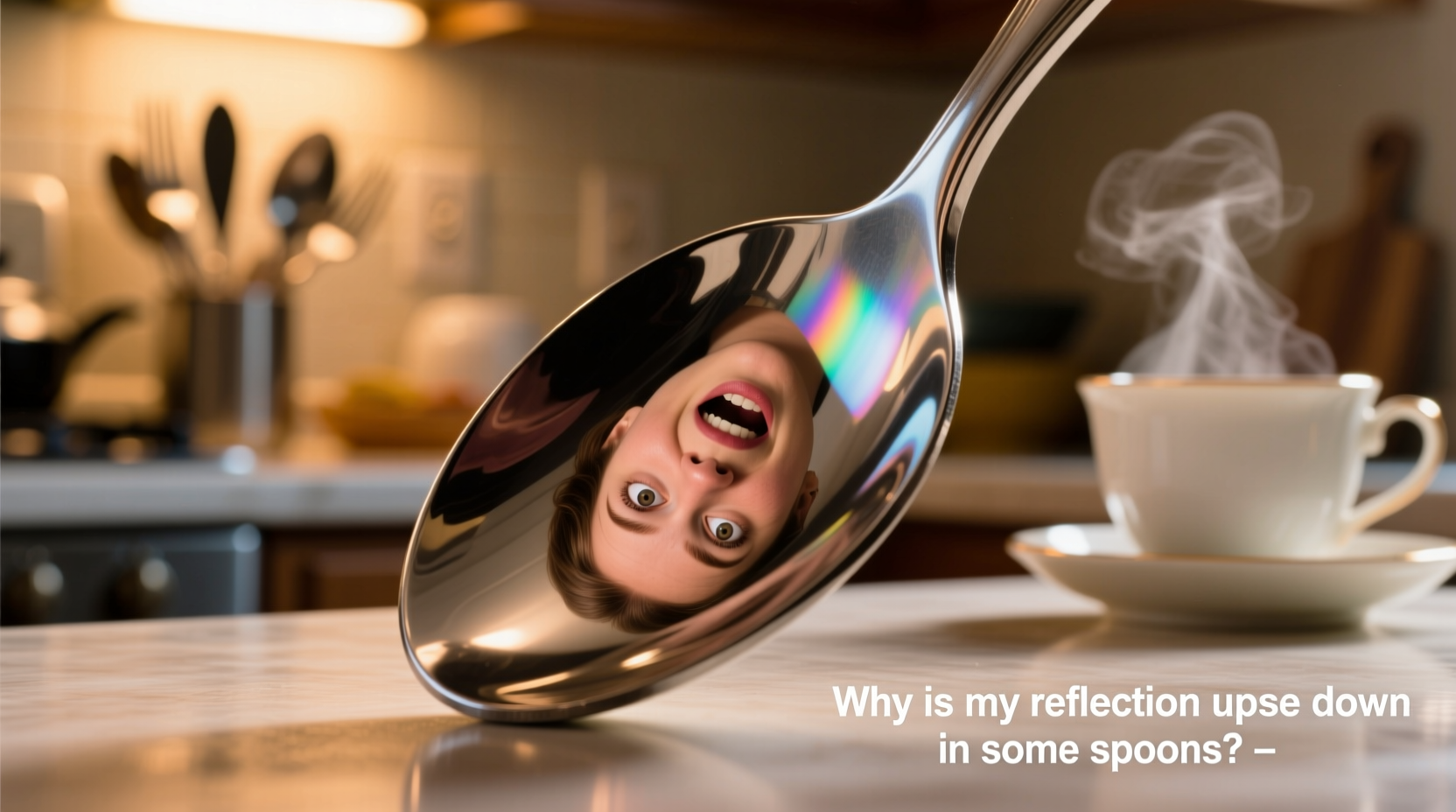
Stand in front of a shiny spoon and look into its bowl-shaped side—you might be surprised to see your face flipped completely upside down. This curious optical illusion isn’t magic, nor is it a flaw in the spoon. It’s a real-world demonstration of how light behaves when reflected off curved surfaces. While spoons are common kitchen tools, they also serve as simple yet effective models for understanding fundamental principles of optics. The phenomenon reveals how mirror shape influences image formation, and why curvature can invert, distort, or magnify what we see.
This effect doesn’t happen on every side of the spoon. Flip it over to the back—the outwardly curved side—and your reflection may appear smaller and upright, though still strangely warped. These differences arise from two distinct types of reflective surfaces: concave and convex. Understanding the physics behind them explains not only spoon reflections but also the design of telescopes, car side mirrors, and even dental instruments.
The Science of Reflection: Concave vs. Convex Surfaces
All reflections occur due to the way light rays bounce off smooth surfaces. When light hits a flat mirror, rays reflect at predictable angles, preserving the proportions and orientation of the object. But when the surface curves—either inward like a cave (concave) or outward like a bubble (convex)—the reflection changes dramatically.
A typical metal spoon has both types of curvature. The inside, or bowl side, is **concave**, curving inward. The outside, or back side, is **convex**, bulging outward. Each shape manipulates incoming light differently, producing unique visual effects.
In a concave surface, parallel light rays reflecting off the curve converge toward a focal point. Depending on the viewer's distance from this focal point, the resulting image can be inverted, magnified, or diminished. This is precisely why your face flips upside down when you hold the spoon close to your eye and look into its bowl.
Conversely, convex surfaces cause light rays to diverge, spreading out after reflection. This creates a virtual image that appears smaller than the actual object and remains upright, regardless of viewing distance. That’s why the back of the spoon shows a shrunken, right-side-up version of your face—even if it looks slightly distorted.
“Curved mirrors don’t just bend light—they reorganize the entire visual field based on geometry. A teaspoon can teach more about optics than a textbook diagram.” — Dr. Alan Pierce, Optical Physicist, MIT
How Distance Affects Your Spoon Reflection
The position of your face relative to the spoon’s focal point determines whether the image is upright or inverted. In concave mirrors, such as the inside of a spoon, there’s a critical threshold known as the **focal length**—the distance from the mirror’s surface to where reflected rays meet.
- If you’re farther from the spoon than its focal point, the reflected rays cross before reaching your eyes, forming an inverted real image.
- If you move closer than the focal length, the rays diverge, creating an upright, magnified virtual image—similar to using a makeup mirror.
Most eating spoons have very short focal lengths—often just a few centimeters—so unless you're nearly touching the spoon, you're likely beyond its focal point, which results in an upside-down reflection.
Why Don’t All Spoons Do This?
Not all spoons produce a clear upside-down image. Several factors influence whether the inversion effect is visible:
| Factor | Effect on Reflection |
|---|---|
| Surface Smoothness | Rough or brushed finishes scatter light, blurring the image. Highly polished stainless steel works best. |
| Curvature Depth | Deeper bowls (like soup spoons) have stronger curvature and shorter focal lengths, making inversion easier to observe. |
| Metal Type | Stainless steel reflects more clearly than silver-plated or antique spoons, which may tarnish or oxidize. |
| Size | Larger spoons provide a wider field of view, improving image clarity compared to tiny teaspoons. |
If your spoon shows only a blurry smudge, it may lack the necessary polish or curvature. A well-maintained dessert spoon or tablespoon is ideal for observing this phenomenon clearly.
Real-World Example: A Child’s First Physics Lesson
In a third-grade classroom in Portland, Oregon, science teacher Maria Lopez uses spoons to introduce optics. She hands each student a polished spoon and asks them to describe what they see on each side. One boy gasps when he notices his nose flipping upside down. “Is it broken?” he asks. Lopez guides him through moving the spoon closer and farther, helping him discover the “flip point” where the image rights itself.
By the end of the lesson, students understand that light follows rules—it’s not random. They draw diagrams showing how rays converge and diverge, using arrows to trace paths off concave and convex surfaces. For many, this spoon activity becomes their first tangible encounter with the laws of reflection. As Lopez says, “You don’t need a lab full of equipment to teach physics. Sometimes, all you need is lunchware.”
Applications Beyond the Kitchen: Where Curved Mirrors Matter
The same principles that turn your face upside down in a spoon are used in advanced technologies. Engineers and scientists apply concave and convex mirror behavior in practical ways across multiple fields.
Concave mirrors are essential in devices requiring focused light. Astronomical telescopes use large concave primary mirrors to gather and concentrate faint starlight onto sensors. Similarly, satellite dishes and solar cookers rely on inward-curving surfaces to focus energy at a single point.
Convex mirrors, meanwhile, are prized for their wide field of view. Car side mirrors often carry the warning “Objects in mirror are closer than they appear” because the outward curve compresses the scene, allowing drivers to see more of the road. Security mirrors in stores and hallways use the same principle to eliminate blind spots.
Dentists also use small concave mirrors to get magnified views inside the mouth. The curvature allows them to illuminate tight spaces while maintaining clarity. Even flashlight reflectors are shaped like shallow concave surfaces to project beams farther and brighter.
Step-by-Step Guide: Observe the Effect Yourself
You don’t need special tools to witness this optical phenomenon. Follow these steps to explore the science firsthand:
- Choose the right spoon: Select a clean, polished metal spoon with a deep bowl—ideally a tablespoon or soup spoon.
- Find good lighting: Stand near a window or under a bright lamp so your face is well illuminated.
- Look into the bowl side: Hold the spoon steady and gaze into the concave surface from about 30 cm away.
- Observe the inversion: Notice how your reflection appears upside down. Move the spoon slowly toward your face.
- Watch for the flip: Around 5–10 cm from your eyes, the image should suddenly become upright and larger.
- Flip the spoon: Now examine the back (convex) side. Note that the reflection stays upright but appears smaller and distorted.
- Compare both sides: Sketch or describe the differences in image size, orientation, and clarity.
This simple exercise demonstrates core concepts in geometric optics: focal points, real vs. virtual images, and ray convergence. It’s a powerful reminder that physics isn’t confined to laboratories—it’s embedded in everyday objects.
Frequently Asked Questions
Can plastic spoons show the same effect?
No, most plastic spoons lack the smooth, metallic finish needed for clear reflection. Even if tinted, plastic scatters light diffusely rather than reflecting it coherently, preventing any distinct image formation.
Why does the image flip only on one side of the spoon?
Only the concave (inside) surface has the ability to form inverted real images when the object is beyond the focal point. The convex (outside) surface always produces upright virtual images, regardless of distance.
Is the upside-down reflection real or just an illusion?
It’s a real optical image formed by converging light rays. If you placed a tiny screen at the correct point in space, you could project an actual upside-down image of your face—just like in a camera or projector.
Final Thoughts: Everyday Objects as Windows to Science
The humble spoon offers more than just utility at the dinner table. When examined closely, it becomes a tool for discovery—a miniature model of complex optical systems. The upside-down reflection isn't a glitch; it's a precise outcome governed by the laws of physics. By understanding why it happens, we gain insight into how light shapes our perception of the world.
Next time you stir your coffee or scoop ice cream, take a moment to pause and peer into the bowl of the spoon. What you see might surprise you—not because it’s strange, but because it reveals the hidden order beneath ordinary experiences. Optics, reflection, and geometry aren’t distant academic topics. They’re alive in the objects we touch every day.




 浙公网安备
33010002000092号
浙公网安备
33010002000092号 浙B2-20120091-4
Comments
No comments yet. Why don't you start the discussion?