
Every evening, as the sun dips toward the horizon, something subtle yet striking happens: your shadow stretches across the ground like a long silhouette reaching into the distance. At noon, the same shadow might be barely noticeable, clustered tightly beneath your feet. This transformation isn’t magic—it’s physics. The changing size of your shadow throughout the day is a direct result of how sunlight strikes the Earth at different angles. Understanding this phenomenon reveals not only how light behaves but also how we can observe fundamental principles of geometry and optics in everyday life.
The Basics of Shadow Formation
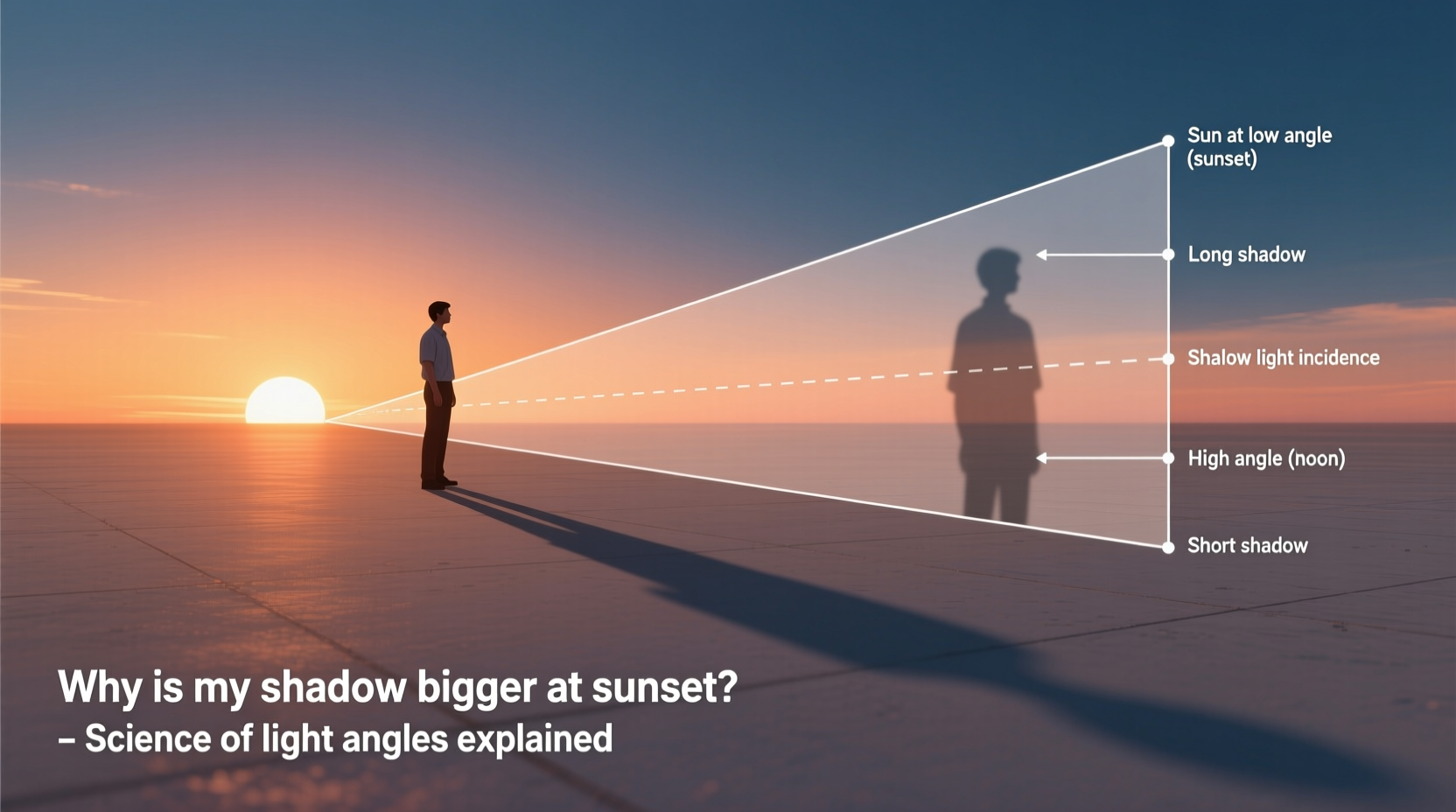
A shadow forms when an opaque object blocks a source of light. In the case of sunlight, your body intercepts rays traveling from the sun, preventing them from reaching the ground directly behind you. The area where light is obstructed becomes your shadow. The shape and length of that shadow depend on two primary factors: the position of the light source and the angle at which the light hits the object.
When the sun is high in the sky—such as around midday—the light rays strike the Earth almost perpendicularly. These near-vertical rays create short shadows because the obstruction (your body) doesn’t extend far along the ground before the light resumes its path. However, as the sun lowers in the sky during sunrise or sunset, the angle of incidence becomes much more oblique. This shallow angle causes light to skim across the surface, stretching any obstruction’s shadow dramatically.
How Light Angles Affect Shadow Length
The key scientific principle behind elongated shadows at sunset is the angle of elevation of the sun. This angle measures how high the sun appears above the horizon, ranging from 0° (on the horizon) to 90° (directly overhead).
At solar noon, especially near the equator or during summer months, the sun can reach close to 90°. At this near-vertical angle, light travels almost straight down, minimizing horizontal displacement. As a result, shadows are shortest.
In contrast, during sunset, the sun's angle of elevation may drop below 10° or even approach 0°. At such low angles, sunlight must travel through more atmosphere and strike surfaces at a shallow incline. Your body still blocks the light, but now the blocked region extends far behind you along the ground. Think of it like holding a flashlight just above a table—you’ll see a long shadow even from a small object.
This relationship between sun angle and shadow length follows basic trigonometry. If you imagine a right triangle formed by:
- The height of a person (vertical leg),
- The length of their shadow (horizontal leg), and
- The path of sunlight from the top of their head to the tip of the shadow (hypotenuse),
Then the tangent of the sun’s angle equals (height / shadow length). Rearranged, shadow length = height / tan(angle). As the angle decreases, the tangent value drops sharply, causing the shadow length to increase exponentially.
Real-World Example: Measuring Shadows at Different Times
Consider a person who is 1.7 meters (about 5’7”) tall.
| Sun Angle (Above Horizon) | Shadow Length Calculation | Resulting Shadow Length |
|---|---|---|
| 80° (Mid-morning) | 1.7 / tan(80°) ≈ 1.7 / 5.67 | ~0.3 meters (~1 ft) |
| 45° (Late afternoon) | 1.7 / tan(45°) = 1.7 / 1 | 1.7 meters (~5’7”) |
| 10° (Sunset) | 1.7 / tan(10°) ≈ 1.7 / 0.176 | ~9.66 meters (~32 ft) |
| 5° (Just before sunset) | 1.7 / tan(5°) ≈ 1.7 / 0.0875 | ~19.4 meters (~64 ft) |
As shown, a mere shift from 45° to 10° increases shadow length sixfold. By the time the sun reaches 5°, the shadow is nearly 20 meters long—over ten times the person’s height.
“Shadows are nature’s way of illustrating geometry. They turn abstract angles into visible, measurable phenomena anyone can witness.” — Dr. Alan Reyes, Astrophysicist and Science Educator
Why the Sun Appears Lower: Earth’s Rotation and Atmospheric Effects
The reason the sun’s angle changes throughout the day is due to Earth’s rotation on its axis. As our planet spins, different locations move into and out of direct sunlight. When your location faces most directly toward the sun (around noon), the angle is highest. As Earth continues rotating, the sun appears to descend, even though it’s actually your vantage point that’s tilting away.
Additionally, atmospheric refraction plays a minor role in enhancing the visual effect. As sunlight passes through layers of air near the horizon, it bends slightly due to density differences. This means we actually see the sun for a few minutes after it has geometrically set below the horizon. While this doesn’t significantly alter shadow length, it does prolong the period of long shadows slightly beyond actual sunset.
Seasonal and Geographic Variations
It’s important to note that the extent of shadow elongation depends on both season and latitude. Near the equator, the sun can pass nearly overhead, producing very short midday shadows year-round. In contrast, at higher latitudes—even during summer—the sun never reaches 90°, so shadows remain somewhat elongated even at noon.
During winter months, the sun’s maximum elevation is lower, meaning longer shadows persist throughout the day. In polar regions, there are times of year when the sun never rises high enough to produce short shadows at all—leading to perpetual twilight and extremely stretched silhouettes.
Practical Applications of Shadow Science
Understanding how light angles affect shadows isn't just academic—it has practical uses in architecture, photography, navigation, and even health.
Photography and Cinematography
Photographers often schedule shoots during the “golden hour”—the period shortly after sunrise or before sunset—because the long, soft shadows add depth and dimension to images. The low-angle light creates dramatic contrasts and warm tones, making subjects appear more three-dimensional.
Architecture and Urban Planning
Architects use shadow modeling software to predict how buildings will cast shadows over streets, parks, and neighboring structures throughout the year. This helps prevent excessive shading in public spaces and ensures compliance with local sunlight access regulations.
Natural Navigation
Before GPS, people used shadows to determine direction and time. The shortest shadow of the day points true north (in the Northern Hemisphere) and occurs at solar noon. By marking shadow tips hourly, one could estimate the time based on their movement—a primitive sundial.
Vitamin D and Sun Exposure
The same low sun angles that stretch shadows also reduce UVB radiation intensity. During early morning and late afternoon, even if the sun is visible, your skin produces little vitamin D because sunlight passes through more atmosphere, filtering out essential wavelengths. This reinforces the idea that midday sun exposure (with proper protection) is most effective for natural vitamin synthesis.
Step-by-Step Guide: Observing and Measuring Your Shadow
You don’t need special equipment to explore the science of shadows. Here’s how to conduct a simple experiment:
- Choose a flat, open area like a sidewalk or parking lot where shadows fall clearly.
- Pick three times of day: morning (e.g., 9 AM), noon (12 PM), and late afternoon (5 PM).
- Stand in the same spot each time, wearing similar clothing and footwear.
- Mark the tip of your shadow using chalk or a small object.
- Measure the distance from your feet to the shadow tip with a tape measure or ruler.
- Record the data alongside the approximate sun angle (use a free astronomy app like Sun Surveyor or Solar Watch).
- Compare results to see how shadow length correlates with time and sun position.
Repeat this over several days to account for seasonal shifts. You’ll begin to notice patterns tied to the sun’s declination and your geographic location.
Common Misconceptions About Shadows at Sunset
Despite being a common sight, several myths surround long shadows at sunset:
- Myth: The sun is physically closer to Earth at sunrise/sunset.
Reality: Distance variation due to Earth’s orbit is negligible on a daily basis. The effect is purely angular. - Myth: Shadows get longer because the sun is “weaker.”
Reality: Intensity affects brightness, not geometry. Even a dim light source creates long shadows if positioned low. - Myth: Tall objects always cast longer shadows.
Reality: Proportionally, all vertical objects cast shadows of equal length-to-height ratio under the same sun angle.
Frequently Asked Questions
Can shadows be longer than the object casting them?
Yes, absolutely. When the sun is below 45° above the horizon, shadows become longer than the object itself. At sunset, they can be many times longer—especially for shorter objects.
Why do shadows look darker at noon but softer at sunset?
At noon, sunlight is more direct and intense, creating sharp contrasts. At sunset, light scatters through more atmosphere, diffusing the rays and softening edges. Also, ambient light from the sky fills in some of the shadowed areas, reducing contrast.
Is it possible to have no shadow at all?
Yes, briefly at solar noon near the equator during equinoxes, the sun can be directly overhead (90°), causing vertical objects to cast almost no shadow. This phenomenon, called \"zero shadow day,\" occurs in places like Mumbai, Singapore, and Nairobi.
Conclusion: Embrace the Everyday Science Around You
The next time you walk past your towering silhouette at dusk, remember—you’re witnessing a perfect demonstration of light, angle, and geometry in action. The science behind why your shadow grows larger at sunset is rooted in simple yet profound physical laws. It connects us to ancient astronomers, navigators, and artists who relied on these same observations to understand time, space, and beauty.
By paying attention to the world around you, even the most ordinary moments become opportunities for discovery. Whether you're teaching a child about light, planning a photo session, or simply enjoying a quiet evening stroll, take a moment to look down. Your shadow tells a story—one written in sunlight and angles, changing with every passing minute.




 浙公网安备
33010002000092号
浙公网安备
33010002000092号 浙B2-20120091-4
Comments
No comments yet. Why don't you start the discussion?