
You step outside on a bright, sunny day and notice your sharp, well-defined shadow stretching across the pavement. A few days later, under a thick blanket of gray clouds, you look down again—and your shadow seems softer, fainter, and oddly larger. It’s not your imagination. Shadows do appear bigger and blurrier on cloudy days, and the reason lies in a fundamental optical phenomenon called light diffusion.
This effect often surprises people because intuition suggests that less direct sunlight should create weaker or even no shadows. Yet, shadows still form—and sometimes appear more expansive—when the sky is overcast. Understanding this requires unpacking how light behaves when it interacts with clouds, atmosphere, and solid objects. This article explores the science behind diffuse lighting, explains why shadows change under cloud cover, and clarifies common misconceptions about light and shadow formation.
The Basics of Shadow Formation
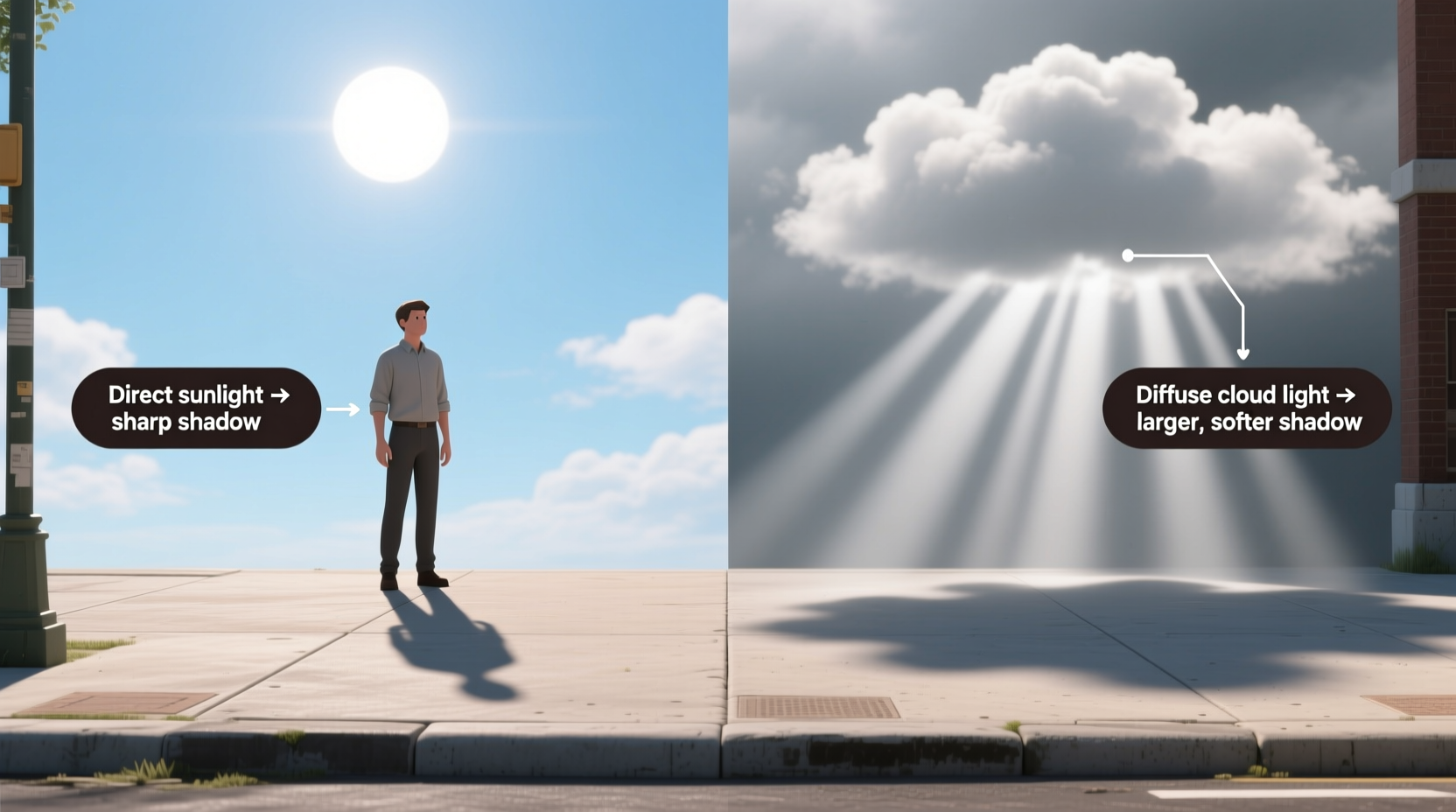
A shadow forms when an opaque object blocks light from a source, creating a region where light cannot reach. The size, shape, and clarity of a shadow depend on three main factors: the position of the light source, the distance between the object and the surface where the shadow falls, and the nature of the light itself—specifically, whether it's directional (focused) or diffuse (scattered).
On a clear day, sunlight travels in nearly parallel rays from the sun, which acts as a distant, concentrated source. When these rays hit an object like a person standing upright, they are blocked in a predictable way, casting a sharply defined shadow with distinct edges. The angle of the sun also determines shadow length; lower angles (like during sunrise or sunset) produce longer shadows.
But when clouds roll in, the rules change. Clouds don’t block all light—they scatter it. Instead of traveling in straight lines from one direction, sunlight bounces off countless water droplets and ice crystals within the cloud layer, spreading out in many directions. This process transforms a single-directional beam into a broad, diffused glow coming from across the entire sky.
What Is Light Diffusion?
Light diffusion refers to the scattering of light waves as they interact with particles in their path. In atmospheric terms, this occurs when sunlight passes through clouds composed of tiny water droplets or ice crystals. These particles are similar in size to the wavelength of visible light, causing Mie scattering—a type of scattering that affects all wavelengths almost equally, which is why clouds appear white or gray rather than colored.
Unlike Rayleigh scattering (which makes the sky blue by preferentially scattering shorter blue wavelengths), Mie scattering redirects light in multiple directions. As a result, instead of receiving light from a single point (the sun), you’re illuminated from many angles across the sky dome. The cloud essentially turns the entire sky into a giant softbox, much like those used in photography studios to create even, shadow-minimized lighting.
This widespread illumination means that no single direction dominates the lighting. Objects are lit from above, the sides, and even slightly from below due to reflected light from surrounding surfaces. Consequently, shadows lose their crispness and become softer, broader, and less intense.
Why Does My Shadow Appear Bigger?
The perception that your shadow is “bigger” on cloudy days isn’t about actual physical expansion but rather about how the shadow is formed and perceived visually. There are several reasons for this illusion:
- Multiple light sources: Diffused light behaves as if it comes from many points across the sky. Each of these virtual sources casts its own faint shadow at slightly different angles. These overlapping shadows blend together, creating a larger penumbra—the fuzzy outer edge of a shadow—while the central umbra (the darkest part) may be weak or absent.
- Increased penumbral area: In physics, the penumbra grows when the light source becomes larger relative to the object. Clouds effectively turn the sun into an enormous extended source, increasing the penumbra significantly. This gives the impression of a broader, more spread-out shadow.
- Contrast reduction: With lower contrast between light and dark areas, the boundary of the shadow becomes harder to define. Your brain interprets this gradual fade as a larger area being affected, contributing to the sense that the shadow occupies more space.
- Surface reflectance effects: Ambient light bouncing off nearby surfaces can subtly illuminate parts of what would otherwise be shadowed, further blurring the line between light and dark.
In essence, your shadow doesn't grow—it spreads out and softens. The absence of a strong central core makes the peripheral dimming more noticeable, leading to the visual impression of increased size.
“Diffuse lighting doesn’t eliminate shadows—it redistributes them. What you see on cloudy days is not one shadow, but hundreds of overlapping micro-shadows blending into a soft halo.” — Dr. Lena Torres, Atmospheric Optics Researcher, University of Colorado Boulder
Comparing Shadow Behavior: Sunny vs. Cloudy Days
| Aspect | Sunny Day | Cloudy Day |
|---|---|---|
| Light Source | Direct, single-point (sun) | Diffuse, multi-directional (entire sky) |
| Shadow Clarity | Sharp, well-defined edges | Soft, blurred edges |
| Shadow Size Perception | Narrower, compact appearance | Larger, spread-out appearance |
| Umbra Strength | Strong, clearly visible | Weak or absent |
| Penumbra Width | Narrow | Very wide |
| Contrast Level | High (bright light/dark shadow) | Low (even illumination) |
| Primary Scattering Type | Minimal atmospheric scattering | Mie scattering in clouds |
Real-World Example: A Photographer’s Dilemma
Consider Maya, a portrait photographer who schedules outdoor shoots based on weather conditions. She once planned a midday session expecting harsh sunlight to create dramatic shadows. But the morning turned overcast, and she worried her photos would lack definition.
To her surprise, the images showed subjects with gentle gradients and minimal harsh shadows. When she reviewed the shots, she noticed that each person had a faint, wide silhouette around them—especially noticeable on light-colored pavement. At first, she thought it was lens flare or exposure issues. After consulting with a colleague familiar with optics, she learned that the large, soft shadows were caused by diffuse lighting from the cloud layer.
Instead of fighting the conditions, Maya adjusted her approach. She used the broad, even light to her advantage, capturing natural-looking portraits without needing reflectors or fill lights. The expanded penumbras added depth without distraction. This experience taught her that understanding light diffusion wasn’t just academic—it directly impacted her creative outcomes.
Common Misconceptions About Shadows and Clouds
Several myths persist about how shadows work under cloud cover. Clarifying these helps deepen understanding:
- Myth: No sun = no shadows. False. Even under thick clouds, enough light penetrates to cast shadows. They're just softer and less obvious.
- Myth: Clouds absorb most sunlight. Not quite. While some light is absorbed, most is scattered. That’s why it’s still bright outside on overcast days.
- Myth: Larger shadows mean stronger light. Actually, the opposite. Strong directional light creates smaller, sharper shadows. Large, soft shadows indicate weaker directional dominance.
- Myth: Only the sun’s position matters. While solar angle affects shadow length, the quality of light (diffuse vs. direct) plays a crucial role in shadow appearance.
How to Observe Light Diffusion Yourself
You don’t need special equipment to witness light diffusion in action. Here’s a simple observational checklist you can follow:
- Choose a flat, light-colored surface (like concrete or asphalt).
- Stand still at the same spot on both a sunny and a cloudy day.
- Observe the outline of your shadow. Note the sharpness of the edges.
- Trace the approximate area your shadow covers using chalk or mental estimation.
- Compare the two: On the cloudy day, notice how the shadow fades gradually rather than ending abruptly.
- Try holding up your hand at arm’s length. On a sunny day, you’ll see fine details like fingernail shadows. On a cloudy day, only a vague hand shape remains.
Frequently Asked Questions
Can you have a shadow at night?
Yes, provided there is a strong enough artificial light source—such as a streetlamp or flashlight. However, ambient city lighting often creates so much scattered light that shadows are faint or non-existent unless close to a direct beam.
Do thicker clouds make shadows disappear completely?
Extremely dense storm clouds can reduce light so much that shadows become imperceptible. But in most overcast conditions—even heavy gray skies—some level of shadow remains due to residual diffuse illumination.
Is this the same reason why photographers use diffusers?
Exactly. Studio photographers place translucent panels between lights and subjects to mimic the effect of clouds. This softens shadows, reduces contrast, and produces flattering results, especially in portrait work.
Conclusion: Embracing the Science of Everyday Light
The next time you notice your shadow appearing unusually large on a cloudy day, remember—you're witnessing a beautiful interplay of physics and perception. Light diffusion transforms the sun into a vast, glowing ceiling, altering how shadows form and how we interpret them. This phenomenon isn’t just relevant to scientists or photographers; it shapes how we experience light and space every day.
Understanding these principles empowers you to better interpret the world around you, whether you're walking through a park, setting up a photo shoot, or simply curious about natural phenomena. Light isn’t just something that lets us see—it tells stories through its behavior, and shadows are among its most subtle narrators.




 浙公网安备
33010002000092号
浙公网安备
33010002000092号 浙B2-20120091-4
Comments
No comments yet. Why don't you start the discussion?