
At first glance, the idea that a shadow could be “brighter” seems contradictory. Shadows are, by definition, areas where light is blocked. Yet many people walking under streetlights at night report seeing their shadows appear unusually bright—sometimes even glowing faintly against the pavement. This phenomenon isn’t an illusion caused by tired eyes or city fog. It’s rooted in physics, human vision, and the unique way artificial lighting interacts with our surroundings. Understanding why your shadow looks brighter at night involves exploring how light scatters, how our eyes adapt to darkness, and the role of ambient reflection in urban environments.
The Science of Light and Shadow Formation
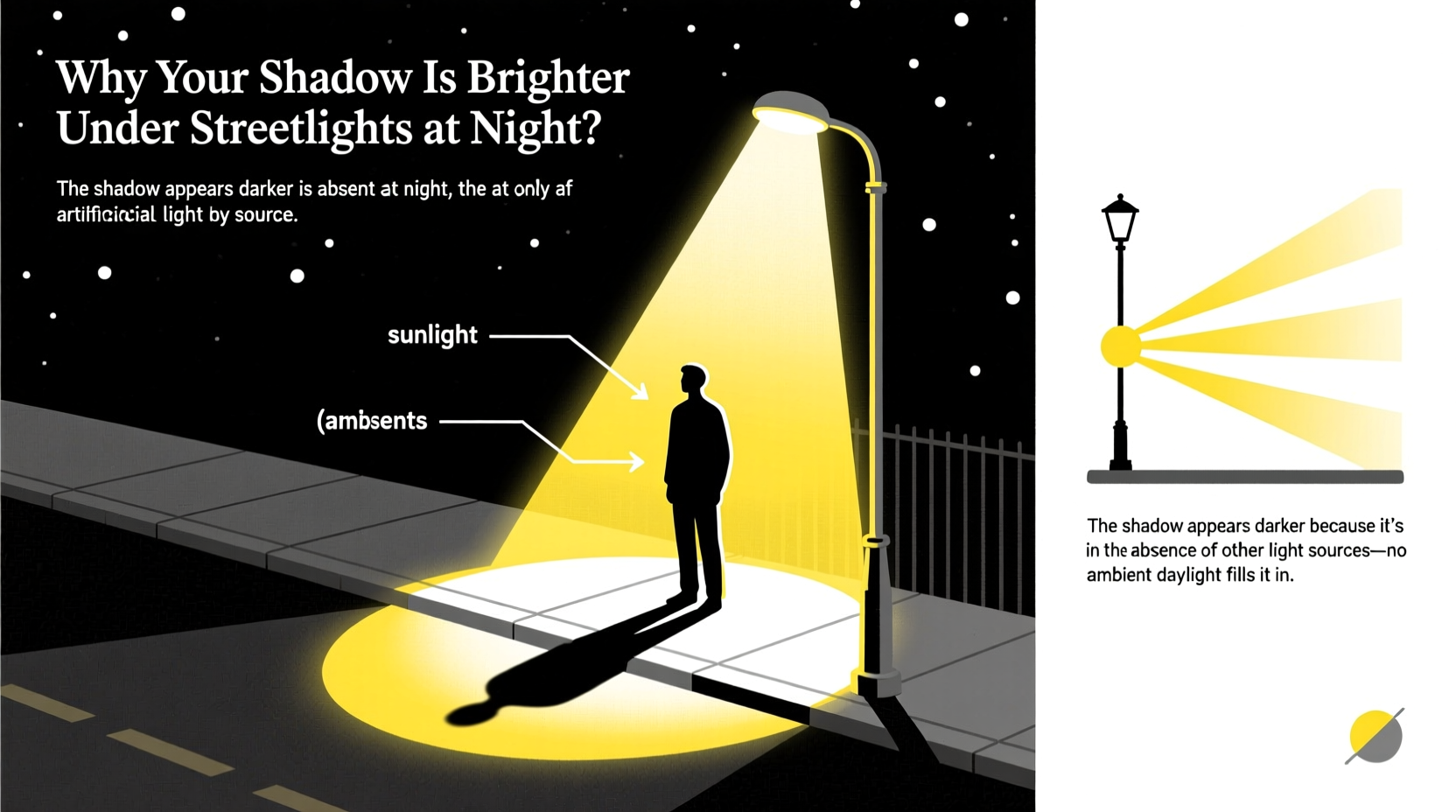
Shadows form when an opaque object—in this case, your body—blocks a source of light. Under direct sunlight, shadows are sharp and dark because the sun is a distant, intense point source with minimal atmospheric diffusion during midday. At night, however, the dynamics change dramatically. Streetlights typically emit light from elevated fixtures using bulbs such as high-pressure sodium (HPS), metal halide, or increasingly, LED sources. These lights are designed to illuminate broad areas rather than create focused beams.
When you stand beneath a streetlight, your body interrupts the downward path of photons, casting a shadow on the ground. But unlike daylight shadows, nighttime shadows aren't surrounded by uniformly lit terrain. Instead, they exist within a gradient of brightness: directly under the lamp is bright; farther away, it grows progressively darker. In this context, what appears to be a \"brighter\" shadow is often a perceptual contrast effect.
The key lies in relative luminance. Your shadow may not actually emit more light—it simply stands out due to the surrounding dimness. The brain interprets regions of slightly higher reflectivity within the shadow as brighter because they contrast with deeper darkness nearby. This is especially noticeable on surfaces like concrete or asphalt, which can weakly reflect available light back into shadowed zones.
Diffuse Reflection and Ground Surface Properties
One major factor contributing to the brightness illusion is diffuse reflection. When light hits a rough surface like pavement, it scatters in multiple directions rather than reflecting cleanly like a mirror. Some of this scattered light finds its way into areas technically in shadow. While your body blocks the direct beam from the streetlight, secondary reflections from walls, sidewalks, vehicles, or even nearby foliage can softly illuminate parts of your shadow zone.
This indirect illumination doesn’t make the shadow brighter than the fully lit area—it makes it less dark than expected. On highly reflective surfaces such as wet concrete or light-colored stone, this effect intensifies. After rain, for example, puddles act as mirrors, bouncing additional light upward and into shadow regions. As a result, your shadow might appear softer, paler, or seem to glow faintly along its edges.
Urban materials play a significant role too. Cities built with lighter construction materials—pale bricks, beige stucco, or gray concrete—reflect more ambient light than those with dark asphalt or dense vegetation. In such environments, even deep shadows receive some level of residual illumination, reducing contrast and creating the impression of brightness within the shadow itself.
Ambient Light Buildup in Urban Settings
Cities suffer from light pollution, but this excess illumination has a side benefit: it increases overall scene brightness. Multiple overlapping pools of light from adjacent streetlights create a baseline glow across streets and sidewalks. Even if you're standing between two lamps, your environment isn’t truly dark. This ambient light fills in shadows partially, making them appear less intense.
In technical terms, this is known as “inter-reflection.” Photons bounce repeatedly between vertical and horizontal surfaces before being absorbed. Each bounce transfers energy into shadowed areas, effectively lifting the floor of darkness. The cumulative effect means no part of the urban nightscape is ever completely unlit—even in what should be the darkest corners.
“Human perception of brightness is relative, not absolute. A shadow in a well-lit urban setting will always appear lighter than the same shadow in a rural field.” — Dr. Lena Torres, Vision Scientist at MIT Media Lab
The Role of Human Night Vision
Our eyes undergo physiological changes in low-light conditions through a process called dark adaptation. Rod cells in the retina become more sensitive over time, allowing us to detect faint light signals after 20–30 minutes in darkness. However, most pedestrians under streetlights haven’t fully adapted—they’re still operating in a state of partial adaptation.
Under these conditions, the eye struggles to judge absolute brightness accurately. A moderately dim area may appear relatively bright compared to pitch-black surroundings. So when you look down at your shadow, which receives both direct occlusion and subtle reflected light, your visual system exaggerates small differences in luminance. This amplifies the perception that something unusual is happening—that the shadow is somehow self-luminous or abnormally light.
Additionally, pupils dilate in dim settings, increasing sensitivity but also enhancing glare and halo effects around bright sources. If a streetlight is overhead, stray light may scatter inside the eye (a phenomenon called intraocular scatter), further distorting contrast perception. What registers as a “bright shadow” could partly be neural noise misinterpreted by the brain.
Color Temperature and Perceived Brightness
Modern LED streetlights emit cooler, whiter light (typically 3000K–5000K) compared to older sodium vapor lamps, which produce a warm yellow-orange glow (~2200K). Research shows that higher color temperature light appears subjectively brighter to humans, even at identical lumen outputs.
Because white light contains more blue wavelengths—shorter wavelengths that scatter more easily in air and on surfaces—it enhances edge definition and micro-contrast. This means shadows cast under LED lighting often have crisper boundaries and slightly more internal detail, reinforcing the impression of brightness within the shadow. The increased spectral content allows for better differentiation of textures and gradients, tricking the mind into thinking there's more light present.
| Light Type | Color Temp (Kelvin) | Perceived Brightness | Shadow Characteristics |
|---|---|---|---|
| High-Pressure Sodium (HPS) | 2000–2200K | Moderate (warm, dim feel) | Soft, orange-tinted, lower contrast |
| Metal Halide | 3700–4200K | High | Sharper, neutral tone, medium fill |
| LED (Cool White) | 4000–5000K | Very High | Pronounced edges, enhanced texture visibility |
Real-World Example: The Midnight Walk Observation
Consider Maria, a nurse who walks home late at night through a mixed-residential neighborhood. One evening, she notices her shadow stretching ahead with an odd clarity—its outline sharp, yet the interior seems faintly illuminated, almost as if outlined in soft silver. She stops and turns around; the shadow follows, still appearing unnaturally bright against the sidewalk.
What Maria doesn’t immediately realize is that several factors converge to create this moment:
- It had rained earlier, leaving thin films of water on the pavement that reflect overhead LED light.
- She walks past a series of new LED streetlights spaced closely together, ensuring continuous ambient glow.
- The buildings lining the street are painted in light beige, bouncing additional illumination downward.
- Her black coat absorbs most incident light, increasing the contrast between her silhouette and surroundings.
Combined, these elements reduce shadow depth while enhancing peripheral brightness. Her eyes, adjusting to intermittent patches of light and dark, interpret the residual illumination in her shadow as “brightness.” It’s not supernatural—it’s optics meeting biology in an engineered environment.
Common Misconceptions About Nighttime Shadows
Some assume that brighter shadows indicate faulty wiring or defective lamps. Others believe it’s related to atmospheric phenomena like fog or humidity alone. While moisture can enhance scattering, it’s rarely the sole cause. Similarly, electrical issues usually manifest as flickering or complete failure—not altered shadow appearance.
Another myth is that certain clothing or materials emit light. While retroreflective strips on safety gear do return light to its source, ordinary fabrics don’t generate luminescence. Any glow observed is due to external reflection, not emission.
The truth is simpler: your shadow isn’t brighter. The world around it is darker, and the mechanisms of light distribution make the difference visible. Perception fills in the gaps with assumptions that don’t always align with physical reality.
Step-by-Step: How to Observe This Effect Yourself
- Choose the right location: Find a well-lit urban sidewalk with modern LED or metal halide streetlights.
- Wait for optimal conditions: Visit after dusk, ideally following light rain for enhanced reflection.
- Position yourself: Stand directly under a lamp post and observe your shadow on the ground.
- Move gradually: Walk toward the edge of the light pool and note how your shadow changes in density and clarity.
- Compare surfaces: Step from asphalt onto concrete or tiled walkways to see how material affects shadow brightness.
- Use a reference object: Lay a light-colored item (like a notebook) in and out of your shadow to objectively assess brightness differences.
- Repeat under different lights: Try the experiment under older yellowish lamps to compare results.
Frequently Asked Questions
Can shadows really be brighter than the surrounding area?
No—by definition, shadows receive less direct light than illuminated areas. What appears as brightness is usually a perceptual effect caused by contrast, surface reflectivity, or ambient inter-reflection. No natural shadow emits more light than its surroundings unless influenced by secondary sources.
Why do some streetlights make shadows look sharper or more defined?
Light source size and placement matter. Smaller, elevated point sources (like focused LEDs) produce sharper shadows. Larger or diffused fixtures spread light more evenly, softening edges. Height also influences angle—taller poles create longer, thinner shadows with potentially greater contrast variation.
Does the time of night affect how bright my shadow looks?
Yes. Earlier in the evening, ambient skyglow from twilight combines with artificial lighting, reducing overall contrast. Later at night, when the sky is fully dark, the same streetlight produces stronger contrasts—but also more pronounced inter-reflections due to fewer competing light sources.
Conclusion: Seeing Beyond the Illusion
The experience of seeing a “brighter” shadow under a streetlight reveals far more about human perception and urban design than it does about light itself. It’s a quiet demonstration of how our senses interpret incomplete information, relying on context, memory, and expectation to construct reality. Far from being a flaw, this quirk highlights the elegance of biological adaptation in engineered environments.
Understanding the interplay of reflection, diffusion, and vision empowers us to appreciate the hidden complexity of everyday moments. Next time you notice your shadow glowing faintly on a city sidewalk, take a pause. You’re witnessing physics in motion—light finding its way through cracks, bouncing off surfaces, and shaping how we see the world after dark.




 浙公网安备
33010002000092号
浙公网安备
33010002000092号 浙B2-20120091-4
Comments
No comments yet. Why don't you start the discussion?