
Shadows are often assumed to be uniformly black or gray, but if you've paid close attention during different hours of the day, you may have noticed that shadows can appear in subtle hues—sometimes bluish, sometimes warm brown, even faintly purple. This phenomenon isn't an optical illusion or a trick of the mind; it's rooted in the physics of light, atmospheric conditions, and human perception. Understanding why shadows change color involves exploring how sunlight interacts with Earth’s atmosphere, how our eyes interpret contrast, and how environmental factors influence what we see.
The Science Behind Shadow Formation
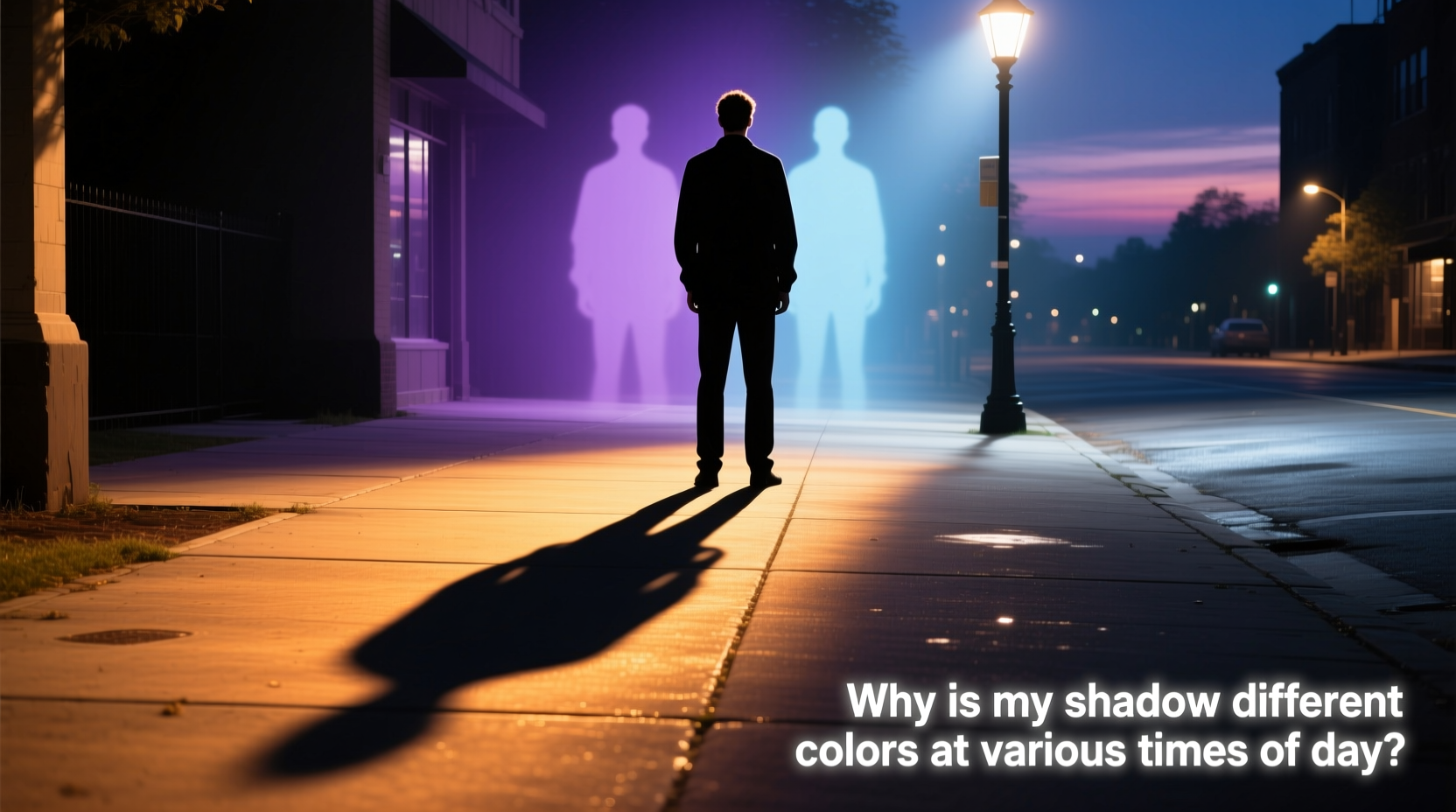
A shadow forms when an object blocks direct light from a source—typically the sun. The area behind the object receives less or no direct illumination, creating a region of reduced brightness. However, this doesn’t mean the shadowed area is completely dark. Ambient light from the sky, reflections from surrounding surfaces, and scattered sunlight still reach the shadow, contributing to its visible tone.
The color of a shadow is not defined by the absence of light alone but by the quality of the indirect light filling it. During midday, when sunlight is intense and white, shadows may appear cooler—often tinged with blue. At sunrise or sunset, when ambient light is rich in reds and oranges, shadows can take on warmer undertones. This variation is primarily due to Rayleigh scattering, a process that affects how sunlight travels through the atmosphere.
“Shadows are never truly black. They carry the fingerprint of the ambient light around them.” — Dr. Lena Patel, Atmospheric Optics Researcher, University of Colorado
How Atmospheric Scattering Influences Shadow Color
Rayleigh scattering explains why the sky is blue—and also why shadows shift in hue. Shorter wavelengths of light (blue and violet) scatter more easily than longer ones (red and orange). When the sun is high in the sky, blue light is scattered across the entire dome of the atmosphere. This diffuse blue light becomes the primary source of illumination for shadowed areas, giving them a cool, bluish tint.
In contrast, during sunrise and sunset, sunlight passes through a thicker layer of the atmosphere. Most of the blue light is scattered away before reaching the observer, leaving predominantly red, orange, and yellow wavelengths in the direct beam. The ambient light in these conditions is warmer, so shadows filled with this scattered light appear less blue and may even reflect the golden tones of the environment.
Time of Day and Shadow Color Variations
The position of the sun governs both the length and coloration of shadows. As the sun moves across the sky, the angle of incidence changes, altering how light interacts with particles in the air and surfaces on the ground. Below is a breakdown of typical shadow characteristics at different times of day:
| Time of Day | Sun Position | Shadow Length | Typical Shadow Color | Primary Light Source in Shadow |
|---|---|---|---|---|
| Sunrise | Near horizon | Very long | Warm brown, reddish | Diffuse orange/red ambient light |
| Morning (8–10 AM) | Low to mid-sky | Long | Gray-blue with warm highlights | Mix of blue sky + direct yellow light |
| Midday (11 AM–2 PM) | High overhead | Shortest | Pronounced blue-gray | Dominant blue skylight |
| Afternoon (3–5 PM) | Mid to low sky | Moderate to long | Cool gray with slight warmth | Blue skylight + increasing yellow direct light |
| Sunset | At horizon | Very long | Golden, amber, deep purple | Red/orange ambient + reflected ground light |
This table illustrates how shadow color evolves not just due to direct sunlight, but because of the changing balance between direct and indirect illumination. In the early morning and late afternoon, the interplay between warm direct light and cooler ambient light creates complex tonal gradients within shadows.
Environmental and Surface Influences
Beyond atmospheric effects, the surface on which a shadow falls plays a crucial role in its perceived color. A shadow cast on green grass may appear slightly yellow-green due to reflected light from the vegetation. On asphalt, shadows can look warmer because dark surfaces emit and reflect low-wavelength radiation. Snow-covered ground, highly reflective and cool-toned, can make shadows appear intensely blue—even under midday sun.
Surrounding objects also contribute. If you're standing near a red wall, some of that red light will bounce into your shadow, subtly tinting it. This phenomenon, known as color bleed, is widely used in photography and cinematography to create mood and depth.
Urban environments amplify these effects. Concrete, glass, and painted surfaces reflect varying wavelengths, leading to unpredictable shadow colors. In a city canyon with tall buildings, shadows may shift rapidly as clouds pass or as the sun aligns with reflective windows.
Mini Case Study: Photographer Captures Blue Hour Shadows
Lena Torres, a landscape photographer based in New Mexico, noticed unusual violet hues in her subject’s shadow during a shoot just after sunset. The sun had dipped below the horizon, but the sky remained illuminated with a gradient of purples and pinks. Her model stood on pale desert sand, which reflected minimal light. The shadow was filled almost entirely by skylight—dominated by scattered blue wavelengths and enhanced by residual pink tones from high-altitude aerosols.
“I wasn’t expecting the shadow to be purple,” she said. “But when I reviewed the RAW file, the color temperature analysis confirmed it: the shadow was picking up the alpenglow effect from the mountains. It wasn’t just blue—it was a blend of twilight hues bouncing off the terrain.”
This real-world example underscores how dynamic and context-dependent shadow color can be. It’s not merely about time of day, but about the entire visual ecosystem—the sky, ground, air quality, and surrounding materials.
Human Perception and Contrast Effects
Our eyes don’t perceive color in isolation. The brain constantly adjusts for contrast, a principle known as simultaneous contrast. When a shadow lies next to brightly lit, warm-colored surfaces (like sunlit brick or golden foliage), the shadow appears cooler by comparison—even if its actual color hasn’t changed.
This perceptual effect can make a neutral gray shadow seem vividly blue or purple simply because it’s adjacent to a warm highlight. Artists and designers use this principle intentionally: placing a gray swatch next to yellow makes it look blue-violet, while the same gray beside blue appears warm.
Additionally, the human visual system adapts to overall lighting conditions. Under noon sunlight, our white balance adjusts to neutral white light, making blue-tinted shadows more noticeable. At sunset, our vision shifts toward warmer tones, so cooler shadows stand out more dramatically.
Step-by-Step Guide to Observing Shadow Color Changes
You can witness these color shifts firsthand with a simple observational routine. Follow this timeline over the course of a clear day:
- 6:30 AM – Sunrise: Stand in an open area with unobstructed sky view. Note the length and color of your shadow on a neutral surface (like concrete). Is it long? Does it appear warm or neutral?
- 9:00 AM: Return to the same spot. Compare the shadow’s length and tone. Use a white piece of paper in the shadow to see its true color without glare.
- 12:00 PM – Solar Noon: Observe how short the shadow has become. Place the white paper again. You should see a distinct blue cast, especially if the sky is clear.
- 3:30 PM: Notice how the shadow is lengthening and warming slightly. Look for any yellow or brown tints compared to midday.
- 6:00 PM – Sunset: Your shadow stretches dramatically. Hold the white paper in the shadow and compare it to one in direct light. The difference in color temperature should be striking.
- Record Observations: Take notes or photos (with consistent camera settings) to document the progression. Over time, you’ll build a personal reference library of natural light behavior.
Frequently Asked Questions
Can shadows really be blue, or is it just how we see them?
Shadows can indeed be physically blue due to the dominance of scattered blue skylight. While perception plays a role, spectrophotometric measurements confirm that shadow regions receive more short-wavelength light under clear skies, especially at midday. So yes—blue shadows are real, not just perceptual.
Why do shadows look black in photographs sometimes?
Digital cameras often struggle with high dynamic range. When the brightest areas (sunlit surfaces) are properly exposed, shadow regions may fall below the sensor’s detection threshold, appearing crushed and black. Using HDR mode, fill flash, or post-processing recovery can restore visible detail and color in shadows.
Do clouds affect shadow color?
Yes. On overcast days, shadows become very soft or disappear entirely because light is diffused evenly across the sky. The shadow color tends to be neutral gray since there’s no strong directional light or dominant wavelength. However, if the clouds are tinted (e.g., during sunrise), they can cast colored ambient light, resulting in warm or pinkish shadows.
Practical Checklist for Observing and Using Shadow Colors
- Choose a clear day with minimal haze for best results.
- Use a white or neutral gray surface to evaluate true shadow color.
- Avoid wearing brightly colored clothing that might reflect into the shadow.
- Take observations at consistent locations and times.
- Use a smartphone with manual camera settings to capture color temperature data.
- Note weather conditions, cloud cover, and ground surface type.
- Compare findings across seasons—winter shadows on snow are often bluer than summer ones on grass.
Conclusion: Embrace the Hidden Palette of Shadows
Shadows are far more complex than mere absences of light. They are dynamic canvases painted by the atmosphere, shaped by time, and interpreted by our eyes in surprising ways. From the cool blue of midday to the golden-purple hues of twilight, shadow colors reveal the invisible dance of light and air around us. Whether you're a photographer, artist, educator, or simply a curious observer, tuning into these subtle shifts enriches your understanding of the natural world.




 浙公网安备
33010002000092号
浙公网安备
33010002000092号 浙B2-20120091-4
Comments
No comments yet. Why don't you start the discussion?