
Shadows are a familiar part of daily life, yet their behavior often goes unexamined. You might have noticed that when you stand under a streetlight at night, your shadow stretches long and fuzzy across the pavement. But in bright sunlight, it snaps into crisp definition. What causes this variation? The answer lies not in magic or mystery, but in the fundamental principles of light physics—specifically, how light travels, interacts with objects, and forms shadows. Understanding why shadows shift between sharp and blurry reveals deep insights into optics, geometry, and the nature of illumination.
The Basics of Shadow Formation
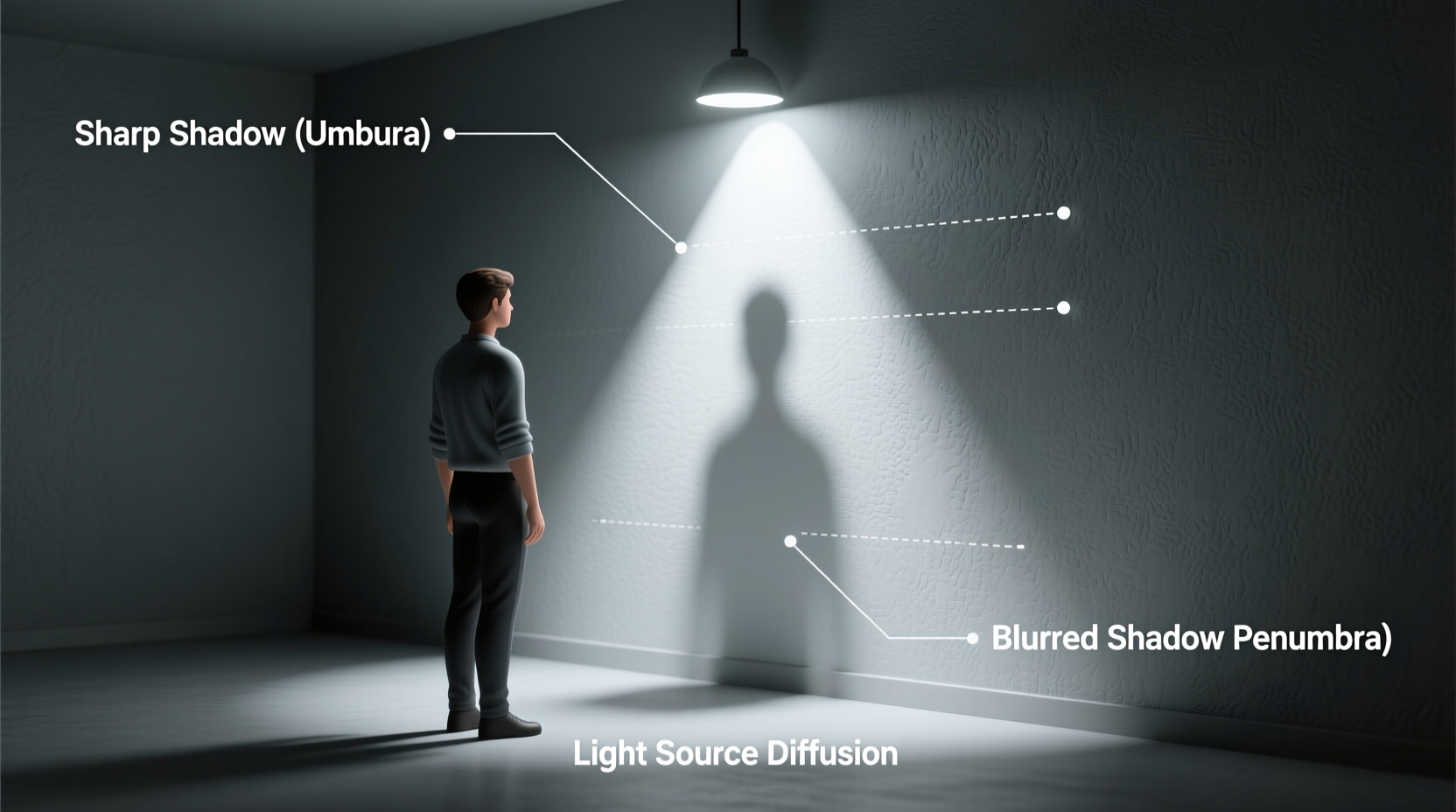
A shadow forms when an opaque object blocks light from a source, creating a region where light cannot reach. This seems simple enough, but the clarity of that shadow depends on several physical factors: the size of the light source, the distance between the source, object, and surface, and whether the light is direct or diffused.
Light travels in straight lines, a principle known as rectilinear propagation. When a small, distant light source like the sun (relative to Earth) shines on an object, the rays arrive nearly parallel, producing a sharply defined shadow. However, larger or closer sources emit rays from multiple points, which converge and diverge around the object, leading to softer edges.
There are two main parts of a shadow:
- Umbra: The central, darkest region where all light from the source is completely blocked.
- Penumbra: The outer, partially shaded region where only part of the light is obstructed.
The presence and width of the penumbra determine whether a shadow appears sharp or blurry. A narrow or nonexistent penumbra results in a crisp shadow; a wide penumbra creates a soft, blurred edge.
How Light Source Size Affects Shadow Clarity
One of the most critical factors in shadow sharpness is the apparent size of the light source. This isn’t just about physical dimensions—it's about angular size, or how large the source appears from the observer’s viewpoint.
Consider two scenarios:
- You're standing outside at noon under a clear sky. The sun is high, and your shadow is sharply outlined.
- You're walking beneath a fluorescent ceiling panel indoors. Your shadow looks faint and diffuse, almost ghostly.
In both cases, the object (you) and the surface (ground) are similar, but the light sources differ dramatically in angular size. The sun, though massive, is so far away that it behaves like a point source—its rays are nearly parallel when they reach Earth. This minimizes the penumbra, resulting in a sharp shadow.
In contrast, a fluorescent panel spans a significant angle in your field of view. Light reaches the object from many different directions across the panel’s surface. Each point on the panel casts its own slightly shifted shadow, and these overlapping shadows blur together, widening the penumbra and softening the overall outline.
This phenomenon is known as partial illumination. Because different parts of the extended source can \"see\" around the edges of the object, some light still reaches areas that would be fully dark if the source were a single point.
Real Example: Eclipse Shadows
A dramatic demonstration of this occurs during solar eclipses. The moon casts a shadow on Earth, but because the sun is an extended source, the shadow has both an umbra (total eclipse zone) and a penumbra (partial eclipse zone). Observers in the penumbra see only a portion of the sun blocked—proof that light from one side of the solar disk still reaches them.
“Shadow softness isn't random—it's a direct map of how much of the light source remains visible from each point in the shadow.” — Dr. Lena Patel, Optical Physicist, MIT
Distance Matters: Object, Source, and Surface
The distances between the light source, the object casting the shadow, and the surface receiving the shadow play a crucial role in determining edge clarity.
Let’s break down the three key relationships:
| Distance Factor | Effect on Shadow Sharpness | Explanation |
|---|---|---|
| Object close to surface | Sharper shadow | Less space for penumbral rays to spread; edges remain tight. |
| Object far from surface | Blurrier shadow | Penumbra widens as light bends around object over longer path. |
| Source close to object | Softer shadow | Larger apparent source size increases penumbra. |
| Source far from object | Sharper shadow | Smaller apparent size mimics point source; tighter umbra. |
Try this experiment: Stand near a wall under a ceiling lamp and trace your shadow. Then take five steps back. Notice how the shadow grows larger and fuzzier. As you move away from the wall, the penumbra expands proportionally, blurring the boundary between light and dark.
Similarly, bringing a flashlight very close to your hand produces a large, soft-edged shadow on the opposite wall—even if the flashlight itself is small. Its proximity makes it appear large angularly, increasing the range of angles from which light strikes the object.
Diffusion and Obstacles: Why Indoor Shadows Are Often Soft
Indoor environments rarely produce sharp shadows, even under seemingly focused lights. This is due to secondary lighting effects such as reflection, diffusion, and scattering.
Walls, ceilings, and furniture reflect light, filling in shadows with indirect illumination. A matte lampshade scatters light in all directions, turning a concentrated beam into a broad glow. Curtains or frosted glass act as diffusers, spreading out light waves and eliminating hard directional beams.
Even air plays a subtle role. Dust particles and moisture scatter light through Rayleigh and Mie scattering, adding ambient glow that reduces contrast. This is why foggy conditions make shadows nearly disappear—the environment becomes uniformly lit.
Photographers and filmmakers manipulate these effects intentionally. Softboxes and bounce cards create flattering, low-contrast lighting by maximizing diffusion. In contrast, studio spotlights with snoots minimize scatter to cast dramatic, razor-sharp silhouettes.
Step-by-Step Guide: Creating Sharp vs. Blurry Shadows
Want to test these principles yourself? Follow this hands-on guide to explore shadow dynamics using everyday materials.
- Gather supplies: A flashlight, a piece of cardboard with a cut-out shape (e.g., star), a white wall, and optional diffusing material (tissue paper, wax paper).
- Set up in a dark room: Eliminate competing light sources to see shadows clearly.
- Test 1 – Point source simulation: Use the flashlight without any cover, placed 6 feet from the wall. Hold the stencil 6 inches from the wall. Observe the sharp edges.
- Test 2 – Extended source effect: Move the stencil to 3 feet from the wall. Note how the shadow enlarges and blurs.
- Test 3 – Diffusion: Cover the flashlight with tissue paper. Repeat Test 1. The shadow will be significantly softer due to scattered light.
- Test 4 – Multiple sources: Add a second flashlight from a different angle. Watch as shadows overlap and fill in, reducing darkness and definition.
- Compare results: Sketch or photograph each outcome to visualize how variables alter shadow quality.
This exercise demonstrates that shadow sharpness is not inherent to the object but emerges from the interplay of light geometry and environmental conditions.
Common Misconceptions About Shadows
Several myths persist about shadows, often stemming from oversimplified explanations.
- Myth: Bigger lights always make blurrier shadows.
Reality: It's the apparent size (angular diameter), not physical size, that matters. A distant stadium light may be huge but act like a point source. - Myth: Shadows are just the absence of light.
Reality: While technically true, this ignores gradation. Most real-world shadows contain gradients due to partial illumination. - Myth: Cloudy days eliminate shadows.
Reality: They diffuse them. The entire sky becomes a giant, uniform light source, casting extremely soft, low-contrast shadows that are hard to detect.
Understanding these nuances helps demystify everyday optical experiences and improves design decisions in photography, architecture, and stage lighting.
Frequently Asked Questions
Can a shadow ever be perfectly sharp?
In theory, yes—if the light source is a perfect point, infinitely distant, and there are no atmospheric disturbances or diffraction effects. In practice, diffraction (a wave property of light) always introduces slight blurring at edges, meaning no shadow is truly razor-sharp at microscopic levels.
Why does my shadow look sharper in winter than in summer?
This perception often comes from the sun’s position. In winter, the sun is lower in the sky, elongating shadows and making them easier to study. However, clarity depends more on atmospheric clarity and time of day. Midday summer sun actually produces sharper shadows due to more direct overhead rays.
Do colored lights change shadow sharpness?
No, color (wavelength) doesn’t directly affect sharpness. However, shorter wavelengths (blue light) diffract slightly more than longer ones (red), which could theoretically cause minute differences in edge fuzziness. These are negligible in everyday observation.
Practical Checklist: Controlling Shadow Quality
Whether you're setting up a photo shoot, designing a workspace, or simply curious, use this checklist to predict and control shadow behavior:
- ✅ Use small, distant lights for sharp silhouettes
- ✅ Place objects close to the projection surface for crisp outlines
- ✅ Avoid reflective backgrounds if minimizing soft shadows is the goal
- ✅ Employ diffusers (fabric, frosted glass) to soften shadows intentionally
- ✅ Combine multiple light sources to reduce shadow visibility
- ✅ Block ambient light to enhance contrast and definition
Conclusion: Seeing Light Through Shadows
Shadows are more than absences—they are maps of light’s journey. Their sharpness or softness encodes information about the source’s size, distance, and environment. By learning to read these cues, we gain a deeper appreciation for the invisible paths light takes through our world.
The next time you see your shadow stretching across the sidewalk, pause and observe its edges. Is it crisp or hazy? Close or distant? That detail tells a story written in photons and geometry. With this knowledge, you’re not just seeing a shadow—you’re interpreting the physics of light itself.




 浙公网安备
33010002000092号
浙公网安备
33010002000092号 浙B2-20120091-4
Comments
No comments yet. Why don't you start the discussion?