
A smoothie should be thick, creamy, and unified—every sip consistent from top to bottom. But if your smoothie separates shortly after blending, leaving liquid at the bottom and pulp floating on top, it’s not just unappetizing; it suggests an imbalance in ingredients or technique. Separation happens when components fail to emulsify properly, breaking down due to density differences, lack of binding agents, or improper blending. The good news? This common issue is both preventable and fixable with targeted adjustments. Understanding why smoothies separate—and how to stop it—is essential for anyone who relies on them for nutrition, convenience, or taste.
The Science Behind Smoothie Separation
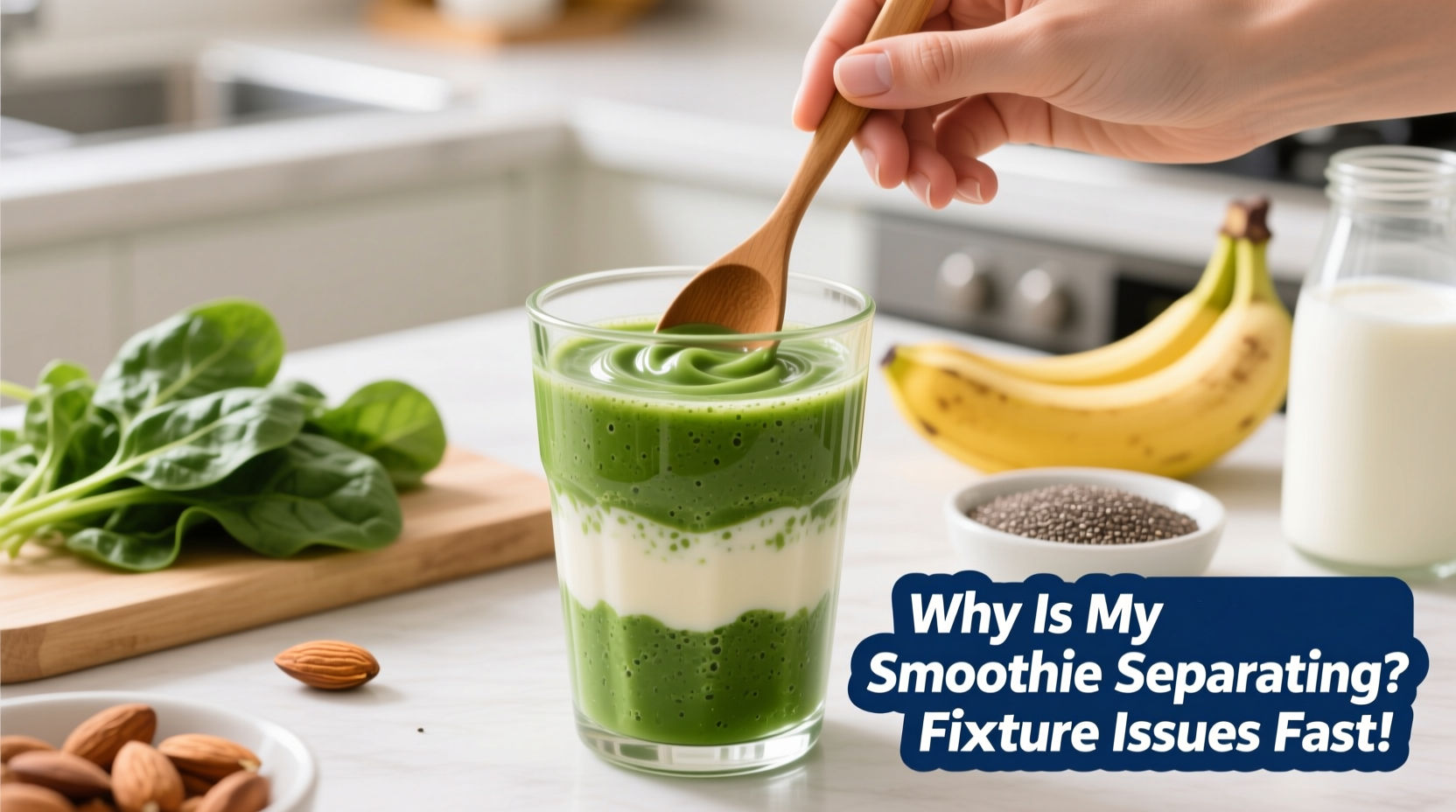
Smoothie separation occurs due to the natural behavior of liquids and solids when not fully integrated. Unlike homogenized products like milk, homemade smoothies contain raw, unprocessed ingredients with varying densities and viscosities. When blended, these components temporarily suspend in liquid, but without proper stabilization, gravity pulls heavier particles downward while lighter fibers and fats rise.
This process, known as phase separation, is driven by several factors:
- Density variance: Leafy greens sink, while banana chunks float.
- Lack of emulsifiers: No binding agents to hold fat and water together.
- Over-dilution: Too much liquid overwhelms solid content.
- Blending inefficiency: Short blending times or weak blenders don’t break down fibers enough.
Fruit-based smoothies high in water content (like watermelon or citrus) are especially prone to separation because they lack structural integrity. Conversely, smoothies rich in fiber, protein, and healthy fats resist breakdown longer due to increased viscosity and molecular cohesion.
“Texture stability in blended beverages depends on particle size reduction and ingredient synergy. A well-balanced smoothie acts like a colloidal suspension—stable, uniform, and long-lasting.” — Dr. Lena Torres, Food Scientist & Nutritional Formulation Specialist
5 Proven Fixes for Smoothie Separation
Fixing separation isn’t about guesswork—it’s about precision. Below are five evidence-based strategies to achieve a consistently smooth texture.
1. Adjust Your Liquid-to-Solid Ratio
One of the most common causes of separation is using too much liquid relative to solids. While hydration matters, excess water, juice, or milk prevents proper suspension of fibers and nutrients.
Use thicker liquids instead of water:
- Unsweetened almond milk (creamy varieties)
- Cold brew coffee or tea (less watery than water)
- Coconut water (contains natural electrolytes and mild viscosity)
- Kefir or Greek yogurt (adds body and probiotics)
2. Incorporate Natural Thickeners and Binders
These ingredients increase viscosity and help bind oil-soluble and water-soluble components, reducing phase separation.
| Thickener | How It Works | Recommended Amount (per 16 oz smoothie) |
|---|---|---|
| Banana (frozen) | Natural pectin and starch create creaminess | ½ medium |
| Oats (rolled or quick) | Beta-glucan fiber absorbs liquid and stabilizes texture | 2–3 tbsp |
| Chia seeds | Form a gel when hydrated; excellent emulsifier | 1 tsp (soaked 5 min prior) |
| Flaxseed (ground) | Omega-3s and mucilage improve cohesion | 1 tbsp |
| Avocado | Healthy fats coat particles, preventing clumping and settling | ¼ fruit |
3. Layer Ingredients Correctly Before Blending
The order you add ingredients affects blending efficiency. Poor layering forces the blender to work harder, resulting in uneven pulverization and incomplete integration.
Follow this optimal layering sequence:
- Liquid base – Bottom layer ensures blades can move freely.
- Soft ingredients – Yogurt, nut butter, honey.
- Frozen items – Ice, frozen fruit, spinach.
- Powders and seeds – On top so they’re pulled down quickly.
This method prevents air pockets and allows the vortex effect to pull everything downward into the blades.
4. Blend Long Enough—and in the Right Way
Under-blending leaves large particles that settle rapidly. Most home blenders require 45–60 seconds on high for full emulsification. High-powered models (e.g., Vitamix, Blendtec) may need only 30 seconds, but pause halfway to scrape sides if necessary.
Pro technique: Use the “pulse and blend” method.
- Pulse 5 times to break up large chunks.
- Blend on high for 45 seconds.
- Let sit 10 seconds, then blend again for 15 seconds to re-emulsify.
5. Use Temperature Strategically
Cold ingredients slow separation by increasing viscosity. However, overly icy blends can dull flavor and strain blenders.
Solution: Use a mix of frozen and fresh produce. For example:
- 1 cup frozen berries + ½ cup fresh banana
- 1 cup frozen cauliflower rice + 1 cup fresh spinach
Frozen fruit acts as a natural thickener while maintaining sweetness. Avoid adding ice cubes unless absolutely necessary—they dilute flavor and melt quickly, accelerating separation.
Checklist: Prevent Smoothie Separation in 7 Steps
Pre-Blend Checklist:
- ✔️ Measure liquid: no more than ½–¾ cup per serving
- ✔️ Include at least one thickener (banana, avocado, oats, chia)
- ✔️ Use frozen fruit instead of ice
- ✔️ Add nut butter or seed powder for fat content
- ✔️ Layer ingredients in correct order
- ✔️ Blend for at least 45 seconds on high
- ✔️ Stir or shake immediately before drinking
Real Example: From Separated Mess to Perfect Pour
Sarah, a busy nurse working 12-hour shifts, relied on morning smoothies for energy. Her go-to recipe was simple: spinach, apple, orange juice, and protein powder. Within minutes, the mixture separated—green pulp on top, bitter juice at the bottom. She often dumped half, frustrated by the inconsistency.
After consulting a nutritionist, she revised her approach:
- Swapped orange juice for unsweetened almond milk
- Added ½ frozen banana and 1 tbsp chia seeds (soaked)
- Increased blending time to 60 seconds
- Stored smoothie in a sealed jar and shook vigorously before sipping
The result? A creamy, uniform drink that stayed blended for over two hours. She now preps jars the night before and enjoys a reliable breakfast even during chaotic mornings.
Do’s and Don’ts of Smoothie Texture Control
| Do’s | Don’ts |
|---|---|
| Use frozen bananas instead of ice | Add plain water as the primary liquid |
| Soak chia or flaxseeds for 5–10 minutes | Blend for less than 30 seconds |
| Include a source of healthy fat (nut butter, avocado) | Overload with watery fruits (watermelon, cucumber) |
| Shake or stir before drinking | Store in wide-mouth containers (increases surface separation) |
| Balance fiber, protein, and fat | Ignore ingredient temperature |
FAQ: Common Questions About Smoothie Separation
Why does my smoothie separate even right after blending?
Immediate separation usually means insufficient blending or an imbalance in ingredients—particularly too much liquid or lack of thickeners. Ensure you're blending long enough and include at least one binding agent like banana, oats, or chia seeds.
Can I fix a separated smoothie once it’s already split?
Yes. Simply re-blend for 20–30 seconds or shake vigorously in a tightly sealed bottle. If separation persists, add 1 tsp of chia seeds or a tablespoon of yogurt and shake again. Avoid stirring with a spoon—it won’t fully recombine dense layers.
Is separation a sign my smoothie has gone bad?
No. Separation is a physical change, not spoilage. As long as the smoothie has been refrigerated and consumed within 24 hours, it's safe. Always check for sour smell or mold before drinking.
Step-by-Step Guide: Make a Non-Separating Smoothie in 5 Minutes
Follow this timeline for guaranteed success:
- 0:00 – Prep (1 min): Gather ingredients: ½ cup almond milk, ½ frozen banana, 1 cup spinach, 1 tbsp peanut butter, 1 tsp chia seeds (pre-soaked), 1 scoop protein powder.
- 1:00 – Layer (1 min): Add liquid first, then soft ingredients, followed by greens and frozen items. Top with powders.
- 2:00 – Blend (1 min): Pulse 5 times, then blend on high for 45 seconds. Pause, scrape sides if needed, blend another 15 seconds.
- 3:00 – Check consistency: It should coat the back of a spoon. If too thin, add 1 tbsp oats or ice and blend 10 seconds more.
- 3:30 – Transfer and seal: Pour into a narrow, airtight bottle or jar.
- 4:00 – Label and store (optional): Refrigerate for up to 24 hours. Shake well before drinking.
- 5:00 – Enjoy: Sip immediately or take on the go—texture remains stable for hours.
Expert Tips for On-the-Go Stability
If you're taking your smoothie to work or the gym, consider these advanced tactics:
- Use a vacuum-sealed shaker bottle: Minimizes air exposure and makes re-mixing effortless.
- Add a pinch of xanthan gum (⅛ tsp): A food-grade stabilizer used in commercial smoothies to prevent settling.
- Avoid citrus-heavy bases: Orange or grapefruit juice breaks down pectin faster, accelerating separation.
- Freeze smoothies in jars (leave headspace): Thaw slowly in the fridge overnight for next-day use.
Conclusion: Turn Separation Into Consistency
Smoothie separation is a fixable flaw, not a permanent limitation. With the right ingredients, blending habits, and storage practices, you can enjoy a rich, cohesive drink every time. The key lies in balancing liquid content, incorporating natural thickeners, and respecting the mechanics of blending. Whether you're fueling a hectic morning or prepping meals for the week, a non-separating smoothie saves time, reduces waste, and enhances satisfaction.




 浙公网安备
33010002000092号
浙公网安备
33010002000092号 浙B2-20120091-4
Comments
No comments yet. Why don't you start the discussion?