
A freshly blended smoothie should be thick, creamy, and uniform—ready to pour into a glass without layers forming before you even take the first sip. Yet many people face the same frustrating issue: their smoothie starts separating within seconds of pouring. The liquid rises to the top, fruit chunks sink, and nut butter floats in oily clumps. This isn’t just unappetizing—it defeats the purpose of a balanced, nutrient-packed drink.
The good news? Instant separation isn’t inevitable. It’s usually a sign of imbalanced ingredients, improper blending technique, or overlooked structural elements in your recipe. With a few smart adjustments, you can create smoothies that stay cohesive from the first pour to the last sip. Let’s break down exactly why this happens and how to fix it with science-backed blending hacks that actually work.
Why Smoothies Separate: The Science Behind the Split
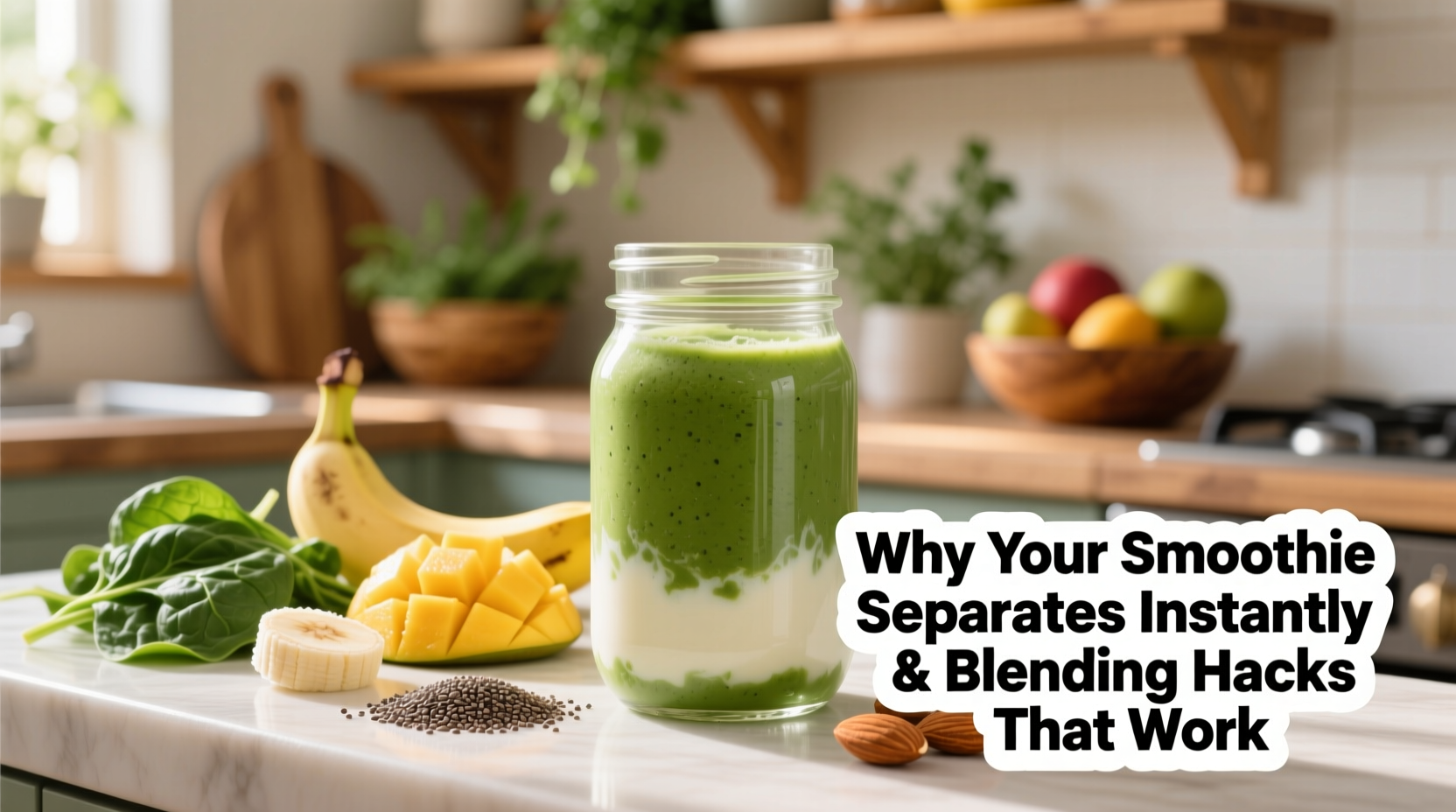
Smoothie separation occurs due to differences in density, viscosity, and emulsification. When ingredients vary greatly in weight and texture, they naturally begin to stratify once blending stops. Think of it like oil and vinegar in a salad dressing—they mix when shaken but separate when left still.
In a smoothie, water-rich fruits (like watermelon or cucumber) are less dense than fibrous greens, seeds, or nut butters. Without proper binding agents or mixing techniques, these components don’t form a stable suspension. Gravity takes over, pulling heavier solids downward while lighter liquids rise.
Additionally, temperature plays a role. Cold ingredients—especially frozen fruit or ice—can cause rapid condensation and uneven blending if not introduced gradually. And if your blender isn’t powerful enough to fully pulverize fibers and release natural gums, the result is an unstable mixture prone to layering.
The 5 Key Factors That Cause Separation
- Density Imbalance: Too much heavy fiber (spinach, chia seeds) with insufficient liquid leads to settling.
- Lack of Emulsifiers: Ingredients like banana, avocado, oats, or flaxseed act as natural thickeners and stabilizers. Skipping them reduces cohesion.
- Overuse of Watery Fruits: Watermelon, citrus, or cucumber add hydration but dilute viscosity unless balanced with thickeners.
- Poor Blending Technique: Starting on high speed with frozen chunks can trap air and prevent thorough mixing.
- Incorrect Layering: Adding ingredients in the wrong order prevents even processing and encourages separation.
Understanding these factors allows you to troubleshoot any recipe. For example, a green smoothie made with kale, apple juice, and frozen mango might look perfect at first but separate quickly because it lacks a binding agent. Add half an avocado or a tablespoon of rolled oats, and the texture transforms into something rich and stable.
Blending Hacks That Work: Step-by-Step Guide to a Stable Smoothie
Creating a non-separating smoothie isn’t about luck—it’s about method. Follow this step-by-step process to ensure consistent results every time.
Step 1: Layer Ingredients Properly
The order in which you add ingredients impacts blending efficiency. Use this sequence:
- Liquid base (e.g., almond milk, coconut water)
- Soft ingredients (yogurt, nut butter, honey)
- Frozen items (fruit, ice)
- Fibrous add-ins (greens, seeds, powders)
This layering helps the blender create a vortex, pulling everything down toward the blades instead of floating on top.
Step 2: Start Low, Then Ramp Up
Begin blending on low speed for 10–15 seconds. This allows ingredients to circulate and prevents air pockets. Gradually increase to high speed for 30–60 seconds until completely smooth.
Step 3: Pause and Scrape (If Needed)
If your blender struggles with thick mixtures, pause halfway, scrape down the sides with a spatula, then resume. This ensures all ingredients are evenly incorporated.
Step 4: Blend Longer Than You Think
Many people stop blending too soon. To fully break down fibers and release natural pectins, blend for at least 45 seconds—even up to 90 seconds for dense recipes.
Step 5: Test Consistency Before Pouring
Tilt the blender gently. If you see streaks or uneven color, blend another 10–15 seconds. A well-blended smoothie should move as a single unit, not swirl in layers.
“Most separation issues stem from under-blending or skipping structural ingredients. A high-powered blender helps, but technique matters more.” — Dr. Lena Torres, Food Scientist & Nutritional Formulation Specialist
Do’s and Don’ts: Smoothie Stability Checklist
| Do | Don’t |
|---|---|
| Use at least one thickener (banana, avocado, oats, chia) | Mix only watery fruits and leafy greens without binders |
| Add liquid first to aid circulation | Put frozen fruit directly on dry blades |
| Blend for 45+ seconds for full emulsification | Stop blending as soon as it looks mixed |
| Include healthy fats (nut butter, seeds) for creaminess | Use only oil-based nut butters without mixing well |
| Chill glasses beforehand to slow separation | Store smoothies for hours without stirring |
Real Example: Fixing a Problematic Green Detox Smoothie
Sarah, a busy nurse, loved her morning green smoothie: spinach, pineapple, ginger, and coconut water. But she noticed it separated within minutes, leaving her with a gritty green sludge at the bottom and watery liquid on top. She’d stir it frantically before drinking, but the texture remained inconsistent.
After analyzing her recipe, she realized three issues: no thickener, too much liquid, and poor blending order. She adjusted her method:
- Reduced coconut water from 1 cup to ¾ cup
- Added ½ banana and 1 tbsp chia seeds (soaked for 10 minutes)
- Layered ingredients correctly: liquid → banana → chia gel → spinach → pineapple
- Blended starting on low, then increased to high for 60 seconds
The result? A silky, uniform smoothie that stayed mixed for over 30 minutes—long enough for her shift change. The banana added creaminess, chia provided structure, and proper layering ensured full integration.
Top 5 Natural Stabilizers for Non-Separating Smoothies
You don’t need artificial additives to keep your smoothie together. These whole-food ingredients enhance texture and stability naturally:
- Banana: High in pectin and starch, it thickens and binds liquids. Use ripe bananas for maximum softness.
- Avocado: Adds creaminess and healthy fats that emulsify water-based ingredients.
- Oats: Rolled or quick oats absorb liquid and create a porridge-like consistency that resists layering.
- Chia or Flax Seeds: When soaked, they form a hydrogel that suspends particles and slows sedimentation.
- Yogurt or Kefir: The proteins and live cultures help stabilize emulsions and improve mouthfeel.
Pro tip: Combine two stabilizers for best results. For example, banana + chia or avocado + oats creates a synergistic effect that outperforms either ingredient alone.
Frequently Asked Questions
Can I prevent separation without adding extra ingredients?
Yes, but with limitations. Perfect blending technique—proper layering, longer blend time, and correct speed progression—can significantly reduce separation. However, most smoothies benefit from at least one natural thickener for lasting stability.
Does blender power matter for smoothie consistency?
Significantly. High-speed blenders (1000+ watts) generate enough shear force to break down fibers and release binding compounds. Lower-powered models may leave chunks and fail to emulsify fats, leading to faster separation. If using a weaker blender, blend longer and use softer ingredients.
How long should a well-made smoothie stay mixed?
A properly formulated and blended smoothie should remain homogeneous for 20–40 minutes. After that, minor settling may occur, but a quick shake or stir should reincorporate it. If it separates in under 5 minutes, revisit your ingredient balance or blending method.
Final Tips for Long-Lasting Smoothie Success
- Pre-chill your blender jar to maintain cold temperature and slow molecular movement that causes separation.
- Avoid over-diluting—stick to 1–1.5 cups of liquid per serving unless making a larger batch.
- Use frozen fruit as a thickener instead of ice, which melts quickly and adds water without nutrients.
- Stir before drinking, even if it looks mixed. Gentle agitation re-suspends any settled particles.
- Drink immediately for optimal texture and nutrient retention.
Conclusion: Turn Separation Into Satisfaction
Instant smoothie separation isn’t a flaw in your ingredients—it’s a signal that your method needs refinement. By understanding the physics of blending and applying practical techniques, you can transform inconsistent shakes into luxuriously smooth, stable drinks every time.
The key lies in balancing textures, leveraging natural stabilizers, and mastering the mechanics of your blender. Whether you’re rushing out the door or prepping meals for the week, a well-constructed smoothie should hold together as beautifully as it tastes.




 浙公网安备
33010002000092号
浙公网安备
33010002000092号 浙B2-20120091-4
Comments
No comments yet. Why don't you start the discussion?