
The Netherlands is one of Europe’s most recognizable countries—famous for tulips, windmills, bicycles, and progressive social policies. Yet many people refer to it as “Holland,” a name that doesn’t officially exist on modern maps. This common misnomer raises an important question: why is the Netherlands often called Holland, and what’s the real difference between the two?
The confusion stems from historical usage, international branding, and regional identity. While \"Holland\" is deeply embedded in global culture, it technically refers only to a part of the country—not the whole nation. Understanding this distinction reveals much about Dutch history, national pride, and efforts to rebrand a modern European state.
The Geographic and Historical Origins of “Holland”
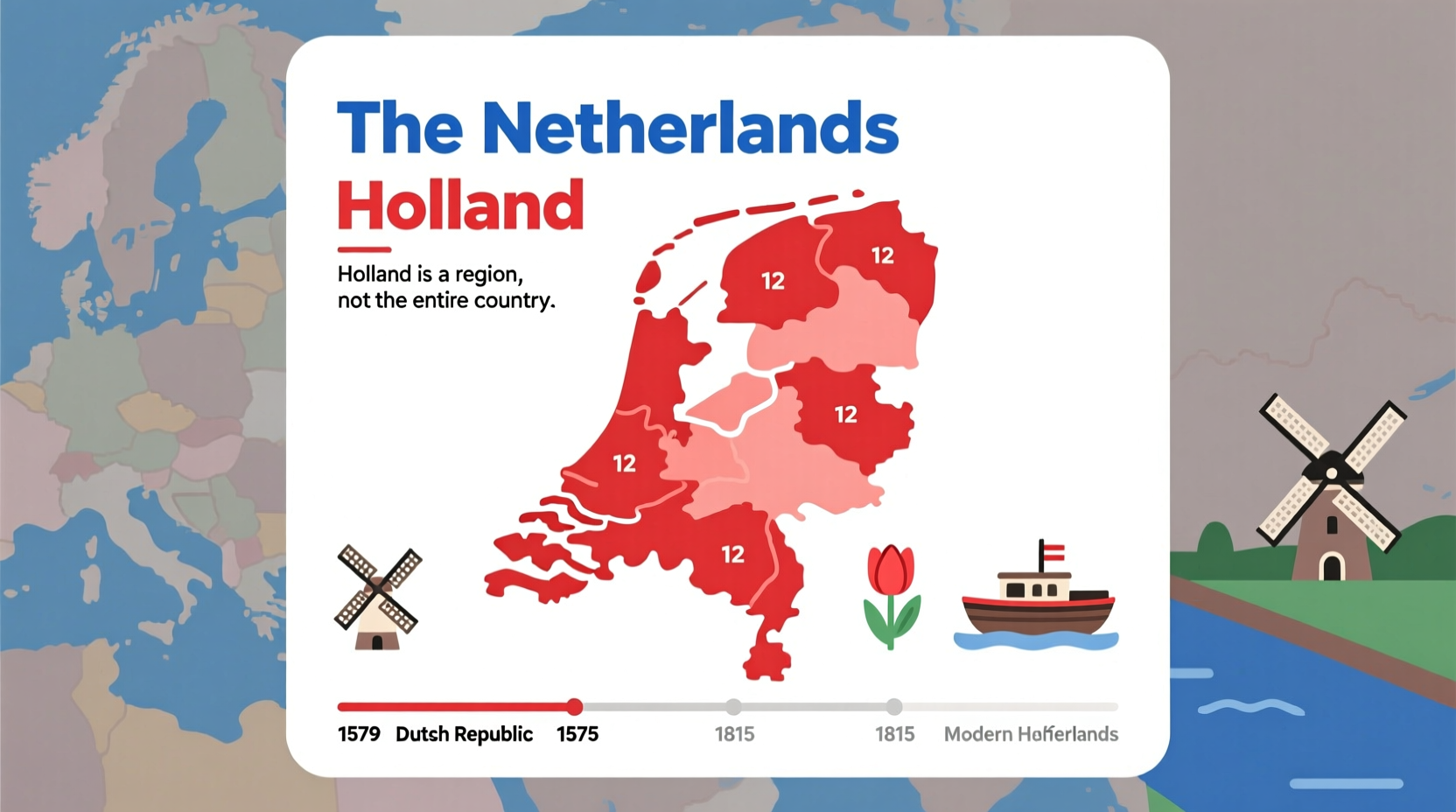
Holland began as a coastal region in the western part of what is now the Netherlands. The name likely derives from “holt land,” meaning “wooded land” in Old Dutch, reflecting the area’s early landscape before large-scale land reclamation.
By the 10th century, Holland emerged as a county within the Holy Roman Empire. Over time, due to its proximity to the North Sea and access to trade routes, the region grew economically powerful. Cities like Amsterdam, Rotterdam, and The Hague—now major national centers—developed within Holland, amplifying its influence.
During the Dutch Golden Age (17th century), Holland was the driving force behind the Dutch Republic’s global empire. Its merchants, sailors, and artists dominated international trade and culture. Because Holland led the economic and political life of the republic, foreigners began using “Holland” interchangeably with the entire country.
“Holland became synonymous with the Netherlands because it was the wealthiest, most visible, and most active province during the nation’s peak of global influence.” — Dr. Marijn van Dijk, Historian at Leiden University
This historical dominance cemented “Holland” in languages around the world—even though the country consisted of multiple provinces, each with distinct identities.
Modern Administrative Structure: Provinces of the Netherlands
Today, the Netherlands is composed of 12 provinces. Holland is not one of them. Instead, the historic region of Holland is divided into two current provinces:
- Noord-Holland (North Holland) – Includes Amsterdam, Haarlem, and Alkmaar
- Zuid-Holland (South Holland) – Home to Rotterdam, The Hague, and Leiden
Together, these two provinces make up just 13% of the country’s land area but contain nearly 40% of its population. Their continued prominence in economy, media, and government perpetuates the misconception that Holland equals the Netherlands.
Official Name Change and National Rebranding Efforts
In 2019, the Dutch government announced a significant shift: it would stop using “Holland” in official tourism and trade promotions. From then on, only “the Netherlands” would represent the country globally.
This decision wasn’t merely bureaucratic—it reflected a growing desire to present a more inclusive and accurate national image. Officials argued that emphasizing “Holland” marginalized regions beyond the west, such as Friesland, Limburg, and Overijssel, which contribute uniquely to Dutch culture, agriculture, and innovation.
The rebranding included updating logos, websites (including Netherlands.com), and diplomatic materials. The goal was to align international perception with constitutional reality: the country’s official name is the Netherlands, not Holland.
Key Reasons Behind the Rebranding
- Geographic Accuracy: Holland represents only two provinces.
- Regional Equity: Other provinces wanted recognition for their contributions.
- Tourism Distribution: Encourage visitors to explore beyond Amsterdam and Rotterdam.
- Diplomatic Clarity: Avoid confusion in international relations and business.
Comparison: Holland vs. the Netherlands
| Aspect | Holland | Netherlands |
|---|---|---|
| Status | Historic region (not an official province) | Official country name |
| Provinces Included | Noord-Holland and Zuid-Holland | All 12 provinces |
| Land Area | ~13% of total | 100% |
| Population | ~40% | 100% |
| Global Use | Common informal term | Official name in diplomacy, law, and new branding |
| Examples of Cities | Amsterdam, Rotterdam, The Hague | Groningen, Utrecht, Eindhoven, Maastricht |
Real-World Impact: Tourism and Identity
A mini case study illustrates the practical implications of this naming issue. In 2022, a travel blogger promoted a “Holland Canal Tour” focused entirely on Utrecht and Gelderland—provinces far from the actual Holland region. Dutch tourism officials responded politely but firmly, noting that such usage could mislead travelers and undermine regional development goals.
As a result, several tour operators revised their marketing materials to use “Netherlands” when highlighting destinations outside North and South Holland. Some even launched campaigns like “Discover the Other Netherlands” to spotlight areas such as the Hoge Veluwe National Park, the Wadden Sea, and the southern wine region of Bosch en Lommer.
This shift has helped balance tourism pressure. While Amsterdam still welcomes millions annually, cities like Leeuwarden and Middelburg are gaining visibility—thanks in part to more precise naming practices.
Common Misconceptions and Clarifications
Despite official changes, many still use “Holland” out of habit. Here are some frequent misunderstandings:
- Misconception: “Holland is another word for the Netherlands.”
Clarification: It’s a widely accepted shorthand, but geographically incorrect. - Misconception: The government banned the word “Holland.”
Clarification: It did not ban it, but stopped promoting it officially to emphasize inclusivity. - Misconception: All Dutch people dislike the term “Holland.”
Clarification: Many in Noord- and Zuid-Holland still identify proudly with the name, while others across the country welcome the correction.
FAQ
Is Holland still used anywhere officially?
No, since 2020, the Dutch government uses only “the Netherlands” in international communications, tourism, and trade. However, some organizations like the Dutch National Tourist Board previously operated under “Holland” and may retain legacy branding.
Can I call the country Holland without offending anyone?
In casual conversation, most Dutch people understand and tolerate the usage. However, in formal contexts—or when discussing regions outside western Netherlands—it’s better to use “the Netherlands” for accuracy and respect.
Why do sports teams like “Holland” in their names?
Tradition and global recognition. Teams like the Dutch national football squad are sometimes informally called “Team Holland” abroad due to widespread familiarity. But official bodies like the Royal Dutch Football Association use “Netherlands” in competitions.
Practical Checklist for Correct Usage
Use “Holland” when:
- Referring specifically to Noord-Holland or Zuid-Holland
- Discussing historical contexts (e.g., Dutch Golden Age)
- Quoting brands or expressions that include the term (e.g., Holland America Line)
Use “the Netherlands” when:
- Talking about the country as a whole
- Writing formally, academically, or journalistically
- Highlighting regions like Friesland, Limburg, or Zeeland
- Engaging in diplomacy, business, or education
Conclusion: Precision Matters in a Globalized World
The distinction between Holland and the Netherlands may seem minor, but it reflects broader themes of identity, representation, and accuracy. As globalization continues to shape how nations present themselves, getting the details right fosters mutual respect and deeper understanding.
The Netherlands’ move away from “Holland” isn’t about erasing history—it’s about expanding recognition. It invites the world to see beyond Amsterdam’s canals and discover the full richness of a diverse, innovative, and forward-thinking country.




 浙公网安备
33010002000092号
浙公网安备
33010002000092号 浙B2-20120091-4
Comments
No comments yet. Why don't you start the discussion?