
Racism remains a deeply entrenched issue in American society, manifesting in disparities across education, employment, healthcare, criminal justice, and social interactions. Despite progress in civil rights and public awareness, racial discrimination persists. Understanding why racism continues to be prevalent requires examining not just individual prejudices but the structural, historical, and cultural forces that sustain it. This article explores the key contributing factors—historical legacy, systemic inequality, economic disparity, media influence, and educational gaps—that help explain the enduring presence of racism in the United States.
Historical Roots and Institutional Continuity
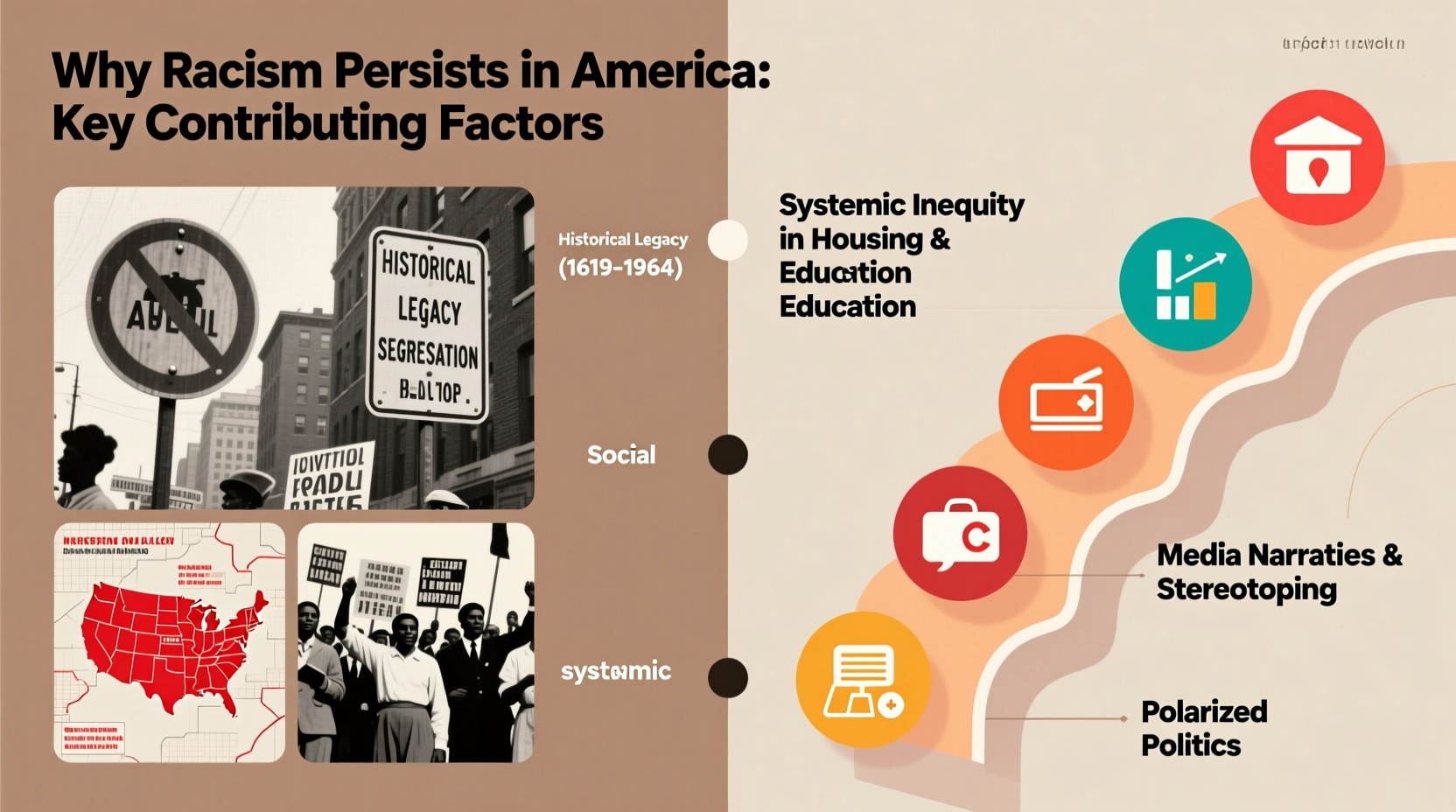
The foundation of modern racism in America lies in its history: slavery, segregation, Jim Crow laws, and forced displacement of Indigenous peoples established racial hierarchies that still echo today. Slavery, which lasted over two centuries, institutionalized the dehumanization of Black Americans. Even after emancipation, Black communities were systematically excluded from wealth-building opportunities through redlining, discriminatory labor practices, and unequal access to education.
These policies were not isolated incidents but part of a broader framework designed to maintain white supremacy. As historian Ibram X. Kendi explains:
“Racist ideas were created to justify racist policies. The policy came first—the idea followed.” — Ibram X. Kendi, *How to Be an Antiracist*
This historical continuity means that institutions such as law enforcement, housing, and education evolved within racially biased frameworks. Reforms have occurred, but many systems retain embedded biases that perpetuate racial disparities without requiring overtly racist intent.
Systemic Inequality in Key Institutions
One of the most significant reasons racism remains prevalent is because it is woven into the fabric of major institutions. Systemic racism refers to how policies, practices, and procedures produce unequal outcomes for different racial groups—even when those rules appear neutral on the surface.
| Institution | Racial Disparity Example | Contributing Factor |
|---|---|---|
| Criminal Justice | Black Americans are incarcerated at nearly five times the rate of white Americans. | Bias in policing, sentencing, and bail systems. |
| Education | Underfunded schools are concentrated in predominantly Black and Latino neighborhoods. | Tax-based school funding models. |
| Healthcare | Black maternal mortality is 2–3 times higher than for white women. | Lack of access and implicit bias among providers. |
| Housing | Homeownership gap between white and Black families exceeds 30%. | Legacy of redlining and mortgage discrimination. |
These disparities are not anomalies—they are predictable outcomes of long-standing structural inequities. Because they are often invisible or normalized, they continue unchecked, reinforcing racial divisions across generations.
Economic Disparities and Opportunity Gaps
Economic inequality plays a crucial role in sustaining racial divides. Centuries of exclusion from land ownership, fair wages, and generational wealth transfer have left many communities of color economically vulnerable. Today, the median white household holds approximately eight times the wealth of the median Black household.
This wealth gap affects every aspect of life—from where people live to the quality of schools their children attend. It also limits upward mobility. For example, families with fewer financial resources are less likely to afford college, move to safer neighborhoods, or withstand economic shocks like job loss or medical emergencies.
Moreover, hiring discrimination persists. Studies using fake job applications with ethnically distinct names show that resumes with “white-sounding” names receive significantly more callbacks—even when qualifications are identical.
Real Example: The Case of Redlining’s Long Shadow
In the 1930s, the federal government created color-coded maps to assess lending risk in urban areas. Neighborhoods with high concentrations of Black residents were marked in red and deemed “hazardous” for investment—a practice known as redlining. These areas were denied mortgages and business loans.
Nearly a century later, formerly redlined neighborhoods still suffer from lower home values, underfunded schools, and limited access to healthy food and green spaces. A 2018 study by the National Community Reinvestment Coalition found that 74% of historically redlined areas remain economically distressed. This illustrates how past policies continue to shape present-day racial outcomes.
Media Representation and Cultural Narratives
Popular culture and media play a powerful role in shaping perceptions of race. From early Hollywood depictions to modern news coverage, people of color—especially Black and Latino men—are disproportionately portrayed as criminals, threats, or sidekicks. These narratives reinforce stereotypes that influence public opinion and even police behavior.
For instance, research shows that local news overrepresents Black individuals as perpetrators of crime while underrepresenting them as victims. This distorts viewers’ understanding of crime and race, fostering fear and bias.
Conversely, positive representation can shift attitudes. Shows like *Black-ish*, *Pose*, and *Never Have I Ever* challenge monolithic portrayals by showcasing diverse experiences within communities of color. However, such examples remain the exception rather than the norm.
- News outlets use racially coded language (e.g., “urban,” “thug”) to describe minority communities.
- Advertising often defaults to white models, marginalizing other races.
- Film and TV casting still lacks proportional diversity in lead roles and creative leadership.
Education and Awareness Deficits
A critical factor in the persistence of racism is what students are—and are not—taught about race in school. Many U.S. curricula downplay or omit the full scope of slavery, colonialism, and civil rights struggles. Some states have even passed laws restricting how teachers can discuss racism and sexism, labeling such conversations as “divisive.”
When young people grow up without accurate historical context, they lack the tools to understand current inequalities. They may attribute disparities to personal failure rather than systemic causes, reinforcing victim-blaming narratives.
“If we don’t teach the full truth of our history, we doom ourselves to repeat it.” — Dr. Bettina Love, Education Scholar
Comprehensive ethnic studies programs have been shown to improve academic performance and empathy among students of all backgrounds. Yet, access to these courses remains limited and unevenly distributed.
Actionable Checklist: How to Confront Systemic Racism
- Educate yourself on the history of racism in America beyond surface-level narratives.
- Advocate for equitable policies in housing, education, and criminal justice reform.
- Support businesses and organizations led by people of color.
- Challenge biased language and jokes when you encounter them.
- Vote for leaders who prioritize racial equity and transparency.
- Engage in open, respectful dialogue about race with family and peers.
- Donate to or volunteer with anti-racism nonprofits and community initiatives.
FAQ
Is racism still a problem if most people aren’t openly prejudiced?
Yes. While overt bigotry has declined in many settings, systemic racism operates independently of individual intent. Policies and institutions can produce racist outcomes even when no one actively intends harm. Recognizing this distinction is essential to addressing deeper inequities.
Can education alone solve racism?
Education is a powerful tool, but it must be paired with policy change and economic reform. Knowledge raises awareness, but dismantling racism requires altering structures—not just minds.
Why do some people deny that systemic racism exists?
Denial often stems from discomfort, misinformation, or a belief in meritocracy. Some interpret discussions of systemic racism as personal accusations, rather than critiques of institutions. Building trust through dialogue and evidence-based discussion is key to overcoming resistance.
Conclusion
The prevalence of racism in America cannot be reduced to individual prejudice alone. It is sustained by deep-rooted historical injustices, institutional inequities, economic exclusion, distorted media narratives, and gaps in education. These forces interact and reinforce one another, making racism a complex, multifaceted challenge.
However, complexity does not mean hopelessness. Change begins with acknowledgment, continues with action, and grows through collective effort. By confronting uncomfortable truths, supporting equitable policies, and engaging in honest conversations, individuals and communities can contribute to a more just society.




 浙公网安备
33010002000092号
浙公网安备
33010002000092号 浙B2-20120091-4
Comments
No comments yet. Why don't you start the discussion?