
It starts quietly. The house is finally quiet, the work emails are closed (or at least minimized), and you’re left with a rare sliver of time that feels like it truly belongs to you. So instead of going to bed, you stay up—scrolling through social media, watching one more episode, or just sitting in the dark, savoring the stillness. You know you should sleep. But this moment? It feels like freedom.
This behavior has a name: revenge bedtime procrastination. And while it may feel like a small act of rebellion against an over-scheduled life, its consequences are far from trivial. By stealing time from sleep, you're not just delaying rest—you're setting yourself up for mornings filled with grogginess, irritability, and diminished performance. Over time, this pattern erodes both physical health and mental clarity.
The irony? The very hours you cling to as personal sanctuary end up robbing you of the vitality needed to enjoy your days—and, ultimately, your life.
What Is Revenge Bedtime Procrastination?
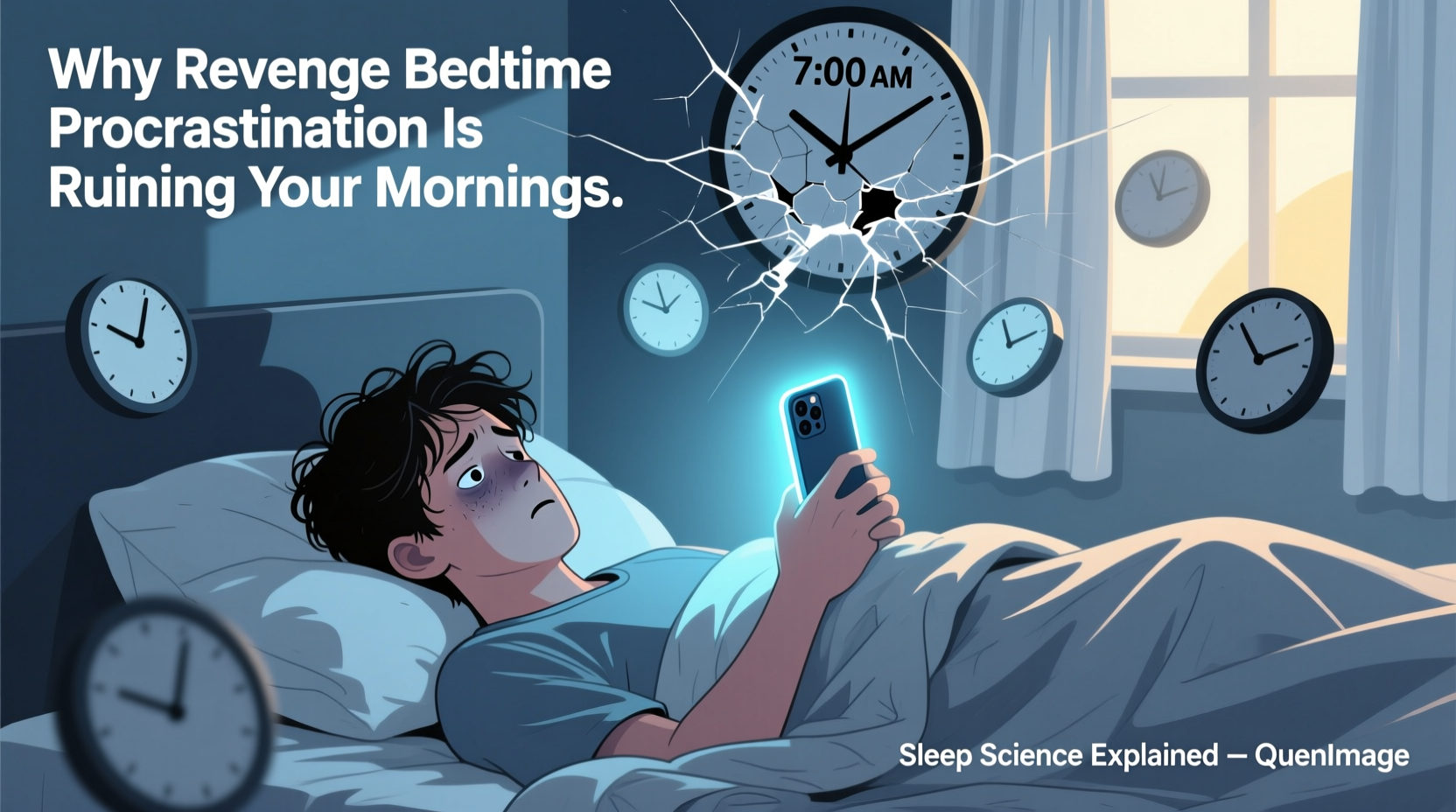
Revenge bedtime procrastination (RBP) refers to the voluntary delay of sleep despite no external reasons for staying awake. The “revenge” part comes from a psychological pushback against a daytime schedule so packed with obligations—work, chores, caregiving—that individuals feel they have no autonomy until late at night.
First identified in Chinese urban workers under high job pressure, the term gained global traction during the pandemic as remote work blurred boundaries between professional and personal time. Now, it’s a widespread phenomenon affecting people across cultures and age groups who feel chronically deprived of leisure.
RBP isn’t about insomnia or medical sleep disorders. It’s behavioral. It happens when someone chooses to stay awake, even when tired, simply because they want to reclaim a sense of control—or experience something enjoyable—outside the demands of their routine.
“People don’t just lose sleep due to stress—they sometimes refuse to sleep as a way of asserting agency over their own time.”
— Dr. Jana Scrivani, Clinical Psychologist & Sleep Researcher
How RBP Sabotages Your Mornings
The damage begins long before your alarm rings. When you cut into your sleep window—even by 60 to 90 minutes—you disrupt essential physiological processes:
- Sleep architecture: Deep sleep and REM cycles are compressed or skipped, reducing restoration.
- Hormonal balance: Cortisol rises earlier in the morning; melatonin production lags, making wake-up harder.
- Cognitive recovery: The brain’s glymphatic system clears metabolic waste during deep sleep—less sleep means slower mental processing the next day.
By morning, these disruptions manifest in tangible ways:
1. Delayed Wake-Up Reaction
You hit snooze—not once, but three times. That’s because your body hasn’t completed enough sleep cycles to trigger natural alertness. The deeper stages of non-REM sleep, crucial for physical restoration, occur primarily in the first half of the night. When you go to bed late, you miss the peak window for these restorative phases.
2. Poor Mood Regulation
Sleep loss directly impacts emotional centers in the brain, particularly the amygdala. With less prefrontal cortex modulation, minor frustrations—traffic, spilled coffee, a terse email—can trigger disproportionate reactions. Morning anxiety and irritability become routine.
3. Reduced Cognitive Performance
Attention span, memory recall, and decision-making all decline significantly after even one night of shortened sleep. A study from the University of Pennsylvania found that participants limited to six hours of sleep for two weeks performed cognitively as if they’d been awake for 48 hours straight.
4. Disrupted Appetite Signals
Leptin (the satiety hormone) decreases, while ghrelin (the hunger hormone) increases. This imbalance often leads to poor breakfast choices—high sugar, high carb—followed by mid-morning crashes. Energy levels dip, reinforcing reliance on caffeine, which further destabilizes sleep the next night.
5. Weakened Immune Response
Chronic sleep restriction impairs immune function. People who regularly get less than seven hours of sleep are nearly three times more likely to catch a cold, according to research published in *Sleep*. Morning symptoms like congestion or fatigue might not be coincidental—they could be cumulative effects of nightly trade-offs.
The Vicious Cycle of Control and Consequence
At its core, revenge bedtime procrastination stems from a legitimate need: autonomy. After a day spent responding to others’ needs—bosses, children, clients, family—it’s natural to crave unstructured time. But when that craving overrides biological necessity, it becomes self-defeating.
Consider this feedback loop:
- You stay up late to watch shows, scroll, or relax.
- You sleep fewer than 6–7 hours.
- You wake up fatigued, unfocused, and emotionally reactive.
- Your productivity drops, requiring longer hours to complete tasks.
- Your daytime feels more oppressive, increasing the desire for nighttime freedom.
- You repeat the cycle—later nights, worse mornings.
Each night feels like a win. Each morning feels like a loss. Over time, this undermines confidence, mood stability, and long-term well-being.
Mini Case Study: Sarah’s Week of Late Nights
Sarah, a 34-year-old project manager and mother of two, prides herself on efficiency. Her days start at 6:30 a.m. with school drop-offs and back-to-back Zoom calls. She rarely finishes work before 7 p.m., followed by dinner prep and helping her kids with homework. By 9:30 p.m., she’s exhausted—but also resentful.
“I didn’t get to talk to my sister. I didn’t read anything for myself. I didn’t even sit down,” she says. So she stays up until 1:00 a.m., scrolling Instagram and watching true crime documentaries. She tells herself it’s “me time.”
But by 6:30 a.m., her alarm blares. She feels heavy, disoriented, and angry. She skips breakfast, drinks two coffees before 9 a.m., and snaps at a colleague during a meeting. By noon, she’s sluggish and reaches for a candy bar. At 7 p.m., she’s already dreading the next day.
After tracking her habits for two weeks, Sarah realized she was averaging 5.5 hours of sleep. The “freedom” she sought at night cost her presence, patience, and joy during the day.
Breaking the Pattern: A Step-by-Step Reset
Ending revenge bedtime procrastination isn’t about willpower. It’s about redesigning your relationship with time, energy, and self-care. Here’s a realistic, step-by-step approach:
Step 1: Audit Your Evenings (Days 1–3)
For three nights, track exactly what you do between 8 p.m. and bedtime. Note:
- When you stop working
- When you begin winding down
- What activities keep you up (e.g., phone use, TV, conversations)
- How you justify staying up (“just one more episode,” “I’ll go in 10 minutes”)
Step 2: Reclaim Small Moments During the Day (Days 4–7)
Instead of hoarding evening time, build micro-moments of autonomy earlier:
- Take a 10-minute walk during lunch without your phone
- Listen to a podcast while commuting or doing dishes
- Read five pages of a novel before starting work
Step 3: Create a Pre-Sleep Ritual (Ongoing)
Replace passive screen time with intentional wind-down routines:
- 8:30 p.m.: Dim lights, close laptop, silence notifications
- 8:40 p.m.: Light stretching or journaling (write down worries or gratitudes)
- 9:00 p.m.: Read a physical book or listen to calming music
- 9:45 p.m.: Begin preparing for bed (brush teeth, skincare, etc.)
- 10:00 p.m.: Lights out
Step 4: Set a “Decision Deadline”
Choose a fixed time—say, 9:30 p.m.—after which no new entertainment decisions are allowed. No picking shows, no opening new browser tabs. This removes the slippery slope of “just one more thing.”
Step 5: Reward Compliance, Not Resistance
Track your progress for two weeks. For every night you meet your target bedtime, mark it on a calendar. After seven successful nights, reward yourself with something meaningful—a massage, a favorite meal, a guilt-free afternoon off. Reinforce the new habit with positive outcomes.
Do’s and Don’ts: Practical Guide to Healthier Evenings
| Do | Don’t |
|---|---|
| Schedule 15 minutes of “me time” earlier in the day | Assume nighttime is the only time for relaxation |
| Use blue light filters or switch to warm lighting after 8 p.m. | Scroll endlessly on bright screens in bed |
| Keep a notebook by the bed to jot down thoughts | Try to solve problems or plan tomorrow mentally at night |
| Practice gratitude or mindfulness before sleep | Consume caffeine or alcohol within three hours of bedtime |
| Stick to a consistent sleep-wake schedule (even weekends) | Use revenge procrastination as a long-term coping mechanism |
Frequently Asked Questions
Is revenge bedtime procrastination a sign of a mental health issue?
Not necessarily. While RBP is linked to stress, burnout, and low perceived control, it’s primarily a behavioral response rather than a clinical diagnosis. However, if it coexists with persistent anxiety, depression, or insomnia, consulting a therapist or sleep specialist is recommended.
Can I recover from one night of revenge procrastination?
Yes—your body can bounce back from occasional sleep loss with proper hydration, nutrition, and a return to regular sleep the following night. But repeated episodes lead to cumulative deficits. The key is consistency, not perfection.
What if my job requires late-night work?
If your profession genuinely demands late hours (e.g., healthcare, tech on-call roles), prioritize compensatory strategies: protect sleep duration when possible, nap strategically, and optimize sleep quality with blackout curtains, white noise, and strict screen limits post-shift.
Final Thoughts: Reclaim Your Mornings by Respecting Your Night
Revenge bedtime procrastination is not laziness. It’s a cry for balance in lives that offer little room for pause. But true autonomy isn’t found in stolen midnight hours—it’s built through daily choices that honor your body’s needs.
Every time you choose sleep over scrolling, you’re not surrendering to obligation. You’re investing in a clearer mind, a calmer mood, and a more present version of yourself. The mornings you reclaim will be brighter, sharper, and more forgiving—not just to your schedule, but to you.




 浙公网安备
33010002000092号
浙公网安备
33010002000092号 浙B2-20120091-4
Comments
No comments yet. Why don't you start the discussion?