
At first glance, space seems like a frozen void—dark, silent, and unimaginably cold. Yet this perception hides a deeper scientific truth: space isn’t “cold” in the way we experience cold on Earth. In fact, temperature in space behaves very differently due to the absence of matter and the unique nature of heat transfer. Understanding why space feels so cold requires rethinking what temperature really means beyond our planet’s atmosphere.
Unlike Earth, where air conducts and convects heat, space is mostly empty—a near-perfect vacuum. Without molecules to carry thermal energy, traditional cooling doesn’t apply. So when we say “space is cold,” we’re often referring not to ambient temperature but to how quickly objects lose heat. This distinction is crucial for space exploration, satellite design, and even sci-fi realism.
The Nature of Temperature in Space
Temperature measures the average kinetic energy of particles in a substance. On Earth, air molecules constantly collide, transferring energy and allowing us to feel warmth or cold. In space, however, particle density is extremely low—about one atom per cubic centimeter in interstellar space, compared to roughly 10^19 molecules per cubic centimeter in air at sea level.
This scarcity of matter means that while individual particles may have high kinetic energy (and thus high \"temperature\"), there are too few of them to transfer meaningful heat. An object placed in deep space won’t instantly freeze because no surrounding medium conducts cold; instead, it radiates its own heat away slowly through infrared emission.
“Temperature in space is misleading. It's not about how cold it 'feels' but how efficiently an object can shed heat.” — Dr. Lena Patel, Astrophysicist at Caltech
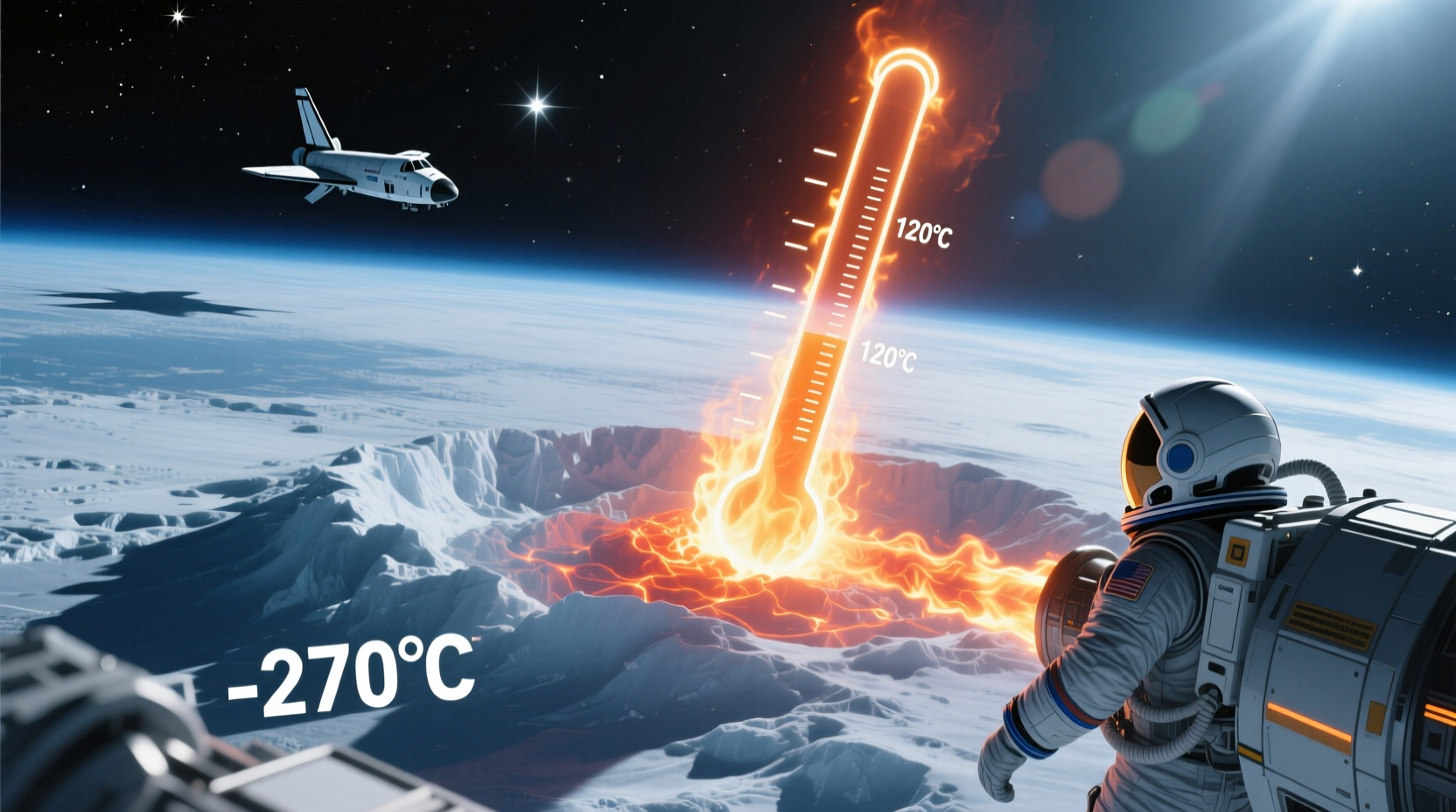
For example, the cosmic microwave background—the afterglow of the Big Bang—has a uniform temperature of about 2.7 Kelvin (-270.45°C or -454.81°F). This sets a baseline for the coldest possible environment in the universe, yet reaching equilibrium with it takes time due to radiation being the only heat transfer method available.
Heat Transfer in Vacuum: Radiation Dominates
On Earth, heat moves via three mechanisms: conduction (direct contact), convection (fluid movement), and radiation (electromagnetic waves). In space, only radiation works. There’s no air for convection and almost nothing to conduct heat.
An astronaut in sunlight near Earth absorbs intense solar radiation—up to 1,360 watts per square meter—while simultaneously losing heat through infrared radiation from their suit. The balance between incoming and outgoing energy determines whether they overheat or freeze. That’s why spacesuits are engineered with reflective outer layers and internal cooling systems.
Why Sunlight Feels Hot But Space Feels Cold
This paradox lies at the heart of public confusion. In low Earth orbit, direct sunlight can heat surfaces to over 120°C (248°F), while shaded areas plummet to below -100°C (-148°F). The International Space Station (ISS) experiences these extremes every 45 minutes as it orbits the planet.
The reason? When exposed to sunlight, objects absorb radiant energy rapidly. But in shadow, they emit infrared radiation into the vast emptiness without any incoming heat to replace it. The result is extreme thermal cycling—one of the biggest engineering challenges in spacecraft design.
| Condition | Approximate Temperature | Explanation |
|---|---|---|
| Direct Sunlight (LEO) | +120°C (248°F) | Solar radiation absorption without atmospheric filtering |
| Full Shadow (LEO) | -100°C (-148°F) | Radiative heat loss into space |
| Deep Interstellar Space | ~3 K (-270°C) | Approaches cosmic background temperature |
| Surface of Moon (Day) | +130°C (266°F) | No atmosphere to moderate temperatures |
| Surface of Moon (Night) | -173°C (-280°F) | Prolonged radiative cooling |
How Spacecraft and Astronauts Survive Extreme Conditions
Thermal control is critical for mission success. Engineers use passive and active systems to manage temperature swings:
- Multilayer Insulation (MLI): Shiny foil-like blankets reflect incoming radiation and reduce heat loss.
- Heat Pipes: Move excess heat from electronics to radiators.
- Radiators: Dark-painted panels emit waste heat efficiently into space.
- Heaters: Electric warming elements prevent instruments from freezing during eclipse phases.
The James Webb Space Telescope, positioned at Lagrange Point 2, uses a tennis-court-sized sunshield to maintain its instruments below -223°C (-370°F), enabling infrared observations. Meanwhile, the side facing the Sun operates at room temperature—an incredible feat of thermal engineering.
Mini Case Study: Apollo 13 and Thermal Challenges
During the Apollo 13 mission, after an oxygen tank explosion disabled power and heating systems, astronauts faced life-threatening cold inside the lunar module. With limited electrical power, they had to shut down nonessential systems, including cabin heaters.
Over several days, interior temperatures dropped to near 4°C (39°F). Condensation formed on walls, and crew members suffered from chills and fatigue. Yet, because the module was sealed and retained some residual heat, they avoided hypothermia. This incident highlighted how vital thermal regulation is—even within enclosed spacecraft.
Common Misconceptions About Cold in Space
Many believe that exposure to space would cause immediate freezing. Movies often depict characters flash-freezing upon hull breach. In reality, the primary dangers are lack of oxygen and ebullism (formation of bubbles in bodily fluids due to vacuum), not instant frostbite.
Human skin exposed to vacuum might eventually freeze—but only after several minutes, once internal heat is fully radiated away. More immediately, water on the eyes, tongue, or lungs would vaporize due to zero pressure, leading to unconsciousness in under 15 seconds.
Checklist: Key Facts About Space Temperature
- Space has no temperature in the conventional sense—it lacks sufficient matter to define it.
- Objects in space lose heat only by radiation, not conduction or convection.
- Sunlit surfaces can be extremely hot; shaded ones become very cold.
- The cosmic background temperature is 2.7 K, but objects take time to reach it.
- Thermal management is essential for spacecraft and astronaut survival.
- A vacuum does not “suck out” heat—it prevents heat transfer except via radiation.
Frequently Asked Questions
Can you freeze instantly in space?
No. While heat escapes steadily through radiation, freezing takes minutes to hours depending on mass, color, and surface area. The real immediate threat is asphyxiation and decompression, not cold.
Why doesn’t the Sun heat space?
The Sun heats objects—not space itself. Its radiation travels unimpeded until it strikes matter, such as planets, spacecraft, or astronauts. Since space is mostly empty, there’s nothing to warm up.
How do satellites avoid overheating or freezing?
Satellites use thermal coatings, insulation, radiators, and sometimes rotating maneuvers to balance exposure. Some spin slowly to distribute heat evenly, preventing localized damage.
Conclusion: Rethinking Cold Beyond Earth
Understanding why space is “cold” forces us to rethink the fundamentals of temperature and heat. It’s not about ambient chill but about isolation and radiative balance. This knowledge powers everything from spacesuit design to deep-space probes venturing beyond Pluto.
As humanity pushes further into the cosmos, mastering thermal dynamics in vacuum becomes ever more critical. Whether shielding delicate instruments or protecting human life, the silent battle against extreme temperatures continues—quietly, invisibly, and absolutely essential.




 浙公网安备
33010002000092号
浙公网安备
33010002000092号 浙B2-20120091-4
Comments
No comments yet. Why don't you start the discussion?