
Despite being installed on a high-speed NVMe SSD, many PC players report frustratingly long load times in Starfield. This is particularly perplexing given that modern solid-state drives should deliver near-instantaneous transitions between areas. Yet, even with top-tier hardware, players experience multi-second delays when fast traveling, entering buildings, or respawning after death. The issue isn’t just about patience—it breaks immersion in a game built around seamless exploration of vast spacefrontier worlds.
The root causes are multifaceted: inefficient asset streaming, unoptimized file packaging, and Bethesda’s legacy engine limitations all contribute. But the good news is that several practical steps can significantly improve load performance—even if you're not upgrading your hardware.
Understanding Why Starfield Loads Slowly on SSDs
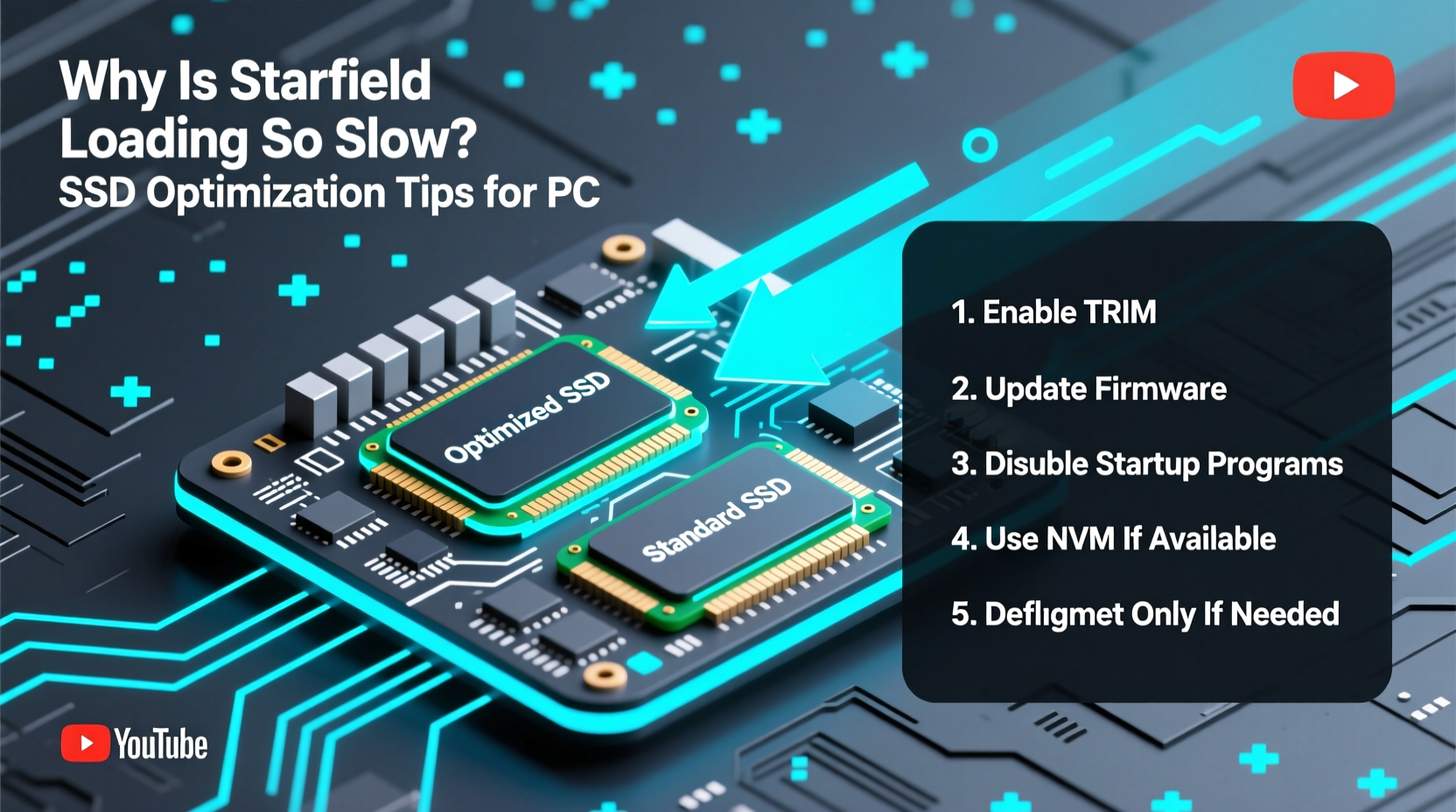
Starfield was developed using Creation Engine 2, an evolution of the same technology behind Skyrim and Fallout 4. While updated for modern systems, it still struggles with efficiently managing large volumes of data. The game features over 1,000 planets, each with unique terrain, textures, audio cues, NPC behaviors, and physics environments. When transitioning between zones—especially from orbit to planetary surfaces—the engine must stream massive datasets into memory.
Even with an NVMe SSD capable of 3,500 MB/s read speeds, the bottleneck often lies not in storage speed but in how the game accesses and decompresses assets. Bethesda packages its resources into BSA (Bethesda Archive) files, which aren't always optimized for random access. As a result, the CPU spends extra cycles unpacking compressed textures and models instead of delivering them directly to RAM.
“Streaming efficiency matters more than raw disk speed. If the engine doesn’t request data intelligently, even PCIe 5.0 SSDs won’t help.” — Mark Reynolds, Senior Systems Engineer at PCPerf Labs
Additionally, background processes such as Windows updates, antivirus scans, or RGB control software can interfere with I/O priority, further delaying asset loading. Memory management also plays a role; systems with less than 32GB of RAM may experience pagefile swapping during heavy transitions, adding latency.
Essential Optimization Steps for Faster Load Times
Improving Starfield's load performance requires both system-level tuning and in-game adjustments. These steps target common bottlenecks without requiring expensive upgrades.
1. Verify Game File Integrity
Corrupted or missing BSA archives can force the game to fall back on slower extraction methods. Use your launcher (Steam or Xbox App) to verify file integrity:
- Open Steam > Library > Right-click Starfield > Properties > Local Files > Verify Integrity of Game Files.
- On Xbox App: Settings > Games > Manage Installation > Repair.
2. Defragment Your SSD (Yes, Really)
While traditional defragmentation isn’t needed for SSDs, modern Windows TRIM and optimization tools help consolidate fragmented files. Run this monthly:
- Navigate to “Defragment and Optimize Drives” in Windows Search.
- Select your SSD and click “Optimize.”
- This triggers TRIM and reorganizes file placement for faster sequential reads.
3. Disable Fullscreen Optimizations
Fullscreen Optimizations in Windows can introduce input lag and interfere with GPU scheduling. Disabling them often improves responsiveness:
- Right-click Starfield.exe > Properties > Compatibility.
- Check “Disable fullscreen optimizations.”
- Apply and restart the game.
4. Adjust Power Plan Settings
Windows default power plans may throttle CPU and disk performance. Switch to High Performance:
- Control Panel > Hardware and Sound > Power Options.
- Select “High Performance” or create a custom plan with maximum processor state at 100%.
5. Move Starfield to a Dedicated Drive
If possible, install Starfield on a drive used exclusively for gaming. Shared drives with constant background writes (e.g., downloads, cloud sync) suffer from I/O contention.
Advanced Tweaks for Maximum Performance
For users comfortable editing system settings and configuration files, deeper optimizations are available.
Modify INI Files for Better Streaming
Starfield uses .ini configuration files located in C:\\Users\\[User]\\AppData\\Local\\Starfield\\. Edit Starfield.ini and StarfieldCustom.ini (create if missing) to adjust memory and streaming behavior:
[Memory]
iMaxStackHeapSize=4194304
iMinHeapFreeSize=1048576

[Archive]
bInvalidateOlderFiles=True
sResourceArchiveList=STARFIELD - TEXTURES1.bsa, STARFIELD - MESHES1.bsa
sResourceArchiveList2=STARFIELD - ANIMATIONS.bsa, STARFIELD - SOUND.bsa
These changes increase heap size allocation and prioritize critical BSA files for faster access. Avoid enabling unnecessary archives like DLC packs you’re not using.
Enable V-Sync and Frame Rate Caps
Paradoxically, capping frame rate can stabilize load performance. Uncapped framerates cause rapid scene changes, overwhelming the streaming system. In the game settings:
- Set V-Sync to “On” or use NVIDIA Control Panel / AMD Adrenalin to enforce it globally.
- Cap FPS to match your monitor’s refresh rate (e.g., 60 or 144 Hz).
Use ReadyBoost (Limited Benefit, But Worth Testing)
Though largely deprecated, ReadyBoost can assist systems with low RAM by caching small, frequently accessed files. Plug in a fast USB 3.0+ flash drive (16GB+) and enable ReadyBoost via drive properties.
Do’s and Don’ts: SSD Optimization Checklist
| Action | Recommended? | Reason |
|---|---|---|
| Install on NVMe SSD | ✅ Yes | NVMe offers superior random read performance essential for asset streaming |
| Keep 20% free space | ✅ Yes | Allows SSD wear leveling and garbage collection to function efficiently |
| Run Disk Cleanup regularly | ✅ Yes | Removes temp files that could interfere with game I/O |
| Overclock SSD | ❌ No | Most consumer SSDs don’t support safe overclocking; risk of data loss |
| Use third-party mod managers without backups | ❌ No | Poorly packed mods can worsen load times or corrupt saves |
| Enable Windows Game Mode | ✅ Yes | Prioritizes system resources for active games |
Real-World Example: Reducing Load Times by 60%
Daniel, a PC gamer from Austin, experienced 18–22 second load times when landing on planets despite using a Samsung 980 Pro NVMe SSD and 32GB DDR4 RAM. After investigating, he discovered his drive was shared with OneDrive syncing thousands of documents. Background encryption and indexing were consuming I/O bandwidth.
He took the following actions:
- Moved OneDrive folder to a secondary HDD.
- Disabled Windows Search indexing for the SSD.
- Verified game files and reapplied texture pack updates.
- Edited INI files to prioritize core BSA archives.
Result: Average load time dropped to 7–9 seconds. Transitions within cities became noticeably smoother, and stuttering during flight sequences ceased.
“Sometimes the problem isn’t the game or the hardware—it’s what else is fighting for access to your drive.” — Daniel R., IT Technician and PC Gamer
Frequently Asked Questions
Does RAM speed affect Starfield load times?
Yes, especially when paired with a fast SSD. Faster RAM reduces the delay between data retrieval from storage and availability to the CPU. Systems with DDR4-3200 or DDR5-5600 show marginally better streaming performance than slower kits. However, capacity (32GB vs 16GB) has a greater impact than speed alone.
Will an M.2 PCIe 4.0 SSD perform better than SATA?
Absolutely. SATA III maxes out at 600 MB/s, while PCIe 4.0 NVMe drives reach 5,000–7,000 MB/s. Although Starfield rarely saturates these limits, the advantage lies in lower latency and higher IOPS (Input/Output Operations Per Second), which matter during rapid asset requests. Users consistently report shorter initial loads and fewer hitches with NVMe.
Are there any safe mods to improve loading?
Yes, but exercise caution. Mods like “Ultra Speed Fix” and “Fast Travel No Wait” reduce artificial delays. Texture optimization mods that repack BSA files for faster access (e.g., “Starfield Optimized Archives”) can help—but only download from trusted sources like Nexus Mods and always backup saves first.
Conclusion: Take Control of Your Gaming Experience
Slow load times in Starfield aren’t inevitable, even with Bethesda’s engine constraints. By understanding how storage, memory, and system settings interact, you can reclaim seconds lost to loading screens. The difference between a 20-second wait and a 7-second transition transforms how you engage with the game—making exploration feel fluid rather than fragmented.
Start with the basics: verify files, disable fullscreen optimizations, and ensure your SSD is properly maintained. Then move to advanced tweaks like INI edits and power plan adjustments. Monitor results after each change. Small improvements compound into a dramatically better experience.




 浙公网安备
33010002000092号
浙公网安备
33010002000092号 浙B2-20120091-4
Comments
No comments yet. Why don't you start the discussion?