
In a world increasingly driven by data, understanding statistics is no longer just the domain of mathematicians or researchers. It’s a vital skill for professionals, policymakers, and even individuals navigating daily decisions. From healthcare breakthroughs to financial planning and public policy, statistics shapes how we interpret information, test assumptions, and make informed choices. Its power lies not in numbers alone, but in what those numbers reveal about patterns, risks, and opportunities.
The Role of Statistics in Decision-Making
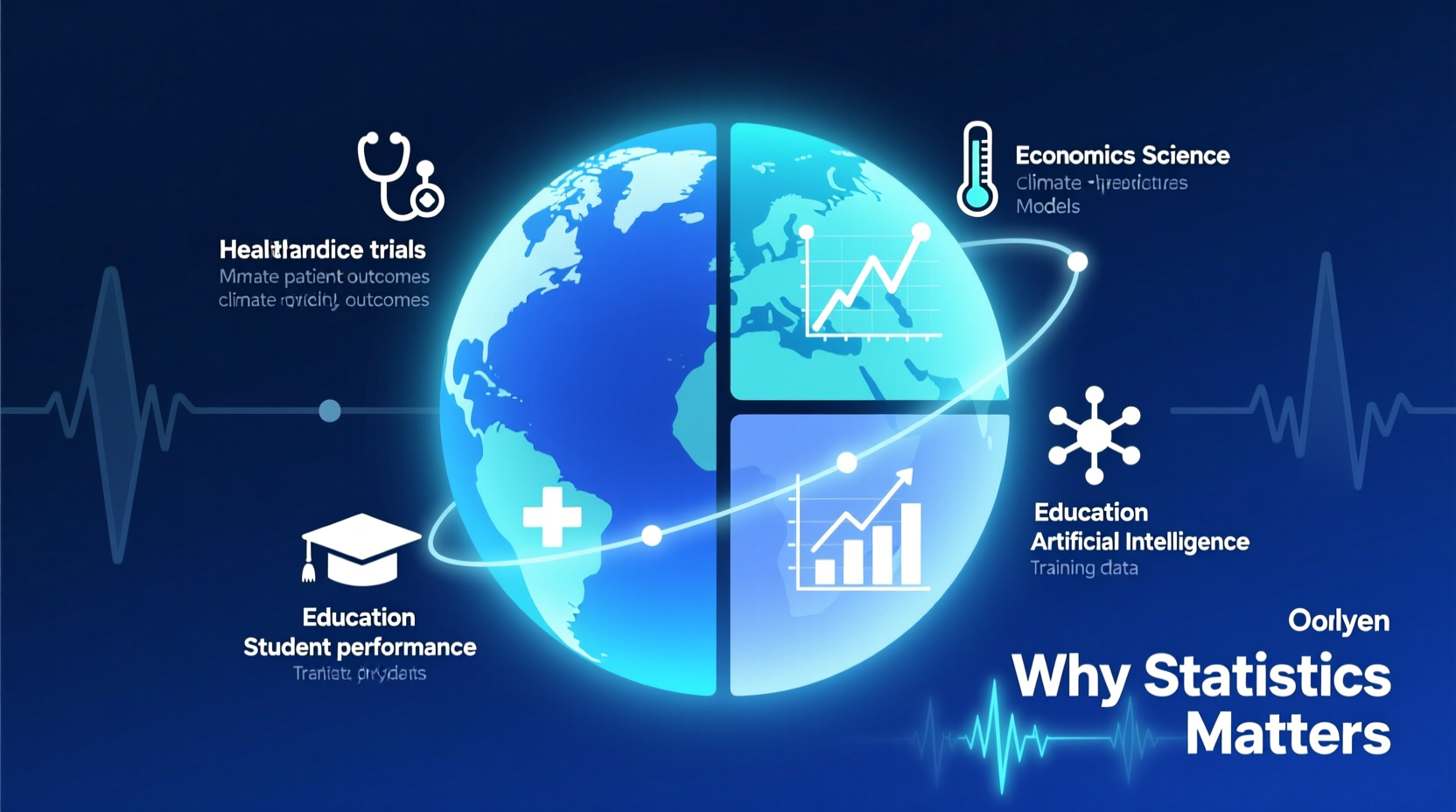
At its core, statistics transforms raw data into meaningful insights. Whether it's a company deciding on a new marketing strategy or a government evaluating the effectiveness of a public health program, statistical analysis provides an objective foundation for action. Without it, decisions are often based on intuition, anecdote, or bias—factors that can lead to costly mistakes.
For example, a retail chain considering expansion into a new region doesn’t rely solely on gut feeling. Instead, analysts use historical sales data, demographic trends, and consumer behavior models to forecast potential success. These predictions are derived through statistical methods like regression analysis and hypothesis testing, which quantify uncertainty and measure confidence in outcomes.
Statistics in Science and Medicine
In scientific research, statistics is indispensable. Clinical trials, epidemiological studies, and experimental designs all depend on statistical principles to ensure validity and reliability. Consider the development of vaccines: before approval, thousands of participants are involved in controlled trials where efficacy and safety are measured using statistical significance tests.
A landmark example is the polio vaccine trial conducted in the 1950s, involving over 1.8 million children. Statistical analysis confirmed that the vaccine reduced infection rates significantly compared to the control group. This rigorous approach gave public health officials the confidence to launch mass immunization campaigns, ultimately leading to near-eradication of the disease.
“Statistical reasoning is the backbone of evidence-based medicine. Without it, we cannot distinguish true treatment effects from random variation.” — Dr. Susan Lindquist, Biostatistician at Johns Hopkins University
Data Interpretation Challenges in Research
Even with robust tools, misinterpretation remains a risk. P-values, often used to determine significance, are frequently misunderstood. A low p-value suggests that observed results are unlikely under the null hypothesis, but it does not prove the alternative hypothesis is true. Misuse of such metrics has contributed to the so-called \"replication crisis\" in psychology and biomedical sciences, where many published findings fail to hold up under repeated testing.
This underscores the need for transparency in data collection, proper sample sizes, and preregistration of study designs—all practices supported by sound statistical frameworks.
Business Intelligence and Market Analysis
In the corporate world, statistics fuels competitive advantage. Companies collect vast amounts of customer data—from purchase history to website interactions—and apply statistical modeling to uncover trends, segment audiences, and personalize experiences.
For instance, e-commerce platforms use clustering algorithms (a statistical technique) to group users with similar behaviors. These segments inform targeted advertising, inventory management, and product recommendations. Amazon’s recommendation engine, responsible for an estimated 35% of its revenue, relies heavily on predictive analytics rooted in probability theory and machine learning—both grounded in statistics.
| Industry | Statistical Application | Impact |
|---|---|---|
| Finance | Risk modeling, portfolio optimization | Reduces exposure to market volatility |
| Retail | Demand forecasting, pricing strategies | Improves inventory turnover and profit margins |
| Manufacturing | Quality control via Six Sigma | Lowers defect rates and production costs |
| Marketing | A/B testing, conversion rate analysis | Optimizes campaign performance |
Everyday Life: How Statistics Empowers Individuals
People interact with statistics daily, often without realizing it. When someone checks the weather forecast—“70% chance of rain”—they’re interpreting probabilistic data. When they compare smartphone reviews or evaluate loan interest rates, they’re engaging in informal statistical thinking.
Understanding basic concepts like averages, standard deviation, and correlation helps individuals avoid being misled by misleading claims. For example, knowing that correlation does not imply causation prevents erroneous conclusions—like assuming ice cream causes drowning because both increase in summer months.
Mini Case Study: Personal Finance Planning
Sarah, a 32-year-old teacher, wanted to save for a down payment on a house. She reviewed historical stock market returns and housing price trends in her city using publicly available datasets. Applying simple statistical tools—mean annual return, inflation adjustment, and compound interest projections—she built a realistic savings timeline. By allocating funds across diversified index funds based on risk tolerance (measured through standard deviation), she minimized emotional investing and stayed on track. Three years later, she purchased her first home with confidence, thanks to data-driven planning.
Building Statistical Literacy: A Step-by-Step Guide
Developing statistical awareness doesn't require advanced math. Here’s a practical path to strengthen your skills:
- Start with foundational concepts: Learn terms like mean, median, mode, variance, and distribution.
- Interpret graphs critically: Practice reading bar charts, histograms, and scatter plots. Ask: What’s being measured? Is the scale misleading?
- Understand sampling: Recognize how sample size and selection affect generalizability.
- Evaluate claims: When encountering headlines like “Study shows coffee extends life,” ask: Was there a control group? How large was the sample?
- Use free tools: Explore platforms like Google Sheets, Khan Academy, or Coursera courses to practice analyzing real datasets.
Frequently Asked Questions
Can statistics be manipulated?
Yes. While statistics themselves are neutral, they can be presented selectively or deceptively. Omitting error margins, cherry-picking time frames, or using inappropriate scales on graphs can distort reality. Critical thinking is essential to detect such manipulation.
Do I need to learn complex math to understand statistics?
Not necessarily. Basic statistical literacy focuses more on interpretation than calculation. Modern software handles computations; the key skill is asking the right questions about data sources, methodology, and conclusions.
How is statistics different from data science?
Statistics is a branch of mathematics focused on collecting, analyzing, and interpreting data to make inferences. Data science is broader, combining statistics, programming, and domain expertise to extract insights from large datasets, often using automation and machine learning.
Conclusion: Embrace the Power of Informed Thinking
Statistics is not just a subject confined to classrooms—it’s a lens through which we can better understand the world. It empowers us to move beyond guesses and hunches toward evidence-based conclusions. In an age of misinformation and data overload, statistical literacy is a form of intellectual self-defense.
Whether you're a student, professional, or curious citizen, taking time to understand how data works will improve your decisions, sharpen your judgment, and deepen your engagement with society. The numbers are already speaking. It’s time to learn how to listen.




 浙公网安备
33010002000092号
浙公网安备
33010002000092号 浙B2-20120091-4
Comments
No comments yet. Why don't you start the discussion?