
The sight of a backward American flag on a soldier’s uniform often raises eyebrows among civilians. At first glance, it may seem like a mistake—after all, isn’t the flag supposed to be displayed with the union (the blue field with stars) in the upper left corner? Yet, on military uniforms, particularly on the right sleeve, the flag appears reversed. This is not an error but a deliberate design rooted in history, tradition, and symbolic movement. Understanding why the flag is worn \"backwards\" reveals deeper layers of military honor, forward momentum, and national pride.
The Symbolism of Movement: “To the Front”
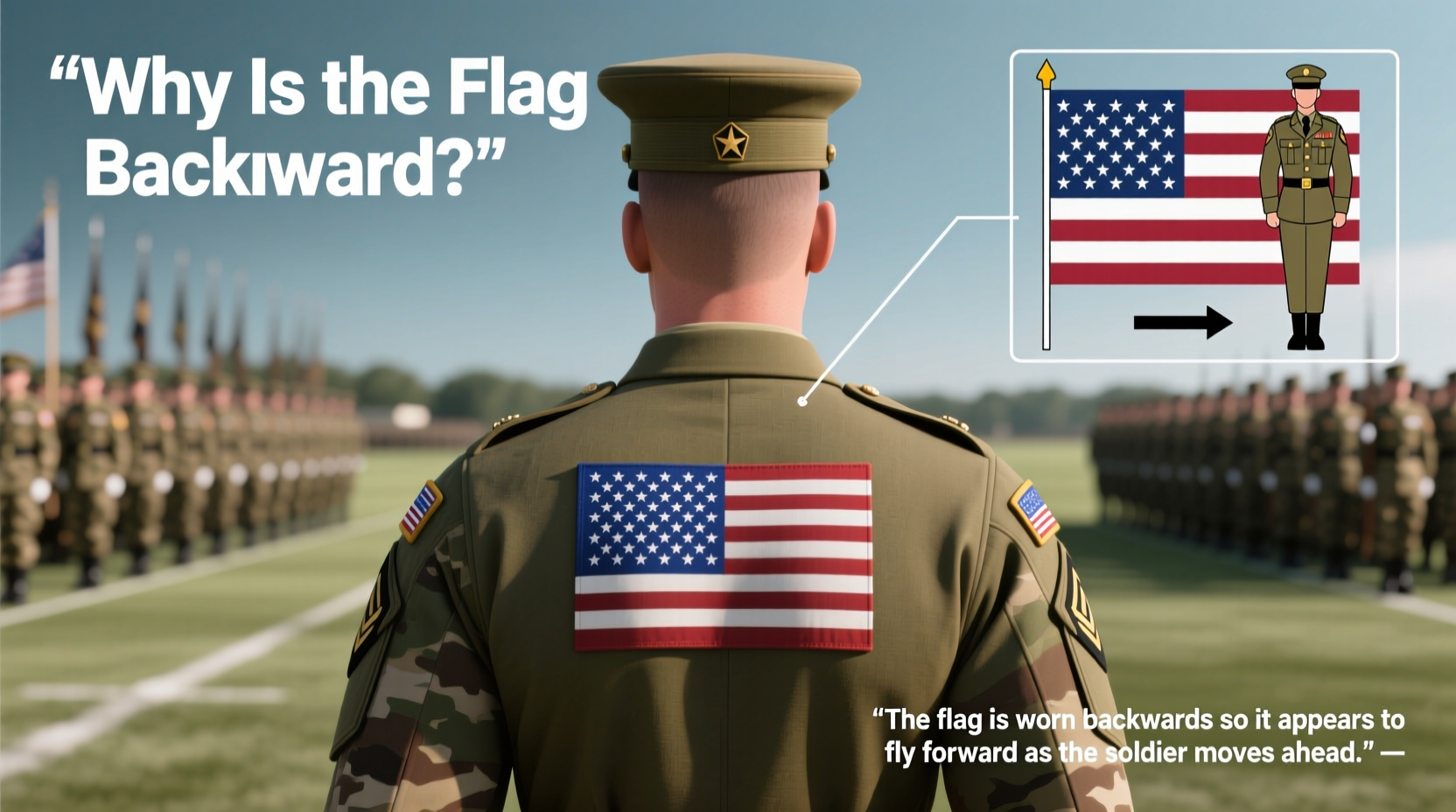
The most important reason for the reversed flag lies in its representation of motion. When a service member moves forward, the flag on their right shoulder is designed to appear as if it is streaming backward from the pole due to the force of movement—just as it would flutter in the wind when carried into battle.
In standard flag display, the union (blue canton) is positioned at the top left, or “hoist side,” closest to the flagpole. According to U.S. Army Regulation 670-1 and Department of Defense guidelines, when the flag is worn on the right arm, it must be oriented so that the union faces forward—or toward the front of the wearer—as though the soldier is advancing under the banner.
This means the flag is not truly “backwards.” It is correctly aligned to simulate the effect of the flag flying in the breeze as the service member marches ahead. The visual effect mimics a flag being carried into combat, leading the way rather than retreating.
“Soldiers don’t retreat; they move forward. The flag follows them, not leads them backward.” — Colonel Robert H. Jenkins Jr., U.S. Army (Ret.)
Historical Origins: From Battlefield Banners to Modern Uniforms
The tradition of carrying flags into battle dates back centuries. In early American conflicts, regiments were identified by their colors—large, mounted flags carried by designated color bearers. These flags served both as rallying points and symbols of unit identity. As troops advanced, the flag would naturally blow backward from the pole, with the union remaining fixed closest to the staff.
When the U.S. military began incorporating flag patches onto uniforms in the 20th century—especially during World War II and later formalized in the Gulf War era—the same principle was applied. The goal was to preserve the visual continuity of the flag moving forward. Thus, the patch on the right shoulder was reversed so that, when the soldier moved, the flag appeared to be billowing in the wind, leading the charge.
It wasn't until the 1990s, during Operation Desert Storm, that the use of full-color American flag patches became standardized across all branches. Since then, precise regulations have governed how and where the flag is worn.
Uniform Regulations Across the Military Branches
All branches of the U.S. Armed Forces follow similar standards for flag placement, though minor variations exist in size, color, and attachment method. The core principle remains consistent: the flag must appear to fly forward.
| Branch | Flag Placement | Union Direction | Regulation Source |
|---|---|---|---|
| U.S. Army | Right and left sleeves | Forward-facing on right; standard on left | AR 670-1 |
| U.S. Navy | Right shoulder of utility uniforms | Blue field forward | NAVPERS 15665I |
| U.S. Air Force | Right sleeve of OCP/ABU | Stars lead toward front | AFCOMI 36-2903 |
| U.S. Marine Corps | Right shoulder of combat utility | Union forward | MCO P1020.34G |
| U.S. Coast Guard | Right sleeve of operational gear | Aligned with Army standards | COMDTINST M1020.6G |
Note that the flag is typically worn on both shoulders—reversed on the right, standard on the left—creating a balanced appearance while maintaining symbolic integrity.
Common Misconceptions About the Backward Flag
Despite official explanations, several myths persist about the reversed flag:
- Myth: A backward flag signifies mourning or defeat.
- Reality: There is no such tradition in U.S. military protocol. Mourning is observed through other means, such as flying the flag at half-staff.
- Myth: Only special forces wear the reversed flag.
- Reality: All service members authorized to wear the flag patch follow the same orientation rules.
- Myth: The reverse flag is a recent trend.
- Reality: The concept dates back to cavalry units and battlefield color bearers long before modern uniforms existed.
Step-by-Step: How the Reversed Flag Is Properly Worn
To ensure correct flag placement on military uniforms, follow these steps:
- Determine the uniform type: Identify whether the uniform requires a flag patch (e.g., OCP, ACU, NWU).
- Locate the right shoulder: The reversed flag goes on the right sleeve, approximately 1/4 inch below the shoulder seam.
- Orient the patch correctly: The blue union must face forward—toward the front of the body—so it appears to trail behind as the wearer moves.
- Secure the patch: Use stitching, hook-and-loop (Velcro), or approved adhesive methods per branch regulations.
- Inspect alignment: Ensure the flag is centered, level, and visible without obstruction.
Mini Case Study: A New Recruit’s First Uniform Inspection
Private James Carter, a recent graduate of Basic Training, prepared nervously for his first duty uniform inspection. During preparation, he carefully attached his flag patch to the right sleeve—but accidentally placed it in the standard orientation, with the union in the upper left.
His drill sergeant paused during inspection, pointed at the flag, and asked, “Son, which way are you moving?”
James hesitated. “Forward, Sergeant.”
“Then why is your flag retreating?” the sergeant replied. He explained the symbolism: the flag must appear to be carried into battle, not dragged behind. James corrected the patch immediately. That moment stayed with him—not just as a lesson in uniform standards, but as a reminder of the values he now represented.
Expert Insight: Why Tradition Matters
Military customs, even subtle ones like flag orientation, serve a larger purpose: reinforcing identity, discipline, and mission focus. Dr. Linda Moore, a historian at the National Museum of American History, explains:
“The backward flag isn’t about aesthetics—it’s about narrative. It tells a story of relentless advance, of never turning back. In every stitch, there’s a message: we go forward, together, under one flag.” — Dr. Linda Moore, Military History Scholar
Frequently Asked Questions
Is wearing a backward flag disrespectful?
No. When worn according to military regulations, the reversed flag is a sign of respect and adherence to tradition. It symbolizes forward motion and active service, not disrespect or error.
Can civilians wear a backward American flag?
Civilians may wear apparel depicting the American flag in any orientation, but doing so in a reversed position on the right shoulder can cause confusion. Unless used to honor military service or in accurate reenactments, it’s best to display the flag in its standard form.
Why isn’t the left shoulder flag reversed too?
The left shoulder flag is displayed in the traditional orientation because it doesn’t need to simulate forward motion. Having the flag reversed only on the right maintains symmetry while preserving symbolic meaning.
Checklist: Ensuring Correct Flag Wear
- ✅ Confirm flag patch is authorized for your uniform
- ✅ Place reversed flag on the right sleeve
- ✅ Align the blue union toward the front of the body
- ✅ Verify placement is 1/4 inch below shoulder seam
- ✅ Double-check against current branch regulations
- ✅ Inspect regularly for wear, fading, or misalignment
Conclusion: Honor in Every Detail
The reversed flag on military uniforms is far more than a sartorial detail—it is a living symbol of courage, progress, and unwavering commitment. Every time a service member dons their uniform, the flag on their shoulder silently communicates a powerful message: they are moving forward, into duty, into danger, and into history.
Understanding this small but significant tradition deepens appreciation for the precision and meaning embedded in military life. It reminds us that even the smallest details carry weight when they represent something greater than themselves.




 浙公网安备
33010002000092号
浙公网安备
33010002000092号 浙B2-20120091-4
Comments
No comments yet. Why don't you start the discussion?