
The Moon has been Earth’s celestial companion for over 4 billion years, stabilizing our climate, shaping ocean tides, and inspiring cultures across history. Yet few realize that the Moon is not a permanent fixture in its current orbit. It is slowly, steadily moving away from Earth at about 3.8 centimeters per year. This may seem negligible on a human timescale, but over millions of years, it adds up. The reason behind this gradual retreat lies in the complex interplay of gravity, rotation, and tidal forces—a fascinating example of how celestial mechanics shape planetary systems.
The Role of Tidal Forces
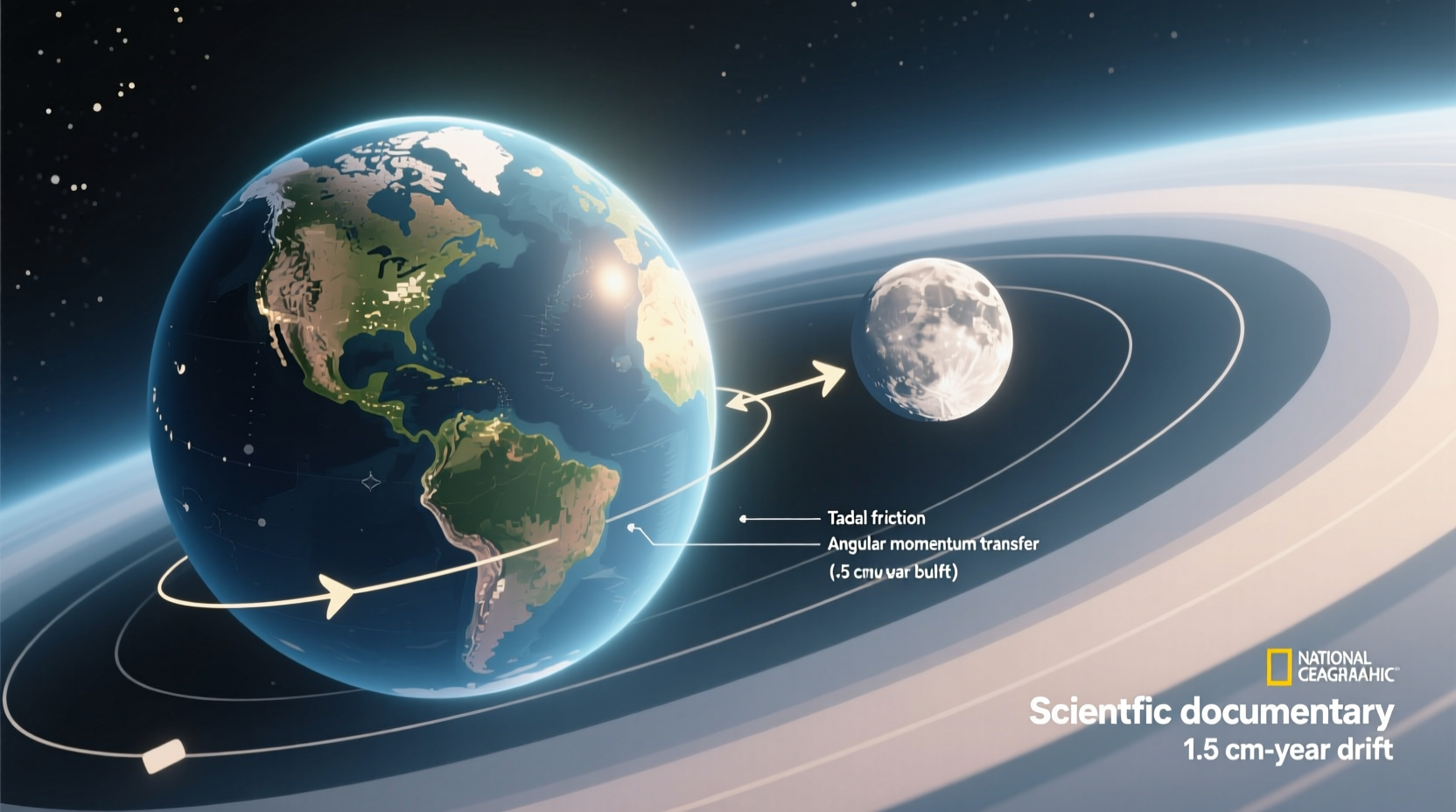
Tidal forces are the primary driver behind the Moon’s retreat. While most people associate tides with the rise and fall of ocean water, the effect extends beyond Earth’s surface. The Moon’s gravitational pull creates bulges in Earth’s oceans—one facing the Moon and one on the opposite side due to inertia. These tidal bulges are not perfectly aligned with the Moon because Earth rotates faster than the Moon orbits.
As Earth spins, it drags the oceanic bulge slightly ahead of the Moon’s position. This offset bulge exerts a gravitational pull on the Moon, giving it a small forward tug. In response, the Moon gains orbital energy and moves into a higher (farther) orbit. Conversely, this interaction slows Earth’s rotation over time—a process known as tidal braking.
Measuring the Moon’s Retreat
The rate of the Moon’s drift—approximately 3.8 cm per year—is not theoretical. It has been measured with remarkable precision using lunar laser ranging experiments. During the Apollo missions (11, 14, and 15), astronauts placed retroreflectors on the Moon’s surface. Scientists on Earth fire lasers at these reflectors and measure the time it takes for the light to return.
By analyzing the round-trip time of the laser beam, researchers can calculate the Earth-Moon distance to within millimeter accuracy. Decades of data confirm the Moon is receding, though the rate has varied over geological time due to changes in Earth’s continental configuration and ocean basin shapes, which affect tidal friction.
“The Moon is leaving us at a pace detectable only through precise instruments, but its departure is written in the laws of physics.” — Dr. James Williams, NASA Jet Propulsion Laboratory
A Historical Perspective: From Past to Future
Scientists estimate that the Moon formed around 4.5 billion years ago, likely from debris after a Mars-sized body collided with early Earth. At that time, the Moon was much closer—possibly only 20,000 to 30,000 kilometers away, compared to today’s average distance of 384,400 km.
Back then, tides were extreme, possibly kilometers high, and Earth’s day lasted only about 5 hours. Over time, tidal interactions transferred angular momentum from Earth’s rotation to the Moon’s orbit, pushing the Moon farther out while slowing Earth’s spin.
This process will continue until Earth’s rotation becomes tidally locked with the Moon—meaning Earth would always show the same face to the Moon, just as the Moon already does to Earth. However, this equilibrium won’t be reached for tens of billions of years, long after the Sun has evolved into a red giant and likely engulfed both bodies.
Timeline of the Moon’s Orbital Evolution
- 4.5 billion years ago: Moon forms at ~30,000 km; Earth day = ~5 hours.
- 620 million years ago: Fossil evidence suggests a 22-hour day and closer Moon.
- Present day: Moon at 384,400 km; Earth day = 24 hours; retreat rate = 3.8 cm/year.
- ~50 billion years from now: Tidal lock expected—if the Earth-Moon system survives.
What If the Moon Stopped Drifting?
If the Moon were to stop moving away, it would imply that Earth and the Moon have achieved tidal synchronization. But this scenario is purely hypothetical under current astrophysical models. The drift will only cease when Earth’s rotation matches the Moon’s orbital period—about 47 of our current days. Until then, the Moon continues its outward spiral.
It's also important to note that the rate of recession isn't constant. Hundreds of millions of years ago, when Earth’s continents were arranged differently, tidal resonance in ocean basins may have amplified tidal friction, accelerating the Moon’s retreat. Today’s configuration produces less efficient tidal coupling, which may explain why the current rate is relatively high compared to long-term averages.
Impact on Earth’s Environment and Life
The Moon’s gradual retreat has subtle but profound long-term implications. As Earth’s rotation slows, days get longer—though the change is imperceptible in a human lifetime (about 2.3 milliseconds per century). Over millions of years, this affects climate patterns, biological rhythms, and even the stability of Earth’s axial tilt.
The Moon acts as a stabilizer for Earth’s obliquity (tilt), preventing chaotic shifts in climate that could otherwise occur. Without the Moon, simulations suggest Earth’s tilt could vary by tens of degrees over millions of years, leading to extreme weather fluctuations. As the Moon moves farther away, its stabilizing influence will weaken—but again, not significantly within the lifespan of the biosphere.
Common Misconceptions About the Moon’s Drift
Several myths persist about the Moon moving away. One is that it will eventually escape Earth’s gravity. This is false. The Moon cannot break free entirely because the energy transfer depends on Earth’s rotation, which will slow to a point where no more net energy can be passed to the Moon. At that stage, the system reaches equilibrium.
Another misconception is that human activity affects the Moon’s orbit. While we’ve left physical artifacts on the surface, our actions have no measurable impact on lunar orbital dynamics. The forces involved are purely gravitational and operate on planetary scales.
Frequently Asked Questions
Will the Moon keep drifting forever?
No. The Moon will stop drifting when Earth becomes tidally locked to it, meaning Earth’s rotation period matches the Moon’s orbital period. However, this will take approximately 50 billion years—long after the Sun has entered its red giant phase and likely destroyed both bodies.
Does the Moon’s drift affect eclipses?
Yes, gradually. As the Moon moves farther away, its apparent size in the sky decreases. In about 600 million years, it will be too far to completely cover the Sun during a solar eclipse. Total solar eclipses will no longer occur; only annular (ring-like) eclipses will be visible.
Could anything speed up or reverse the Moon’s drift?
In theory, a massive external gravitational disturbance could alter the Moon’s orbit, but no such events are expected in our solar system. Natural reversal is impossible under current physics—tidal forces only push the Moon outward, never inward.
Conclusion: A Slow Dance Governed by Gravity
The Moon’s drift is a quiet testament to the dynamic nature of our solar system. What appears to be a static night sky is actually a cosmic ballet shaped by invisible forces. The Moon’s retreat is not a flaw or anomaly—it’s a consequence of the same tidal interactions that have sculpted Earth’s geology and influenced the rhythm of life.
Understanding this process deepens our appreciation for the delicate balance that governs planetary systems. While the changes unfold over timescales far beyond human experience, they remind us that even the most familiar celestial objects are in constant motion.




 浙公网安备
33010002000092号
浙公网安备
33010002000092号 浙B2-20120091-4
Comments
No comments yet. Why don't you start the discussion?