
The moon is often thought of as a nighttime companion, glowing softly in the dark sky. Yet many people are surprised to see it hanging above the horizon in broad daylight. This phenomenon isn’t rare or mysterious—it’s a regular part of our celestial rhythm. The moon appears in the daytime sky more often than most realize, governed by predictable orbital mechanics and Earth's rotation. Understanding why this happens demystifies one of nature’s quieter wonders and deepens appreciation for the dynamic relationship between Earth, moon, and sun.
How Lunar Visibility Works
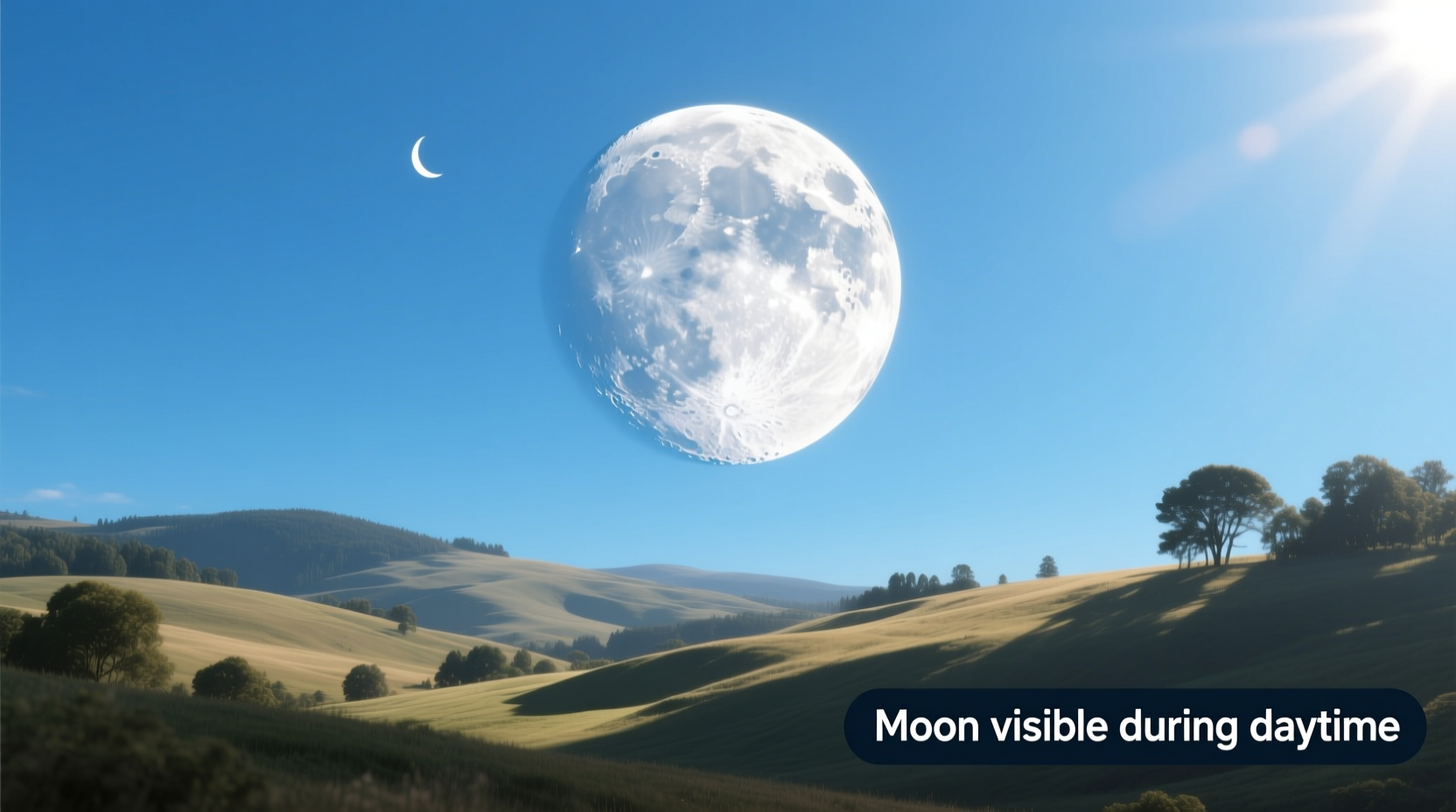
The moon does not produce its own light. Instead, it reflects sunlight, making it visible from Earth. Whether we see it at night or during the day depends on three key factors: the moon’s position in its orbit, the angle of sunlight reflecting off its surface, and the observer’s location on Earth.
The moon orbits Earth approximately every 27.3 days, but due to Earth’s simultaneous movement around the sun, the full lunar cycle—known as the synodic month—takes about 29.5 days. During this time, the moon passes through phases: new moon, waxing crescent, first quarter, waxing gibbous, full moon, waning gibbous, last quarter, and waning crescent. At certain points in this cycle, particularly between the first quarter and last quarter phases, the moon spends significant time above the horizon during daylight hours.
Daytime visibility occurs when the moon is high enough in the sky and sufficiently illuminated by the sun while the sky is still bright. Unlike stars, which are drowned out by scattered sunlight, the moon is large and reflective enough to remain visible even in a blue sky.
Factors Influencing Daytime Moon Sightings
Several interrelated conditions determine whether the moon can be seen during daylight hours:
- Orbital Position: When the moon is near 90 degrees east (first quarter) or west (last quarter) of the sun, it rises or sets roughly six hours apart from the sun, increasing overlap with daylight.
- Altitude Above Horizon: The higher the moon climbs in the sky, the easier it is to see. Atmospheric scattering diminishes visibility near the horizon.
- Sky Conditions: Clear skies with minimal cloud cover improve visibility. Hazy or polluted air reduces contrast.
- Lunar Phase: A half-lit or gibbous moon reflects more light than a thin crescent, enhancing its visibility against the bright sky.
- Observer Location: Latitude and local topography affect viewing angles. Observers near the equator may notice different patterns than those at higher latitudes.
“Many assume the moon is only a nocturnal object, but it’s up there just as often during the day—we’re just less likely to look.” — Dr. Sarah Chen, Planetary Scientist at Lowell Observatory
When Is the Moon Most Likely Visible During the Day?
Visibility peaks during specific parts of the lunar cycle:
| Lunar Phase | Rise Time | Set Time | Best Daytime Viewing Window |
|---|---|---|---|
| New Moon | ~6:00 AM | ~6:00 PM | Rarely visible (too close to sun) |
| First Quarter | ~12:00 PM (noon) | ~12:00 AM (midnight) | Afternoon sky (1–6 PM) |
| Full Moon | ~6:00 PM | ~6:00 AM | Morning before sunrise |
| Last Quarter | ~12:00 AM (midnight) | ~12:00 PM (noon) | Early morning (6–11 AM) |
| Waxing Crescent | ~9:00 AM | ~9:00 PM | Late afternoon (3–7 PM) |
As shown, the first and last quarter moons offer the most reliable opportunities for daytime observation. During these phases, the moon forms a right angle with the Earth-sun line, allowing it to rise or set midway between sunrise and sunset.
A Real Example: Spotting the Moon on a Tuesday Afternoon
In early April, a teacher in Portland, Oregon stepped outside during her lunch break and noticed a bright, half-lit moon in the southern sky. It was 2:30 PM, and the sun was still high. Curious, she checked a skywatching app and discovered it was two days past first quarter. The moon had risen at 1:15 PM and wouldn’t set until after midnight. With clear skies and good contrast, it stood out clearly against the pale blue backdrop. Her students later sketched it during a science lesson, turning an everyday sight into a teachable moment about celestial motion.
Step-by-Step Guide to Observing the Daytime Moon
Finding the moon during daylight doesn’t require special equipment—just timing and awareness. Follow these steps:
- Determine the current lunar phase using a calendar, astronomy app, or website like timeanddate.com.
- Check moonrise and moonset times for your location. Focus on days near first or last quarter.
- Look east in the morning after last quarter, or west in the afternoon after first quarter.
- Scan the sky away from the sun to avoid glare. Use your hand to block the sun if needed.
- Use landmarks like trees or buildings to help track its position over successive days.
- Observe changes in shape and brightness daily to understand how phase and visibility correlate.
Common Misconceptions About the Daytime Moon
Several myths persist about lunar visibility:
- Myth: The moon cannot be seen during the day.
Fact: It’s visible on average 25 days per month, many of them during daylight. - Myth: Only the full moon is visible.
Fact: Half-moons and even crescents can appear in daylight under the right conditions. - Myth: Seeing the moon during the day means something unusual is happening.
Fact: It’s a normal result of orbital geometry, not an anomaly.
FAQ
Why don’t we always see the moon during the day?
The moon isn’t always above the horizon during daylight hours. Its visibility depends on its orbital position. Around the new moon, it’s too close to the sun in the sky and lost in glare. During full moon, it’s opposite the sun and primarily visible at night.
Can the moon be seen during a solar eclipse?
Yes—but only because the moon itself becomes the focal point. During a solar eclipse, the moon passes directly in front of the sun, making it dramatically visible even though it’s blocking sunlight. This is a rare exception where the moon’s silhouette is seen in daytime due to alignment, not reflection.
Does the atmosphere affect how clearly we see the daytime moon?
Absolutely. Air pollution, humidity, and particulates scatter sunlight and reduce contrast. On hazy days, the moon may appear washed out or harder to locate. High-altitude locations with clearer air often provide better viewing.
Conclusion
The moon’s presence in the daytime sky is not an illusion or a rare event—it’s a predictable consequence of celestial mechanics. By understanding the moon’s orbit, phases, and relationship to the sun, anyone can anticipate when and where to look. Observing the moon during daylight fosters a deeper connection to the rhythms of our solar system and reminds us that wonder is often hiding in plain sight.




 浙公网安备
33010002000092号
浙公网安备
33010002000092号 浙B2-20120091-4
Comments
No comments yet. Why don't you start the discussion?