
Sriracha has become a global condiment sensation, adorning everything from tacos to ramen. Yet for many English speakers, one aspect of this fiery sauce remains puzzling: why is the \"r\" in \"sriracha\" silent? The word rolls off the tongue as \"see-rah-cha,\" not \"sri-racha,\" leaving many wondering about its linguistic roots. The answer lies not in culinary trends but in the phonetics and orthography of the Thai language—the true birthplace of sriracha.
To understand this pronunciation quirk, we must look beyond English conventions and explore how Thai script and sound systems shape the way words are spoken. This article unpacks the historical, linguistic, and cultural reasons behind the silent \"r\" in sriracha, offering clarity for curious food lovers, language enthusiasts, and anyone who’s ever hesitated before ordering at a Thai restaurant.
The Origins of Sriracha: A City, Not Just a Sauce
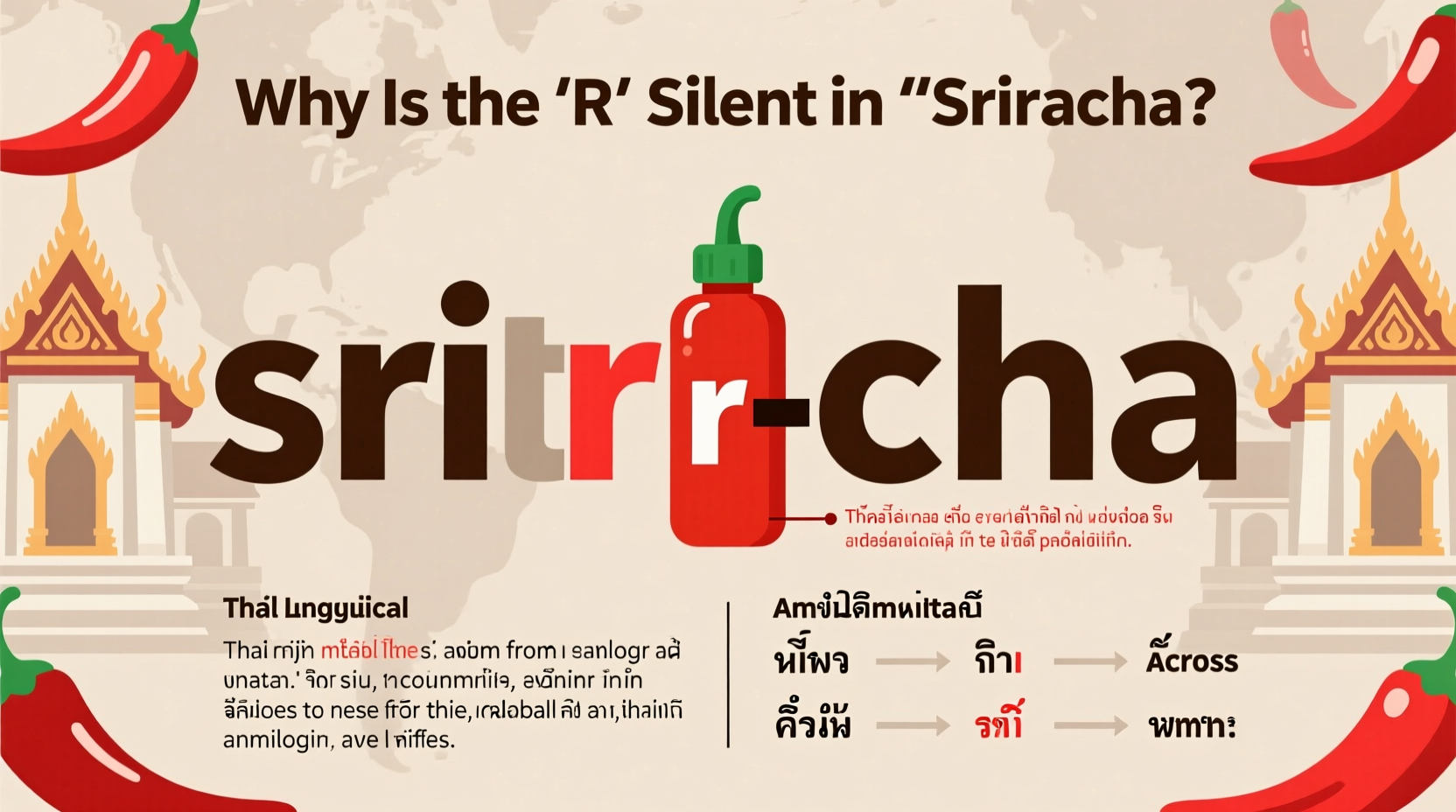
The word \"sriracha\" originates from the coastal city of Si Racha (ศรีราชา) in Chonburi Province, Thailand. Known for its seafood and vibrant fishing culture, Si Racha has been home to a distinctive chili sauce for decades—long before Huy Fong Foods popularized the rooster-labeled version in the United States.
In Thai, the full name of the city is written as Si Racha, where \"Si\" means \"city\" or \"splendor,\" and \"Racha\" derives from the Sanskrit word *rāja*, meaning \"king.\" Together, the name translates roughly to \"City of the King\" or \"Splendid Kingdom.\" When transliterated into the Roman alphabet, the spelling becomes \"Sriracha\"—a compromise between Thai phonology and Western writing systems.
This transliteration is where confusion begins. English readers see two \"r\"s and instinctively want to pronounce them both. But in Thai pronunciation, that first \"r\" doesn’t function like an English \"r\" at all.
Thai Phonology: Why Letters Don’t Always Match Sounds
Thai is a tonal language with 44 consonants and 32 vowels, organized into a complex system that doesn’t map directly onto the Latin alphabet. When scholars and linguists transliterate Thai words, they aim for phonetic accuracy, but compromises are inevitable.
The Thai consonant at the beginning of \"Si Racha\" is ศ (*sor sua*), which makes an \"s\" sound. It’s followed by ร (*ror rua*), which represents a liquid consonant similar to an \"r.\" However, when these two appear together in the cluster sr-, the resulting sound is not a hard \"sr\" as in \"straw,\" but rather a softened, almost glottal onset that leans toward \"si\" or \"shi.\"
Linguist Dr. Nattaya Srisa-ard explains:
“In Thai, initial clusters like ‘sr’ are rare and often assimilate into a palatalized ‘s’ sound. Native speakers don’t emphasize the ‘r’—it’s more of a transitional glide than a distinct consonant.”
This subtle shift means that even though \"sriracha\" is spelled with two \"r\"s in Roman script, only the second \"r\" is clearly pronounced. The first \"r\" serves more as a marker of etymology than a vocal cue.
Transliteration vs. Pronunciation: The Spelling Trap
One of the main reasons people mispronounce \"sriracha\" is the mismatch between spelling and sound in transliterated Thai. Unlike languages such as Spanish or Italian, where spelling closely reflects pronunciation, Thai-to-English transliteration often prioritizes visual consistency over phonetic precision.
Consider the following comparison:
| Word | Original Script | Transliteration | Actual Pronunciation (IPA) | Common Mispronunciation |
|---|---|---|---|---|
| Sriracha | ศรีราชา | Sriracha | /siːˈrat͡ɕʰaː/ | SRIGH-uh-cha |
| Pad Thai | ผัดไทย | Phat Thai | /pât̚.tʰaj/ | PAD-tie (correct), but often said as PAHD-thigh |
| Mangosteen | มังคุด | Mangkood | /māŋ.kùt/ | MANG-go-steven |
As shown, transliteration preserves the structure of the original word but can mislead non-native speakers. In the case of \"sriracha,\" the double \"r\" suggests a stronger consonant presence than actually exists in speech.
How to Pronounce Sriracha Correctly: A Step-by-Step Guide
Mastering the authentic pronunciation of \"sriracha\" takes awareness and practice. Follow these steps to get it right:
- Break it into syllables: See – rah – cha
- Start with a soft “s”: The initial sound is smooth, not sharp. Think of “she” but with a flatter tongue.
- Skip the first “r”: Don’t articulate the first “r.” Let the “s” glide directly into the “ee” vowel.
- Pronounce the second “r” lightly: The “rah” syllable uses a soft, tapped “r”—similar to the Spanish “pero,” not the rolled “rr.”
- End with a clear “cha”: This rhymes with “ha,” not “chai.” Avoid adding extra syllables.
Listen to native Thai speakers saying “Si Racha” online—you’ll notice the absence of any strong “sr” blend. Instead, it flows naturally as three distinct, evenly stressed syllables.
Common Mispronunciations and How to Avoid Them
- “SRI-racha” – Overemphasizing the first “r” makes it sound like “sky” or “crib.” Drop the “r” sound entirely after “s.”
- “Shir-asha” – While closer, this adds unnecessary fricatives. Stick to a clean “see” vowel.
- “Sree-rot-sha” – Adding extra syllables distorts the rhythm. Thai has no “sh” or “ts” here.
Why Getting It Right Matters: Cultural Respect and Clarity
Correct pronunciation isn’t just about linguistic accuracy—it’s also a gesture of cultural respect. As global cuisine becomes increasingly interconnected, honoring the origins of food terms fosters better understanding and appreciation.
A mini case study illustrates this well: At a Bangkok street market, a tourist confidently ordered “SRIGH-uh-cha sauce” from a vendor who sold homemade chili dips. The vendor paused, confused, then offered a bottle of soy sauce—misunderstanding due to the unfamiliar pronunciation. When the customer tried again with “see-rah-cha,” the vendor smiled and handed over the correct bottle, nodding in approval.
Small moments like this show how accurate pronunciation builds connection. It signals that you’re not just consuming a trend, but engaging with its roots.
“Pronouncing food names correctly is a form of culinary empathy. It shows you value more than just flavor—you honor the culture behind it.” — Dr. Lina Phan, Cultural Linguist and Food Anthropologist
Frequently Asked Questions
Is the “r” completely silent in “sriracha”?
Yes, in standard Thai pronunciation, the first “r” is not pronounced. The word begins with a soft “s” sound flowing into “ee,” making it “see-rah-cha.”
Why do some people still say “sri-racha”?
Because English spelling typically dictates pronunciation, many assume both “r”s should be voiced. Additionally, American branding (like the Huy Fong label) reinforces the written form over the spoken one.
Does regional Thai accent affect how “sriracha” is said?
Minor variations exist, but across central and southern Thailand, the pronunciation remains consistent: /siːˈrat͡ɕʰaː/. Northern dialects may soften vowels slightly, but the core syllabic structure holds.
Checklist: Mastering Sriracha Pronunciation
- ✅ Listen to native Thai speakers say “Si Racha”
- ✅ Practice saying “see-rah-cha” slowly
- ✅ Record yourself and compare to authentic audio
- ✅ Use it in conversation: “I’d like some sriracha on my noodles”
- ✅ Teach someone else the correct way
Conclusion: Speak the Sauce, Honor the Source
The silent “r” in sriracha isn’t a linguistic error—it’s a window into the nuances of Thai language and culture. By understanding why we say “see-rah-cha” instead of “sri-racha,” we move beyond mere consumption and step into deeper appreciation.
Whether you're a chef, a food blogger, or simply someone who loves a good kick of heat, getting the pronunciation right connects you to the real story behind the sauce. So next time you reach for that red bottle, take a moment to say its name the way it was meant to be said.




 浙公网安备
33010002000092号
浙公网安备
33010002000092号 浙B2-20120091-4
Comments
No comments yet. Why don't you start the discussion?