
The names of the planets in our solar system carry echoes of ancient mythology, scientific discovery, and cultural evolution. Among them, Uranus stands out—not just for its sideways spin or icy composition, but for the unusual story behind its name. Unlike Mercury, Venus, Mars, Jupiter, and Saturn, which were known since antiquity and named after Roman gods, Uranus entered both human awareness and nomenclature much later. So why is Uranus called Uranus? The answer lies at the intersection of astronomy, mythology, and one astronomer’s attempt to honor a royal patron—albeit unsuccessfully.
The Discovery That Changed Everything
For thousands of years, only five planets were visible to the naked eye: Mercury, Venus, Mars, Jupiter, and Saturn. These celestial bodies moved against the fixed backdrop of stars, earning them the name “wanderers” from the Greek word *planētēs*. But on March 13, 1781, everything changed when William Herschel, a German-born British astronomer and composer, observed an object through his handmade telescope that didn’t behave like a star.
Herschel initially believed he had discovered a comet. However, further observations by astronomers across Europe revealed that the object followed a nearly circular orbit beyond Saturn—indicating it was, in fact, a new planet. This marked the first time in recorded history that a planet was discovered using a telescope, expanding the known boundaries of the solar system.
With this discovery came the need for a name. Traditionally, planets bore names from classical mythology, following Greco-Roman conventions. Herschel, perhaps eager to gain favor with King George III of England, proposed naming the new planet *Georgium Sidus*—the Georgian Star—in honor of his royal patron.
The Naming Controversy: From Georgian Star to Uranus
Herschel’s choice of *Georgium Sidus* was met with resistance outside Britain. Astronomers in France, Germany, and elsewhere rejected the politically charged name, preferring something consistent with the mythological lineage of the other planets. For decades, the planet was referred to inconsistently—as *Herschel* (after its discoverer), *the Georgium Star*, or simply as “the new planet.”
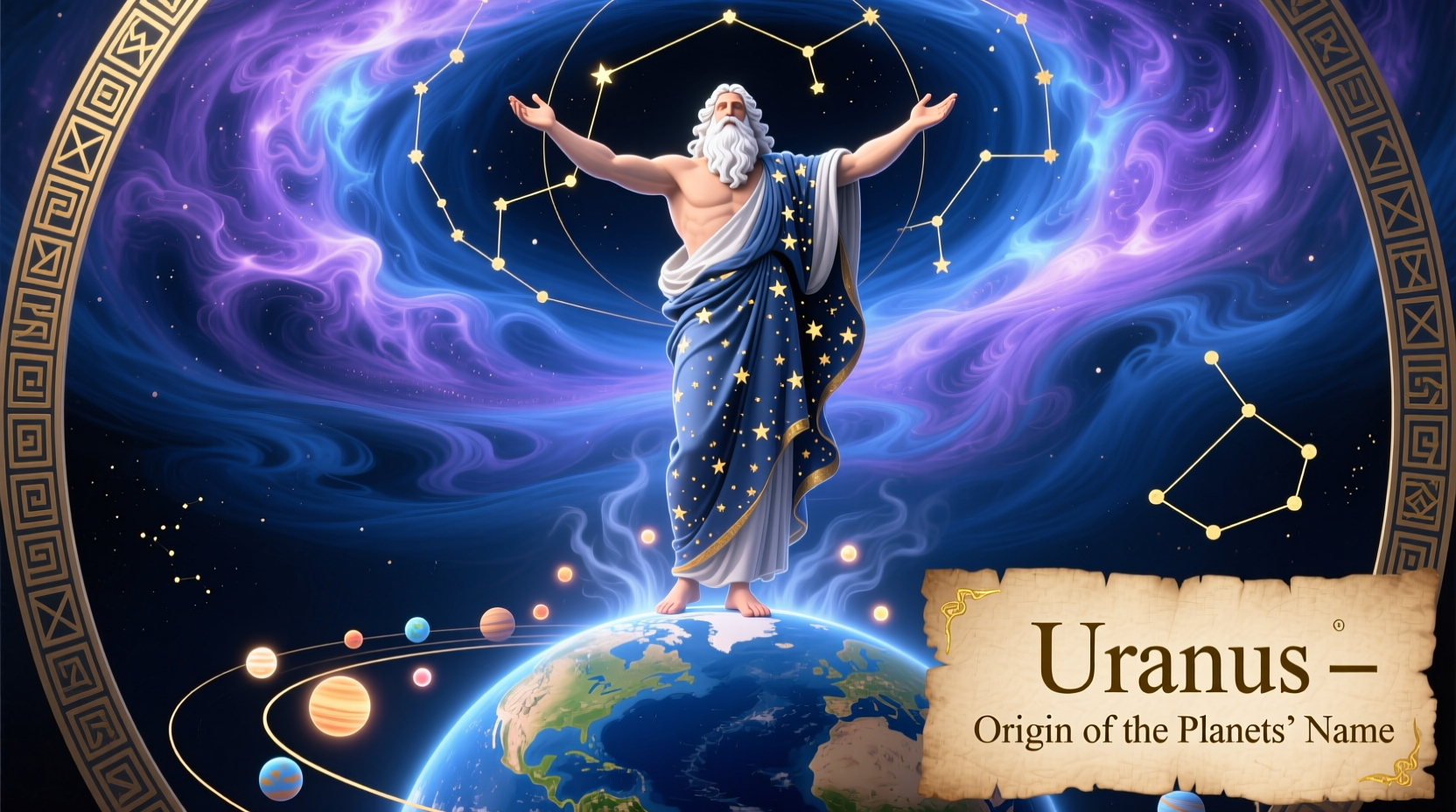
The turning point came in 1782 when Johann Elert Bode, a prominent German astronomer, suggested the name *Uranus*. Bode argued that if Saturn was the father of Jupiter in Roman mythology, then the next planet outward should be named after the grandfather of Jupiter—Uranus, the personification of the sky and one of the primordial deities in Greek cosmology.
Bode’s proposal aligned with existing mythological hierarchy:
- Jupiter = son of Saturn
- Saturn = son of Uranus
- Uranus = primordial sky god
“Naming the new planet Uranus restored the mythological consistency of the solar family tree.” — Dr. Elena Martinez, Historian of Astronomy
Mythological Roots: Who Was Uranus?
To fully appreciate the name, one must understand its mythological foundation. In Greek mythology, Uranus (Ouranos) was the god of the sky and one of the earliest beings in existence. He emerged from Gaia (Earth), who arose spontaneously from Chaos. Uranus and Gaia became lovers and produced the Titans, Cyclopes, and Hecatoncheires (hundred-handed giants).
Despite being a creator god, Uranus was not benevolent. He feared his children and imprisoned them within Gaia, causing her great pain. Eventually, Cronus (Saturn), the youngest Titan, castrated Uranus with a sickle, overthrowing him and beginning the cycle of divine succession that would later include Zeus (Jupiter) dethroning Cronus.
Though Uranus does not appear frequently in myths compared to Zeus or Poseidon, his role as the primal sky god made him a symbolically fitting name for the seventh planet—a distant, cold, and enigmatic world far beyond the familiar realms of the inner solar system.
A Timeline of the Name’s Adoption
The acceptance of \"Uranus\" wasn’t immediate. Here’s how the name gained traction over time:
- 1781: William Herschel discovers the planet and proposes *Georgium Sidus*.
- 1782: Johann Bode suggests *Uranus* to align with mythological tradition.
- 1800s: European astronomers increasingly adopt *Uranus*, while British astronomers continue using *Georgium Sidus*.
- Mid-19th century: International consensus forms around *Uranus* as the standard name.
- 1850s: The British Nautical Almanac officially drops *Georgium Sidus* in favor of *Uranus*.
- 20th century: *Uranus* becomes universally accepted in all major languages, often adapted phonetically (e.g., *Urano* in Spanish, *Ouranos* in modern Greek).
Why Not Herschel or George? A Cultural Perspective
The rejection of *Georgium Sidus* highlights a broader principle in astronomical naming: neutrality and universality. While honoring individuals is common in science (e.g., craters, asteroids, telescopes), planets are considered too significant to be tied to national or political figures. The International Astronomical Union (IAU), founded in 1919, later formalized this idea by establishing strict guidelines for celestial nomenclature.
In contrast, mythological names transcend national boundaries and offer a shared cultural framework. By choosing *Uranus*, astronomers preserved a naming convention that connected the new planet to the same pantheon that gave us Mars (god of war), Venus (goddess of love), and Neptune (god of the sea).
| Name Proposed | Proposer | Reason | Adopted? |
|---|---|---|---|
| Georgium Sidus | William Herschel | Honor King George III | No – limited regional use |
| Herschel | Various astronomers | Honor the discoverer | No – used briefly in some texts |
| Uranus | Johann Bode | Mythological continuity | Yes – globally accepted |
Frequently Asked Questions
Is Uranus pronounced “YOOR-uh-nus” or “yur-IN-us”?
Astronomers typically use “YOOR-uh-nus” (/ˈjʊərənəs/), aligning with Latin and scientific pronunciation. The alternative “yur-IN-us” is sometimes heard in casual conversation but is less accurate in academic contexts.
Why isn’t Uranus named after a Roman god like the others?
It is—indirectly. While Uranus originates from Greek mythology, the Romans adopted many Greek deities under different names. Since no direct Roman equivalent existed for Uranus, astronomers retained the Greek form to maintain clarity and consistency.
Are there any moons of Uranus named after characters from mythology?
Yes. Unlike the moons of Jupiter or Saturn, which often bear Greco-Roman names, Uranus’s moons are named after characters from Shakespearean plays and Alexander Pope’s poetry. For example: Titania, Oberon, Puck, and Miranda—all drawn from literary sources rather than myth.
Conclusion: A Name Born of Science and Story
The name Uranus may seem whimsical to modern ears, especially given common mispronunciations and jokes, but its origin reflects a serious effort to preserve astronomical tradition. It represents a moment when science, culture, and mythology converged to make sense of a newly discovered world.
From Herschel’s royal tribute to Bode’s mythological insight, the naming of Uranus illustrates how scientific discoveries are not made in isolation—they are shaped by history, language, and the human desire to find meaning in the cosmos. Today, Uranus stands not just as a distant ice giant, but as a testament to the enduring power of stories written in the stars.




 浙公网安备
33010002000092号
浙公网安备
33010002000092号 浙B2-20120091-4
Comments
No comments yet. Why don't you start the discussion?