
Many learners of Spanish are surprised when they hear native speakers say “jo” instead of “yo,” especially at the beginning of words like *yo* (I), *yema* (yolk), or *yate* (yacht). It seems as though the letter Y is being replaced by a J sound. This isn’t a mistake—it’s a natural feature of Spanish phonology. Understanding why \"yo\" sounds like \"jo\" unlocks deeper insight into how Spanish is actually spoken, beyond textbook rules.
The phenomenon stems from the evolution of the Spanish language and the way certain consonants interact with vowels. To grasp it fully, we need to explore the historical development of the letter Y, its phonetic behavior, and regional variations across the Spanish-speaking world.
The Origins of the Letter Y in Spanish
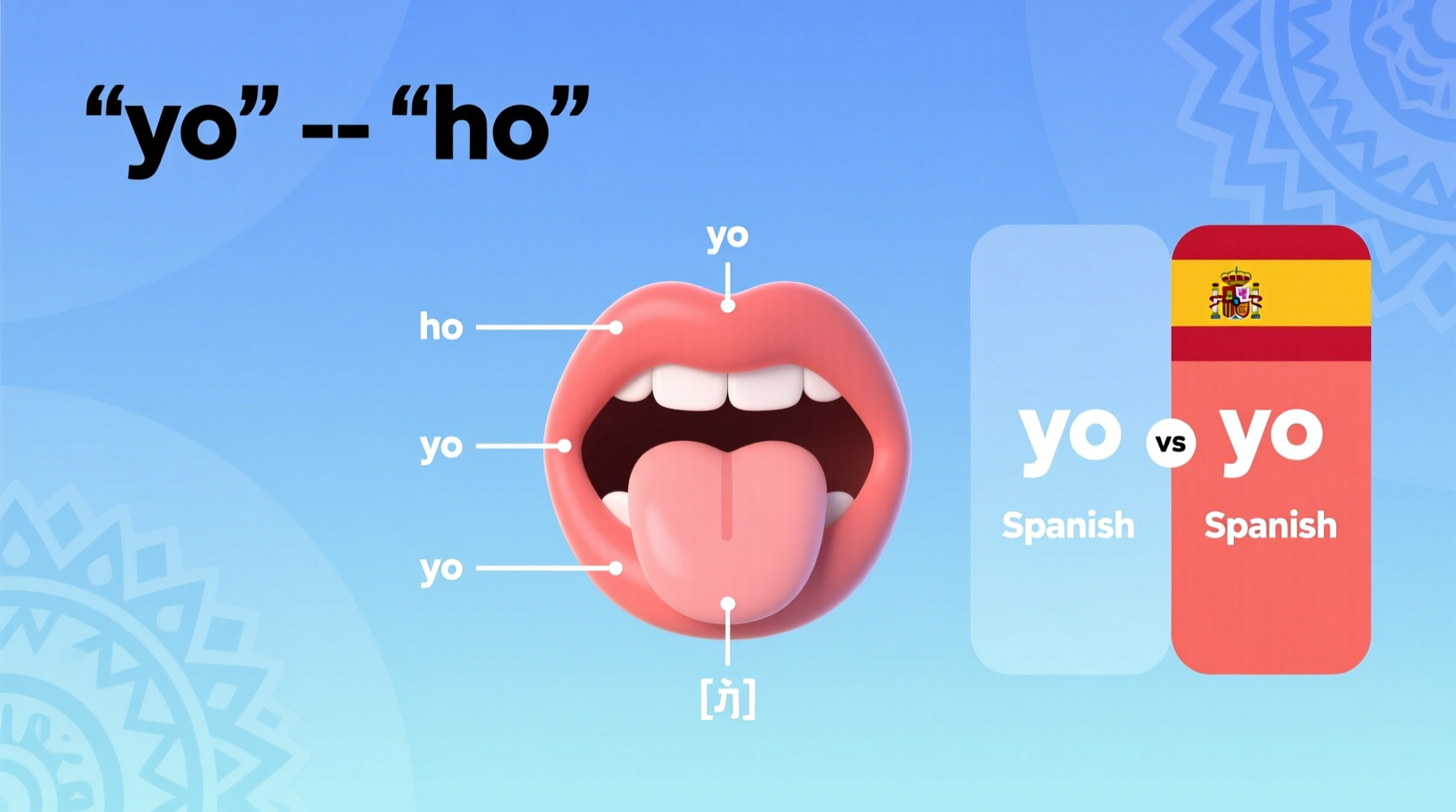
In early forms of Spanish, the letter Y served both as a consonant and a vowel. Historically, it was known as *i griega* (\"Greek I\") because Latin used I for both vowel and consonant sounds, and Spanish adopted Y to distinguish the consonantal use. Over time, the pronunciation of the consonantal Y shifted.
During the Middle Ages, the consonant /ʝ/—a voiced palatal fricative—emerged as the standard sound for Y in most contexts. This sound is similar to the \"y\" in English \"yes,\" but produced with more friction, closer to a soft \"j\" or even a gentle \"sh\" in some dialects. In many regions, particularly in Spain and parts of Latin America, this /ʝ/ sound further evolved into [ʒ] or even [ʃ]—closer to the \"s\" in \"measure\" or the French \"j\" in *je*.
However, in rapid speech or under certain phonological conditions, this palatal fricative can become stronger, approaching a more guttural or affricated sound—perceived by English speakers as \"jo.\"
Phonetic Rules Behind the \"Jo\" Sound
The shift from \"yo\" to \"jo\" is not arbitrary. It follows specific phonetic principles rooted in assimilation and coarticulation—processes where sounds influence each other based on their position in a word or sentence.
When the consonant Y appears before a high front vowel like /o/ or /a/, but especially before stressed /o/ or /e/, the articulation shifts slightly. The tongue moves into a position that anticipates the following vowel, creating a sound that resonates more in the palate and throat. This results in a slight frication—audible friction—that makes the Y sound heavier, almost like the Spanish J, which is pronounced as a voiceless velar fricative [x], similar to the \"ch\" in Scottish \"loch.\"
Yet, crucially, the Y never becomes a true J. What English speakers interpret as \"jo\" is usually an exaggerated perception of the palatal glide becoming a palatal fricative—[ʝ] or [j̞]. In fast, connected speech, this subtle friction can resemble a soft \"j,\" especially to untrained ears.
“The distinction between /j/ and /ʝ/ in Spanish is minimal, but context and speech rate amplify the difference. Learners often mishear palatal frication as velarization.” — Dr. Rafael Mendoza, Linguist, Universidad Complutense de Madrid
Regional Variations in Pronunciation
Spanish is not a monolithic language. The way \"yo\" is pronounced varies significantly across regions, influenced by local accents and historical sound changes.
| Region | Pronunciation of \"yo\" | Notes |
|---|---|---|
| Central Spain (Madrid) | [ʝo] → slightly fricated \"yoh\" | Palatal fricative, may sound close to \"zh\" in rapid speech |
| Andalusia (Southern Spain) | [ɟ͡ʝo] or [jo] | Stronger affrication; closer to \"dyo\" or \"jo\" |
| Mexico & Central America | [jo] or [jwo] | Often diphthongized; perceived as \"jo\" by foreigners |
| Argentina & Uruguay | [ʃo] (\"sho\") | Due to yeísmo with sibilant realization; \"yo\" sounds like \"sho\" |
| Caribbean (Cuba, Puerto Rico) | [jo] or weakened [o] | Y often merges with J or drops entirely in casual speech |
This variation explains why a learner might hear \"jo\" in Mexico City, \"sho\" in Buenos Aires, and nearly \"djo\" in Seville—all spelled the same way: *yo*. The spelling remains consistent, but pronunciation adapts to regional phonetic systems.
Common Misconceptions and Learning Challenges
English speakers often struggle with this because English lacks a direct equivalent to the Spanish palatal fricative. They may either under-pronounce the Y (making it too weak) or overcorrect by using the hard Spanish J sound, which is incorrect and can lead to confusion.
For example, pronouncing *yo como* as \"ho ho-mo\" (using the strong J /x/) changes the word entirely and sounds unnatural. The correct approach lies in producing a smooth, voiced glide with slight friction—never guttural.
- Myth: \"Yo\" is supposed to be pronounced like \"jo\" in all dialects.
- Reality: It depends on region and speech style. In many areas, it's closer to \"yoh\" with a soft buzz.
- Myth: The letter Y always sounds like J.
- Reality: Only in specific dialects and contexts does it approach that sound. Most often, it's a palatal approximant or fricative.
How to Master the \"Yo\" vs. \"Jo\" Pronunciation: A Step-by-Step Guide
Becoming comfortable with this sound requires practice and listening. Follow these steps to develop accurate pronunciation:
- Listen to native speakers from various regions. Pay attention to how they say \"yo,\" \"ayer,\" and \"yema.\" Use platforms like YouTube, podcasts, or language apps with native audio.
- Practice the palatal glide. Start by saying \"yes\" in English, but make the \"y\" longer and add slight friction—like a whisper behind the teeth.
- Compare minimal pairs: Practice saying *yo* [ʝo] vs. *jo* [xo]. Record yourself and compare with native examples.
- Use tongue positioning: Place the middle of your tongue close to the hard palate without touching it. Vibrate your vocal cords gently—this creates the [j] or [ʝ] sound.
- Speak slowly first, then increase speed. In rapid speech, the friction increases naturally—don’t force it.
Frequently Asked Questions
Is it correct to pronounce \"yo\" as \"jo\"?
It depends on the dialect. In many regions, especially in Latin America, the pronunciation may sound like \"jo\" due to affrication or diphthongization. However, it’s not a true J (/x/) sound. If you’re aiming for standard Peninsular or Latin American pronunciation, aim for a soft, palatal [ʝo], not the harsh J used in words like *jamón*.
Why do some Spanish speakers say \"sho\" instead of \"yo\"?
This occurs primarily in Argentina, Uruguay, and parts of Central America due to a linguistic feature called yeísmo con distinción sibilante. Here, the consonants Y and LL merge into a sibilant sound [ʃ], similar to \"sh\" in English. So *yo* becomes \"sho\" and *llamar* sounds like \"shamar.\"
Does spelling reflect pronunciation in this case?
No. Spanish spelling is largely conservative and doesn't change with pronunciation shifts. Even though \"yo\" may sound like \"jo\" or \"sho,\" it’s still spelled with a Y. This consistency helps maintain mutual intelligibility across dialects.
Real Example: Maria’s Experience Learning Spanish in Mexico City
Maria, an American student learning Spanish in Mexico City, kept being corrected when she said \"yo quiero.\" She pronounced it clearly as \"yo,\" like in English \"yoga.\" Her teacher smiled and asked her to listen closely: “Now say it faster—‘wanna’ but with ‘yo.’” After several attempts, Maria noticed that in rapid speech, her tongue naturally raised, creating a slight \"w\"-like glide followed by friction—sounding like \"jo.\" Her classmates confirmed they heard the difference. Within days, her \"yo\" began sounding natural, blending seamlessly into conversation.
This small adjustment didn’t just fix one word—it improved her overall fluency. Words like *yunque*, *yate*, and *yugo* started flowing better, and native speakers responded more positively to her accent.
Conclusion: Embrace the Nuance
The reason \"yo\" often sounds like \"jo\" in Spanish is not an error—it’s a reflection of natural speech patterns, regional diversity, and centuries of linguistic evolution. By understanding the phonetic mechanisms behind this shift, learners move beyond robotic repetition and begin speaking with authenticity.
Mastery comes not from imitating a single \"correct\" version, but from recognizing variation and adapting intelligently. Whether you're conversing in Madrid, Bogotá, or Buenos Aires, awareness of these subtleties builds confidence and connection.




 浙公网安备
33010002000092号
浙公网安备
33010002000092号 浙B2-20120091-4
Comments
No comments yet. Why don't you start the discussion?