
The \"why is you here\" meme stands as one of the most delightfully awkward and linguistically jarring cornerstones of early 2010s internet humor. At first glance, it appears grammatically incorrect, intentionally so—its charm lies in that very imperfection. The phrase, often paired with a confused or confrontational image, captures a moment of blunt social interrogation: not just “why are you here?” but “why *is* you here?”—a grammatical trainwreck turned comedic gold. Its rise reflects broader trends in online culture: absurdism, linguistic play, and the celebration of unintentional comedy.
Beyond surface-level silliness, the meme reveals how digital communities reshape language for humor, irony, and emotional resonance. From its murky beginnings on image boards to mainstream adoption by celebrities and brands, \"why is you here\" has evolved into a cultural shorthand for discomfort, surprise, and existential questioning—all wrapped in broken grammar.
Origins: Chaos, Miscommunication, and Image Board Culture
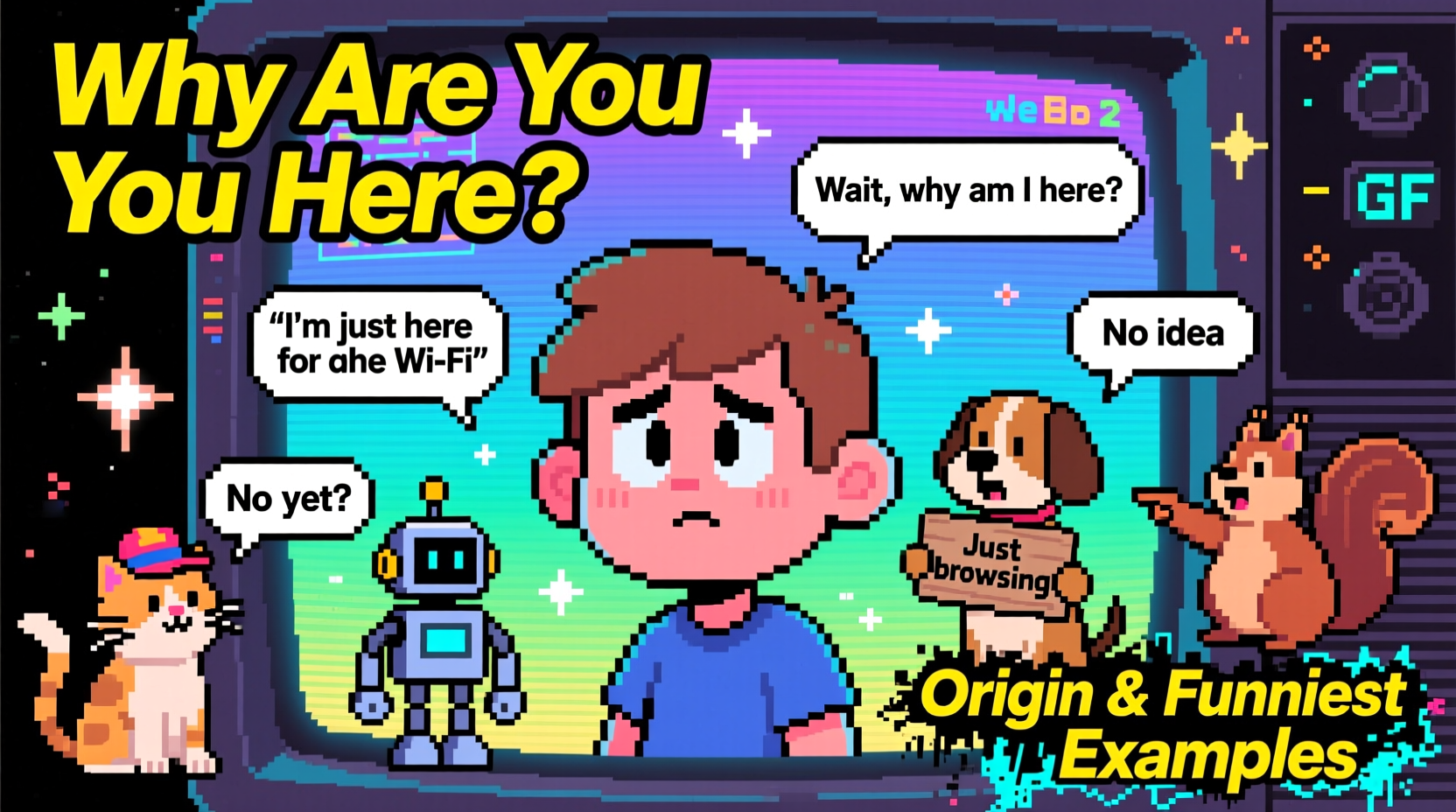
The earliest known appearances of \"why is you here\" trace back to anonymous imageboards like 4chan around the late 2000s and early 2010s. These platforms thrived on surreal humor, where memes were born not from polished wit but from accidental phrasing, misspellings, and miscommunications. In this environment, grammatical errors weren’t corrected—they were celebrated.
One of the first documented uses comes from a screenshot of a poorly translated instant message conversation. A user, likely non-native in English, wrote: “Why is you here?” instead of “Why are you here?” The post was shared on /b/, 4chan’s random board, with the caption “This person do be confused.” The juxtaposition of serious intent and comically incorrect grammar struck a chord. It wasn’t mockery in a cruel sense—it was appreciation for the poetic wrongness of it.
From there, the phrase was isolated and repurposed. Users began pairing it with stock photos of stern-looking individuals, wide-eyed animals, or characters caught mid-confusion. The image-text contrast amplified the humor: someone asking a profound question using flawed syntax, turning confrontation into absurdity.
Linguistic Appeal: Why Bad Grammar Works Online
The staying power of \"why is you here\" isn't just about randomness—it taps into deeper patterns of internet communication. Linguists studying digital discourse have noted that non-standard English forms (like “is you” instead of “are you”) carry expressive weight. They signal informality, emotion, or intentional deviation from norms.
In African American Vernacular English (AAVE), constructions like “he don’t” or “they be working” follow consistent grammatical rules distinct from Standard American English. While \"why is you here\" doesn’t align precisely with AAVE syntax, its misuse borrows aesthetic elements from dialects often marginalized in formal writing. This raises ethical questions: when does playful imitation become appropriation?
“Internet memes often flatten complex linguistic diversity into punchlines. We laugh at ‘errors,’ but those ‘errors’ may reflect legitimate dialects.” — Dr. Lena Torres, Sociolinguist at UC Berkeley
Yet, within meme culture, the phrase transcended its roots. It became less about mocking language and more about capturing a universal feeling: the shock of encountering someone—or something—in an unexpected place. Whether it's your cousin showing up uninvited to a work meeting or a raccoon inside a vending machine, “why is you here” fits.
Evolution and Mainstream Usage
By the mid-2010s, \"why is you here\" had escaped niche forums. It appeared in Reddit threads, Twitter captions, and even Instagram stories. Its format remained consistent: bold white Impact font over a centered image, usually featuring a person or animal looking suspiciously at the viewer.
Notable adaptations include:
- Corporate Use: Brands like Wendy’s and MoonPie used variations in social media replies, leveraging the meme’s confrontational tone for humorous clapbacks.
- Fandom Crossovers: Fans inserted the phrase into movie stills—Dumbledore staring at Harry Potter, or Thanos pausing mid-snap to ask a bystander, “why is you here?”
- Political Remixes: During election seasons, the meme resurfaced with politicians peering over podiums, questioning constituents or rivals with deadpan intensity.
The meme also inspired spin-offs such as “how did you get in here,” “who let you in,” and “what you doing,” all sharing the same spirit of blunt, socially awkward inquiry.
Timeline of Key Moments in the Meme’s History
- 2009–2011: Emerges on 4chan via miswritten chat logs.
- 2012: Gains traction on Reddit’s r/funny and Know Your Meme archives it.
- 2015: Appears in YouTube compilations of “worst grammar ever” videos.
- 2017: Adopted by fast-food brands for sassy social media responses.
- 2020: Resurfaces during pandemic lockdowns—images of cats staring at people working from home, captioned “why is you here.”
- 2023: Referenced in a Saturday Night Live sketch about AI assistants.
The Funniest Examples That Broke the Internet
Some iterations of the meme achieved legendary status due to perfect timing, visual irony, or sheer unpredictability. Here are three standout examples:
1. The Office – Dwight Schrute Edition
A still of Rainn Wilson as Dwight Schrute, squinting intensely at the camera, overlaid with “WHY IS YOU HERE.” The image resonates because Dwight is already prone to authoritarian suspicion. Adding grammatically incorrect English amplifies his oddness while making him oddly relatable when confronting intruders in his beet farm.
2. Cat in a Suitcase
A viral photo shows a tabby cat sitting deep inside a packed suitcase, eyes wide, as if it has been there for hours. Caption: “WHY IS YOU HERE.” The absurdity of a cat choosing luggage over furniture, combined with the accusatory text, made this version a favorite on Tumblr and Pinterest.
3. Elon Musk at a Dogecoin Conference
A cropped image of Musk mid-speech, pointing offstage with a puzzled expression. The caption “WHY IS YOU HERE” plays on his reputation for erratic public appearances and cryptic tweets. It circulated widely during crypto volatility spikes, symbolizing collective bewilderment.
| Meme Example | Context | Why It Went Viral |
|---|---|---|
| Dwight Schrute | The Office reruns + meme templates | Character already embodies rigid authority; flawed grammar adds satire |
| Cat in Suitcase | Pet humor + relatable pet antics | Visual absurdity meets existential pet mystery |
| Elon Musk Pointing | Crypto culture + celebrity scrutiny | Captures public confusion about tech leaders’ motives |
How to Use the Meme Responsibly and Creatively
While \"why is you here\" is undeniably funny, its use requires awareness. Because it mimics non-standard English, deploying it carelessly can perpetuate stereotypes about intelligence or education based on speech patterns. To avoid crossing the line from humor to harm:
- Use it in clearly absurd contexts, not to mock real people’s language.
- Avoid pairing it with images of marginalized individuals.
- Prefer self-deprecating or situational humor (e.g., yourself in pajamas at a Zoom meeting).
Checklist: Creating Your Own “Why Is You Here” Meme
- Choose an image with a clear focal subject appearing surprised, annoyed, or suspicious.
- Ensure high contrast so white text will stand out.
- Center the phrase “WHY IS YOU HERE” in bold, uppercase Impact font.
- Keep background noise minimal—focus on facial expressions.
- Test it: Does it make someone chuckle without needing explanation?
Frequently Asked Questions
Is “why is you here” grammatically correct?
No, in Standard English, it should be “why are you here.” However, the humor stems precisely from the incorrect grammar. It’s not meant to be correct—it’s meant to be memorable.
Can I use this meme in professional settings?
Sparingly, and only in informal internal communications. For example, a team lead might send a lighthearted Slack message with a GIF of a meerkat saying “why is you here” before a surprise meeting. Avoid client-facing or formal presentations.
Has the meme been used outside English-speaking countries?
Yes. Translations exist in Spanish (“¿Por qué es tú aquí?”), French (“Pourquoi est tu ici?”), and Japanese (using katakana to mimic broken English pronunciation). These versions often double down on the absurdity, highlighting cross-cultural misunderstandings.
Conclusion: The Enduring Power of Awkward Questions
The “why is you here” meme endures because it speaks to a fundamental human experience: encountering the unexpected. Whether it’s an uninvited guest, a glitch in the matrix, or simply seeing yourself in the mirror after three all-nighters, we’ve all wanted to ask that question—even if our grammar slips in the process.
More than a joke, it’s a linguistic artifact of internet culture’s love for chaos, creativity, and communal laughter. As long as people show up where they’re not supposed to, this meme will find new life.




 浙公网安备
33010002000092号
浙公网安备
33010002000092号 浙B2-20120091-4
Comments
No comments yet. Why don't you start the discussion?