
American Express is often seen as a premium credit card brand—synonymous with exclusivity, rewards, and elite customer service. Yet despite its reputation, many consumers find themselves in awkward situations when their Amex card is declined at restaurants, small shops, or even online retailers. Why, in a country where credit cards are ubiquitous, does American Express still face limited acceptance? The answer lies in a mix of economic, structural, and strategic factors that shape how merchants decide which payment networks to support.
The Interchange Fee Problem: Cost to Merchants
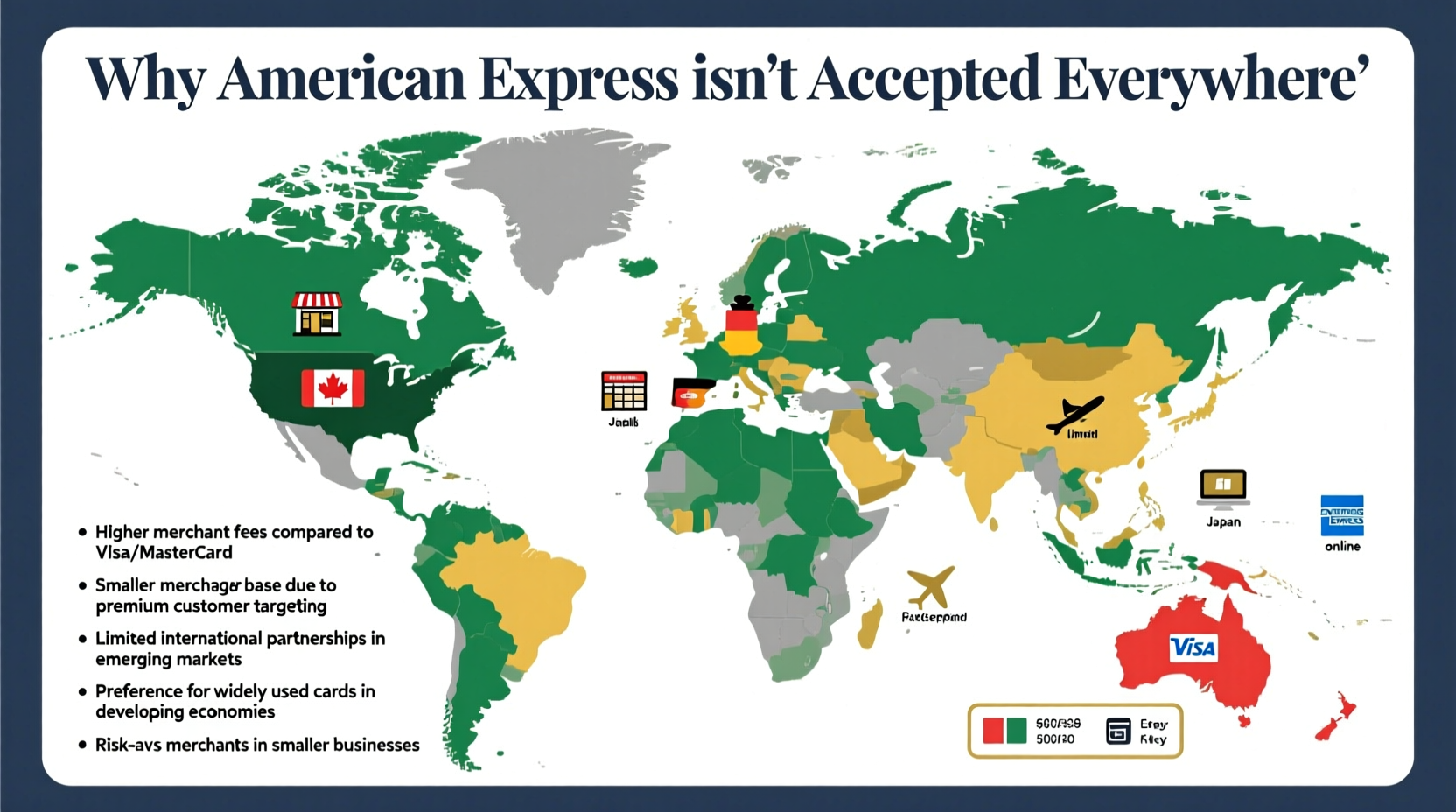
At the heart of Amex’s limited acceptance is the issue of interchange fees—the charges merchants pay every time a customer uses a credit card. While Visa, Mastercard, and Discover all operate on an \"open-loop\" system where issuing banks and networks share revenue and risk, American Express runs a \"closed-loop\" model. This means Amex issues the card, processes the transaction, and assumes the credit risk—all while charging significantly higher fees to merchants.
On average, American Express interchange fees range from 2.5% to 3.5% per transaction, sometimes exceeding 4% for certain industries like travel or luxury goods. In contrast, Visa and Mastercard typically charge between 1.5% and 2.5%. For a small business processing $500,000 in annual sales, accepting Amex could mean paying up to $17,500 more in fees compared to other networks.
Merchant Control and Network Policies
Unlike Visa and Mastercard, American Express has historically maintained strict control over pricing and network participation. Merchants cannot freely choose to accept only certain Amex products—they must take all or none. This lack of flexibility frustrates business owners who might welcome high-spending customers but object to blanket fee structures.
In recent years, Amex introduced the OptBlue program aimed at small businesses, aligning its pricing more closely with Visa and Mastercard rates. However, adoption remains inconsistent, and many small retailers still view Amex as financially burdensome. Moreover, unlike other networks, Amex does not allow surcharging in most states, meaning merchants can’t pass the cost directly to the cardholder—a missed opportunity for cost recovery.
“American Express delivers high-value customers, but the cost structure makes it hard for thin-margin businesses to justify acceptance.” — Linda Chavez, Retail Industry Analyst at PayTech Insights
Comparison of Major Card Networks’ Merchant Fees
| Card Network | Average Interchange Rate | Surcharging Allowed? | Network Type | Typical Merchant Adoption |
|---|---|---|---|---|
| Visa | 1.5% – 2.5% | Yes (with restrictions) | Open-loop | Widespread |
| Mastercard | 1.5% – 2.6% | Yes (with restrictions) | Open-loop | Widespread |
| Discover | 1.5% – 2.5% | Yes | Open-loop | Moderate |
| American Express | 2.5% – 4.0%+ | No (in most cases) | Closed-loop | Selective |
Market Positioning and Consumer Behavior
American Express has long cultivated an image of exclusivity. Its marketing emphasizes premium travel benefits, concierge services, and elite status—appealing to affluent, high-spending consumers. While this strategy strengthens brand loyalty among cardholders, it also reinforces a perception among merchants that Amex users are fewer in number and concentrated in urban or upscale markets.
This creates a feedback loop: smaller or rural businesses see fewer Amex transactions, so they’re less inclined to absorb the higher costs. As a result, Amex becomes less useful in those areas, discouraging potential applicants outside major metropolitan centers. According to Federal Reserve data, Amex holds about 27% of U.S. credit card spending volume but only around 9% of total cards in circulation—indicating higher per-card spending but lower overall reach.
Real Example: A Local Restaurant’s Dilemma
Consider “Maria’s Bistro,” a family-owned Italian restaurant in Cleveland, Ohio. With tight profit margins and monthly card processing volumes under $30,000, the owner, Maria Lopez, evaluated whether to renew her Amex acceptance. After reviewing her statements, she found that only 4% of her transactions came from Amex—but those same transactions accounted for 12% of her total processing fees. She decided to drop Amex, posting a small sign at checkout: “Now Accepting Visa, Mastercard, and Discover.” Within weeks, several regulars expressed disappointment, but her net profits improved by nearly $400 per month. For Maria, the math was clear—even if it meant losing some prestige.
Strategies for Amex Holders: Maximizing Usability
If you carry an American Express card, especially one with annual fees and rich rewards, you need to be strategic about where and how you use it. Here’s how to avoid embarrassment and make the most of your card:
- Check merchant websites in advance: Many restaurants and retailers list accepted payment methods online.
- Use Amex Serve or digital wallets: Some merchants accept Apple Pay or Google Pay linked to Amex, even if they don’t display the Amex logo.
- Carry a backup card: Always have a Visa or Mastercard available, particularly at gas stations, convenience stores, or budget hotels.
- Leverage the Amex Offers portal: Use targeted discounts at participating merchants to boost value where Amex is accepted.
- Ask politely: In small businesses, staff may occasionally process Amex manually if the terminal supports it, even if it's not advertised.
Future Outlook: Can Amex Expand Acceptance?
American Express has made strides in improving merchant relations. Beyond OptBlue, the company has invested heavily in integrated payment platforms like Express Checkout and partnerships with major e-commerce providers such as Shopify and Square. These integrations reduce friction for online sellers and increase automatic acceptance.
Additionally, co-branded cards issued through large retailers—like Amazon, Costco, or Hilton—have helped Amex gain ground in specific ecosystems. The Costco Anywhere Visa, for example, replaced the Amex partnership in 2016, but Amex regained partial traction through exclusive member offers and digital promotions.
Still, systemic change requires either lower fees, greater merchant flexibility, or broader consumer demand. Until then, widespread parity with Visa and Mastercard remains unlikely.
Frequently Asked Questions
Why do some gas stations not accept American Express?
Gas stations operate on very thin margins and face high fraud risks with fuel purchases. The combination of Amex’s higher transaction fees and slower authorization times makes it less appealing. Additionally, some older pumps aren’t programmed to handle Amex’s network protocols.
Can a merchant refuse American Express but accept other cards?
Yes. Unlike debit cards (regulated under the Durbin Amendment), merchants have full discretion over which credit networks they accept. There is no federal requirement to accept any specific credit card brand.
Does American Express pay merchants to accept their cards?
Not directly. However, Amex occasionally runs incentive programs for small businesses to join the network, offering discounted rates for the first six months or waived setup fees through partnered processors.
Final Thoughts: Navigating the Payment Landscape
American Express offers undeniable benefits—superior rewards, strong fraud protection, and premium services. But its closed-loop model and pricing structure create real-world limitations. Understanding why Amex isn’t accepted everywhere empowers both consumers and merchants to make smarter financial decisions.
If you value the perks, continue using your Amex where it counts: at airlines, hotels, and high-end retailers. But recognize that true payment flexibility comes from having multiple options in your wallet. For merchants, weigh the cost against customer demographics—sometimes the prestige of accepting Amex outweighs the fees, especially in competitive markets.




 浙公网安备
33010002000092号
浙公网安备
33010002000092号 浙B2-20120091-4
Comments
No comments yet. Why don't you start the discussion?