
The four canonical Gospels—Matthew, Mark, Luke, and John—are foundational to Christian theology. Yet among them, John stands apart. While Matthew, Mark, and Luke are grouped as the “Synoptic Gospels” due to their similar structure, language, and narrative sequence, John diverges significantly in tone, content, and theological emphasis. This divergence raises a critical question: Why isn’t John considered synoptic? More importantly, what does this distinction reveal about its purpose and message?
The answer lies not in deficiency but in deliberate design. John’s Gospel was never intended to mirror the Synoptics. Instead, it offers a deeper, more reflective portrait of Jesus—one centered on divine identity, spiritual truth, and eternal life. Understanding this distinction is essential for anyone seeking a fuller grasp of the New Testament’s portrayal of Christ.
The Synoptic Gospels: A Shared Framework
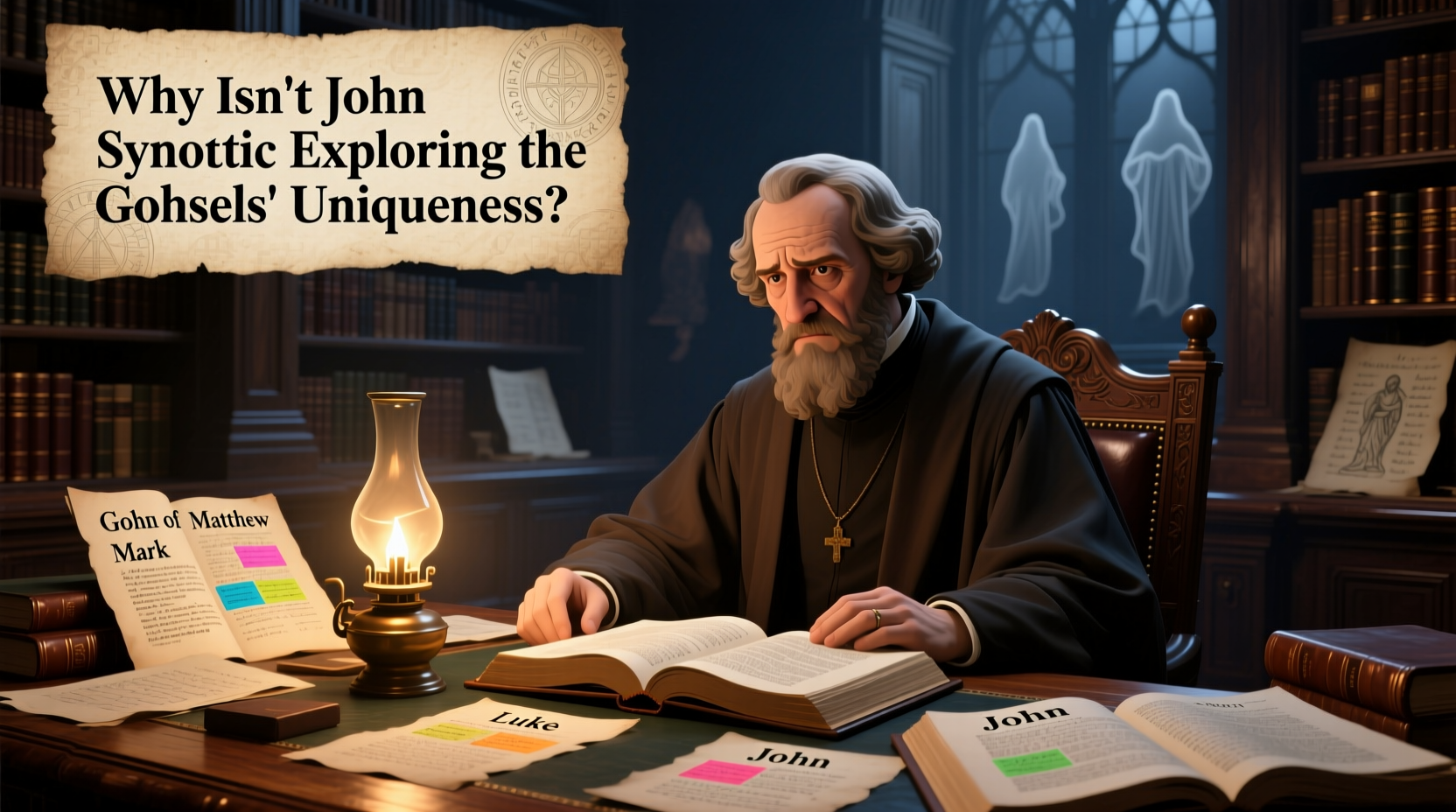
The term “synoptic” comes from the Greek *synopsis*, meaning “seen together.” Matthew, Mark, and Luke share enough parallel content, wording, and sequence that they can be studied side by side. Scholars estimate that over 90% of Mark’s content appears in both Matthew and Luke, and much of the triple tradition follows nearly identical phrasing.
This similarity has led to extensive scholarly debate about the “Synoptic Problem”—the question of literary dependence among the three. Most scholars accept the Two-Source Hypothesis, which posits that Mark was written first, and both Matthew and Luke used Mark and a hypothetical sayings source called “Q” to compose their accounts.
The Synoptics focus on Jesus’ earthly ministry: his parables, miracles, exorcisms, ethical teachings, and journey toward Jerusalem. They emphasize the Kingdom of God, social justice, and discipleship in practical terms. Their narratives unfold with a sense of immediacy and historical progression.
John’s Unique Narrative Architecture
In contrast, John’s Gospel operates on a different plane. It omits entire elements found in the Synoptics: no infancy narratives, no exorcisms, no institution of the Lord’s Supper, and only one parable (if any). Instead, John presents extended discourses, symbolic miracles (called “signs”), and a highly developed Christology.
Where the Synoptics move toward Jerusalem gradually, John structures Jesus’ ministry around multiple visits to Jerusalem, suggesting a longer public ministry—possibly three Passovers. This timeline allows for deeper theological reflection at each stage.
John’s miracles are not just acts of compassion but signs pointing to Jesus’ divine nature. The turning of water into wine at Cana (John 2:1–11) is labeled explicitly as “the first of his signs.” Similarly, the raising of Lazarus (John 11) serves as the climactic sign preceding Jesus’ passion, underscoring his claim: “I am the resurrection and the life.”
“He who sees me sees the one who sent me.” — Jesus, John 12:45
Key Differences Between John and the Synoptics
| Aspect | Synoptic Gospels | Gospel of John |
|---|---|---|
| Miracles | Healings, exorcisms, nature miracles | Seven \"signs\" with symbolic meaning (e.g., feeding 5,000, walking on water) |
| Jesus’ Speeches | Parables, short teachings, kingdom ethics | Extended discourses (e.g., Bread of Life, I Am statements) |
| Chronology | One Passover (final week) | Three or more Passovers indicated |
| Temple Cleansing | Occurs near the end of Jesus' ministry (final week) | Occurs early (John 2:13–22) |
| Christology | Jesus as Messiah, Son of Man, teacher | Jesus as pre-existent Word, Son of God, divine embodiment |
| Last Supper | Presented as a Passover meal | No explicit mention; foot washing replaces Eucharistic institution |
Theological Depth and Purpose in John
John’s Gospel is deeply theological from its opening verses. The Prologue (John 1:1–18) echoes Genesis while declaring the incarnation: “The Word became flesh and dwelt among us.” This high Christology is absent in the Synoptics, where Jesus’ divinity unfolds gradually through events like the Transfiguration or Peter’s confession.
John emphasizes belief as a central theme. The author states his purpose clearly: “These are written so that you may believe that Jesus is the Messiah, the Son of God, and that by believing you may have life in his name” (John 20:31). This evangelistic aim shapes the entire narrative, selecting and arranging material to provoke faith.
Unlike the Synoptics, which often veil Jesus’ identity (the so-called “Messianic Secret”), John removes the veil early. Jesus openly declares, “Before Abraham was, I am” (John 8:58), invoking the divine name revealed to Moses. Such claims provoke conflict with Jewish leaders throughout the Gospel, framing opposition as a spiritual battle between light and darkness.
A Mini Case Study: The Healing at Bethesda
Consider the healing of the paralytic at the pool of Bethesda (John 5:1–15). In the Synoptics, such miracles typically evoke awe and immediate response. But in John, the miracle becomes a springboard for a profound theological confrontation.
Jesus heals on the Sabbath, prompting religious authorities to accuse him of breaking the law. Rather than defend himself, Jesus escalates: “My Father is always at his work to this very day, and I too am working” (John 5:17). He then asserts equality with God: “The Son can do nothing by himself; he can do only what he sees his Father doing” (John 5:19).
This exchange illustrates John’s method: a miracle leads directly to discourse, revealing Jesus’ divine authority and relationship with the Father. The narrative is less about the healed man and more about who Jesus is.
Why John Isn’t Synoptic—And Why That Matters
John wasn’t trying to write a fourth version of the same story. He likely knew the Synoptic tradition but chose a complementary path. Early church father Clement of Alexandria noted that John wrote “a spiritual Gospel” after the others had recorded the “external facts.”
“John, perceiving that the bodily facts had been set forth in the Gospels, was urged on by his disciples and, inspired by the Spirit, composed a spiritual Gospel.” — Clement of Alexandria, quoted in Eusebius, Ecclesiastical History
This spiritual dimension transforms how readers encounter Jesus. John invites contemplation rather than mere observation. His use of symbolism—light, water, bread, vine—draws believers into a mystical union with Christ.
Moreover, John’s delayed composition (likely late 1st century) allowed time for theological reflection within the early Church. By then, debates about Jesus’ nature were emerging. John’s Gospel served not only to proclaim but also to defend the full divinity of Christ against early forms of proto-Gnosticism and Jewish rejection.
Checklist: How to Engage with John’s Uniqueness
- Read John alongside a Synoptic Gospel to observe contrasts in tone and content.
- Identify and reflect on the seven “I Am” statements in John.
- Trace the theme of belief/unbelief throughout the narrative.
- Notice how Jesus’ miracles are labeled “signs” and what they reveal.
- Study the Prologue (John 1:1–18) as a theological foundation for the entire book.
- Pay attention to irony and double meanings in conversations (e.g., Nicodemus, Samaritan woman).
- Consider the role of eyewitness testimony (“the disciple whom Jesus loved”).
Frequently Asked Questions
Did John know the Synoptic Gospels?
Most scholars believe John was aware of the general tradition behind the Synoptics, though he may not have had direct access to the written texts. His omission of certain Synoptic material appears intentional, not accidental.
Is John less historically reliable because it’s so different?
Difference does not imply inaccuracy. John’s reliability lies in theological truth and eyewitness perspective. Archaeological and linguistic evidence supports many of John’s details, such as the existence of the Pool of Bethesda and accurate topography of Jerusalem.
Can we harmonize John with the Synoptics?
Partial harmonization is possible, especially regarding chronology and geography. However, forcing complete alignment risks flattening John’s distinct voice. Better to appreciate each Gospel as a unique witness to Christ.
Conclusion: Embracing the Full Portrait of Christ
The absence of John from the Synoptic category is not a flaw—it’s a feature. The Gospel’s uniqueness enriches the biblical witness, offering a transcendent vision of Jesus as the eternal Word made flesh. While the Synoptics ground us in the historical and ethical dimensions of Jesus’ mission, John lifts our gaze to the divine mystery at its heart.
To fully understand Jesus, we need both the compassionate teacher of the Sermon on the Mount and the self-revealing Son who says, “Anyone who has seen me has seen the Father.”




 浙公网安备
33010002000092号
浙公网安备
33010002000092号 浙B2-20120091-4
Comments
No comments yet. Why don't you start the discussion?