
Understanding how you learn best isn't just a classroom convenience—it's a fundamental key to unlocking your full potential. Whether you're mastering a new language, preparing for a certification, or advancing in your career, aligning your study methods with your natural learning preferences can dramatically improve retention, motivation, and performance. Despite its impact, many adults navigate education and professional development without ever assessing how they absorb information most effectively. Recognizing your learning style is not about labeling yourself; it’s about empowering your mind with strategies that work *with* your brain, not against it.
The Science Behind Learning Styles
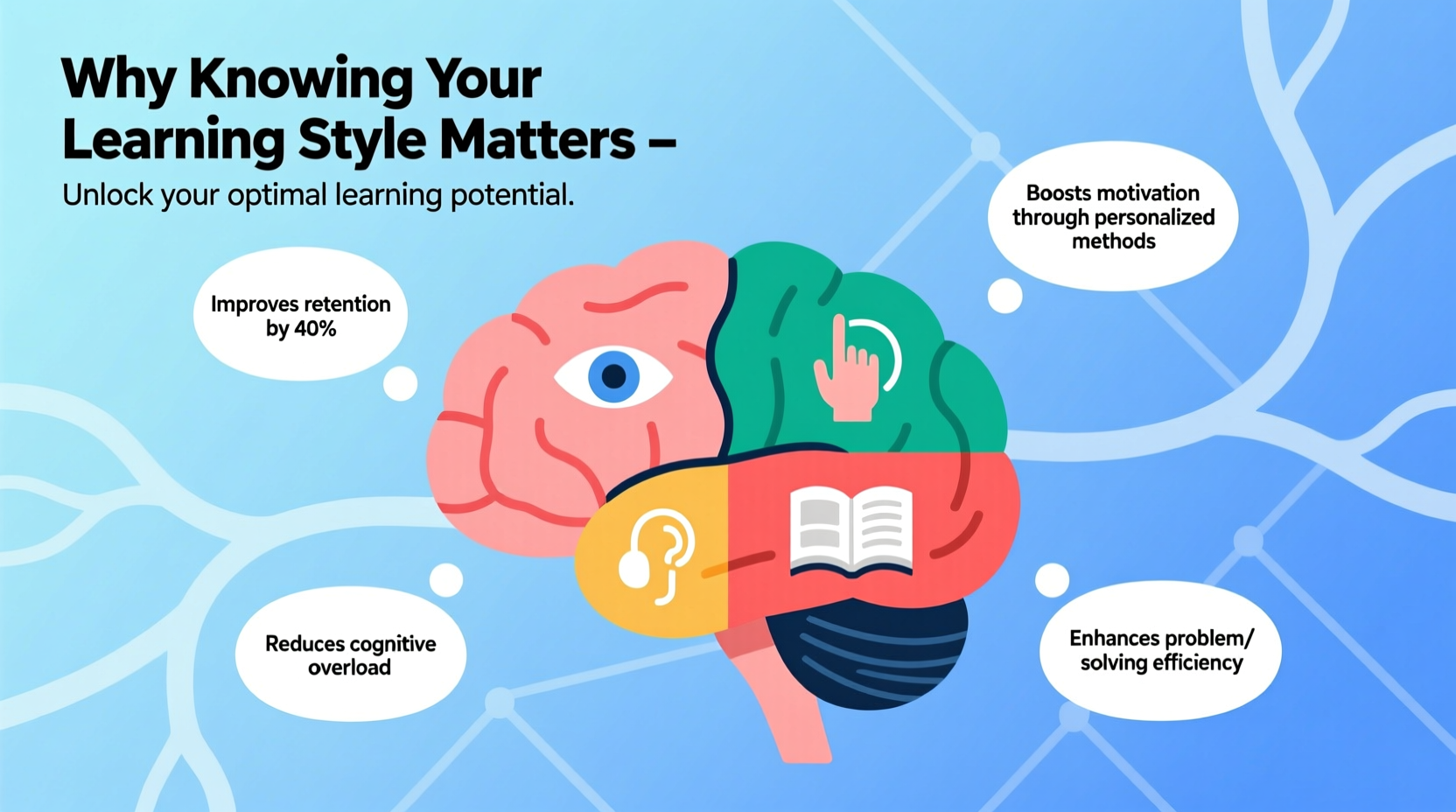
Learning styles refer to the consistent ways individuals perceive, process, store, and recall information. While the concept has evolved over decades, one of the most widely recognized models is the VARK framework—Visual, Auditory, Reading/Writing, and Kinesthetic—developed by educational researcher Neil D. Fleming. Each category reflects a different sensory channel through which people prefer to receive and engage with knowledge.
Neuroscience supports the idea that different regions of the brain activate depending on the mode of input. For example, visual learners show increased activity in the occipital lobe when processing diagrams, while auditory learners rely more heavily on the temporal lobes during listening tasks. Though critics argue that rigid categorization may oversimplify cognitive diversity, research consistently shows that matching teaching methods to individual preferences enhances comprehension and engagement.
“Tailoring instruction to how students learn best doesn’t lower standards—it raises achievement.” — Dr. Linda Silverman, Director, Gifted Development Center
Four Primary Learning Styles and Their Traits
While most people use a combination of learning modalities, one or two typically dominate. Understanding these core styles helps identify effective strategies for studying, training, and problem-solving.
| Learning Style | Key Characteristics | Effective Techniques |
|---|---|---|
| Visual | Learns through images, diagrams, colors, maps, and spatial organization. Remembers what they see rather than hear. | Mind maps, charts, color-coded notes, infographics, video tutorials. |
| Auditory | Processes information best through listening. Benefits from discussions, lectures, and verbal repetition. | Recorded lectures, group discussions, mnemonic rhymes, reading aloud. |
| Reading/Writing | Thrives on text-based input and output. Prefers written instructions, lists, and taking detailed notes. | Note-taking, rewriting concepts, reading textbooks, writing summaries. |
| Kinesthetic | Learns by doing. Needs movement, hands-on practice, and real-world application to grasp ideas. | Role-playing, lab experiments, building models, using physical flashcards. |
Real-World Impact: A Case Study
Consider Maria, a junior software developer struggling to master backend frameworks through online video courses and documentation. Despite long hours, she retained little. After taking a learning style assessment, she discovered she was strongly kinesthetic. She shifted her approach: instead of passively watching tutorials, she began building small projects immediately, debugging live code, and using tactile coding exercises on interactive platforms.
Within six weeks, her confidence and competence surged. Her team lead noted faster problem-solving and clearer communication during stand-ups. By aligning her method with her learning preference, Maria reduced frustration and accelerated skill acquisition—without increasing study time.
Benefits of Knowing Your Learning Style
The advantages extend far beyond academic success. Here are five tangible benefits:
- Improved Retention: Information presented in your preferred format is encoded more deeply into long-term memory.
- Efficient Study Time: You spend less time re-reading or re-watching because comprehension happens faster.
- Increased Motivation: When learning feels intuitive, you’re more likely to stay engaged and persistent.
- Better Communication: Understanding your style helps you explain ideas to others more clearly—or adapt when teaching different types of learners.
- Career Advancement: Professionals who optimize their learning gain skills quicker, making them more agile and valuable in fast-changing industries.
Do’s and Don’ts Based on Learning Style
| Style | Do | Don’t |
|---|---|---|
| Visual | Use color coding, sketch ideas, watch explainer videos | Rely solely on audio lectures or dense text blocks |
| Auditory | Explain concepts aloud, join study groups, use podcasts | Sit in silent environments for long periods without verbal processing |
| Reading/Writing | Take detailed notes, rewrite lessons, annotate texts | Expect to learn well from demonstrations alone |
| Kinesthetic | Use physical objects, walk while memorizing, apply concepts in real-time | Stay seated for hours without breaks or interaction |
How to Discover Your Learning Style: A Step-by-Step Guide
Identifying your dominant learning style doesn’t require expensive tools—just self-awareness and reflection. Follow this simple process:
- Observe Past Learning Experiences: Recall moments when you learned something quickly or struggled despite effort. What method was used?
- Take a Validated Assessment: Use free tools like the VARK questionnaire (vark-learn.com) to get an initial profile.
- Experiment Actively: Learn a new topic using each style—draw it, say it, write it, do it—and compare results.
- Track Your Preferences: Keep a journal noting which techniques feel easiest and yield the best recall.
- Refine Over Time: Reassess every few months, especially as you tackle different subjects or skills.
Frequently Asked Questions
Can my learning style change over time?
Yes. While core preferences often remain stable, life experiences, age, and exposure to diverse teaching methods can shift your dominant style. For instance, someone who once relied on reading may become more auditory after years in collaborative roles. Flexibility is key—use your primary style as a foundation, but develop secondary ones for broader adaptability.
Are learning styles scientifically proven?
The debate continues, but numerous studies confirm that personalized instruction improves outcomes. While the \"matching hypothesis\" (teaching in a student’s preferred style leads to better results) has mixed evidence, self-awareness of how you learn boosts metacognition—an essential skill for lifelong learning. The value lies not in strict categorization, but in encouraging reflective, intentional learning habits.
What if I’m a mix of styles?
Most people are. Multimodal learners make up over 60% of the population according to VARK data. If you relate to multiple styles, focus on blending techniques—e.g., create a diagram (visual), then explain it aloud (auditory), and finally write a summary (reading/writing). This layered approach strengthens neural connections across brain regions.
Final Insights and Action Steps
Knowing your learning style is not a shortcut, but a compass. It guides you toward methods that reduce friction, deepen understanding, and make growth sustainable. In an era where continuous learning defines professional relevance, self-knowledge is your greatest advantage.
Start today. Take ten minutes to reflect on how you’ve learned best in the past. Try one new technique aligned with your suspected style. Notice the difference. Small shifts compound into significant gains over time.




 浙公网安备
33010002000092号
浙公网安备
33010002000092号 浙B2-20120091-4
Comments
No comments yet. Why don't you start the discussion?