
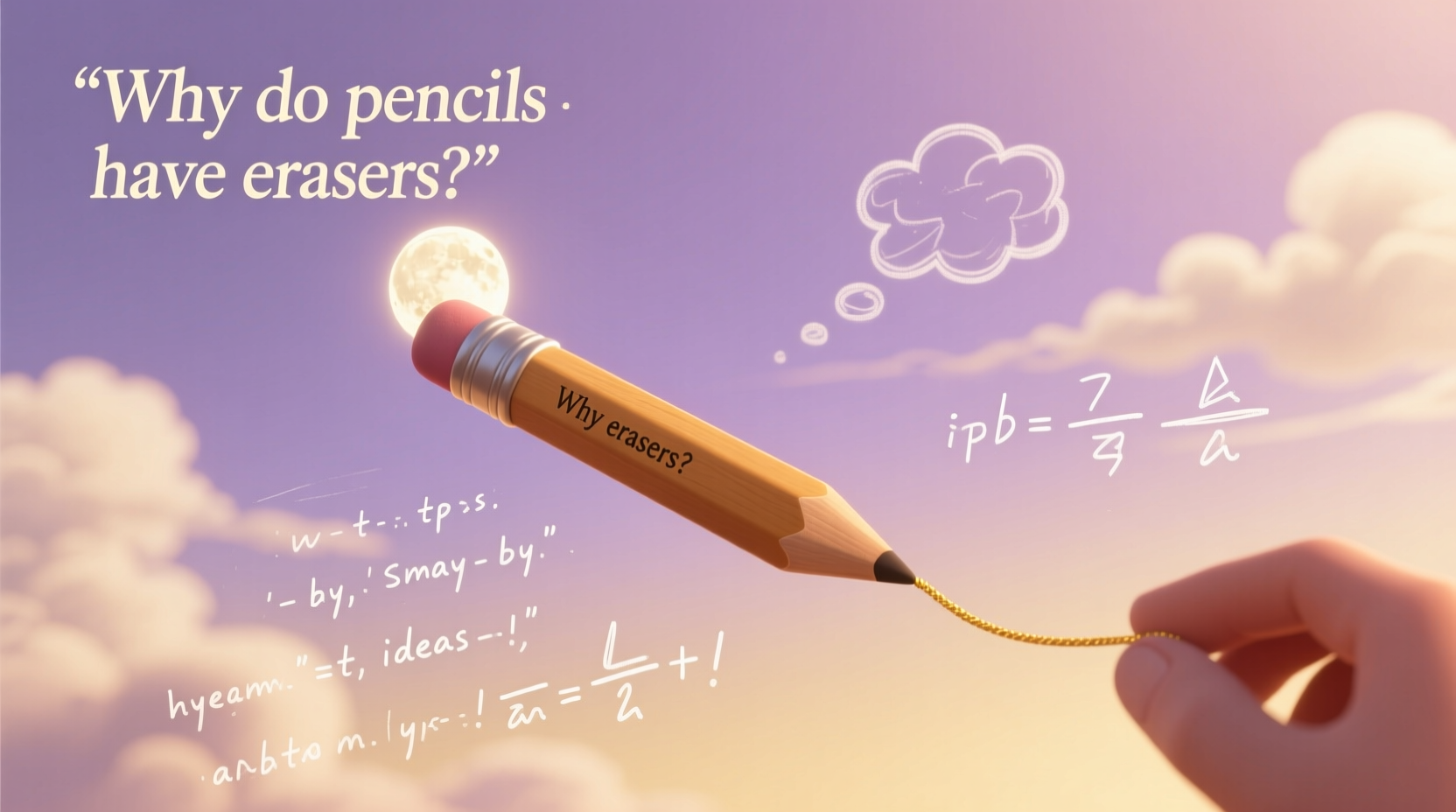
Pencils are among the most basic tools in education, creativity, and daily life. Yet one feature stands out as both practical and symbolic: the eraser. Tethered to the pencil by a small metal ferrule, it’s often overlooked—until a mistake is made. But why do pencils have erasers at all? The answer goes beyond functionality. It speaks to a universal truth: nobody’s perfect. This small rubber attachment isn’t just for correcting errors—it’s a quiet acknowledgment of human fallibility and the value of second chances.
The presence of an eraser on a pencil carries subtle philosophical weight. Unlike pens, which commit words to paper with permanence, pencils allow revision. They invite experimentation. And in doing so, they reflect a mindset that embraces learning through trial and error. In classrooms, offices, and sketchbooks around the world, the pencil-and-eraser duo silently reinforces a powerful message: mistakes aren’t failures—they’re part of the process.
The Evolution of the Eraser
The eraser wasn’t always attached to the pencil. In fact, it took decades of innovation to pair the two. Before rubber was discovered, people used wax, bread crumbs, or even their fingers to smudge out graphite marks. In 1770, English engineer Edward Nairne is credited with popularizing rubber as an effective erasing material after reportedly using a piece by accident. By the mid-19th century, manufacturers began experimenting with attaching small rubber tips to pencils.
In 1858, Hymen Lipman patented the first pencil with an integrated eraser—gluing a piece of rubber to the end of a cedar pencil. Though the patent was later overturned (a court ruled it was merely a combination of two existing items), the idea stuck. Today, over 90% of standard #2 pencils sold in schools come equipped with erasers, making them a standard feature rather than an optional extra.
Nobody’s Perfect: A Philosophy Built into Design
The phrase “nobody’s perfect” is more than a comforting cliché—it’s embedded in the design of everyday objects. The pencil’s eraser is a physical manifestation of that idea. It acknowledges that errors will happen and provides a built-in solution. This contrasts sharply with tools like ink pens, where corrections require cover-ups, strikethroughs, or white-out—a visual reminder of imperfection rather than an opportunity to erase and begin anew.
Educators have long recognized the psychological benefit of erasable writing. Students feel freer to attempt problems, write drafts, or sketch ideas when they know mistakes can be cleanly removed. Psychologically, the eraser reduces fear of failure. It encourages risk-taking, exploration, and iterative thinking—all essential components of learning.
“Mistakes are the portals of discovery.” — James Joyce
This quote resonates deeply with the symbolism of the pencil and eraser. Every correction isn’t a step backward but a movement toward clarity. The act of erasing isn’t about hiding errors; it’s about refining thought, improving expression, and progressing toward accuracy.
How the Eraser Shapes Learning and Creativity
In early education, the ability to erase plays a critical role in cognitive development. Young learners are still building fine motor skills and confidence. Knowing they can fix a misdrawn letter or miscalculated sum empowers them to keep trying. Without erasers, small errors might discourage persistence, leading students to abandon tasks prematurely.
Creative fields rely on erasability even more. Architects, illustrators, and designers use pencils extensively because their work evolves through layers of revision. A single line may shift position dozens of times before finalization. The eraser becomes not just a correction tool, but a creative instrument—used to lighten lines, create highlights, or redefine shapes.
| Field | Use of Pencil + Eraser | Benefit |
|---|---|---|
| Elementary Education | Writing practice, math drills | Reduces anxiety around mistakes |
| Architecture | Drafting blueprints | Allows iterative refinement |
| Art & Illustration | Sketching, shading | Enables dynamic composition |
| Journaling | Personal notes, reflections | Supports honest self-expression |
When Erasers Wear Out: A Metaphor for Growth
Over time, erasers shrink. They fray, darken, and eventually disappear. Some users remove them entirely once they’re gone, continuing with the pencil alone. Others replace them with larger, more efficient erasers. This lifecycle mirrors personal development. Early mistakes may be frequent and require constant correction. As skill grows, fewer errors occur—but the capacity to correct remains vital.
A worn eraser doesn’t mean failure; it means use. It signifies engagement, effort, and active learning. Just as a frayed eraser proves a pencil has been put to good work, our own stumbles prove we’re trying, evolving, and pushing forward.
Mini Case Study: Maria’s Sketchbook Journey
Maria, a first-year architecture student, started college convinced she needed to produce flawless drawings from the start. She avoided sketching freely, fearing every line would be judged. After receiving feedback that her work lacked spontaneity, she decided to change her approach. She began using only pencils with large erasers, allowing herself to redraw walls, windows, and perspectives multiple times per page.
Within months, her confidence grew. Her sketches became bolder, more experimental. She learned to see erasure not as defeat but as part of the design rhythm. One professor noted, “Your revisions tell a story. I can see your thinking evolve across the page.” Maria now keeps her early notebooks as proof of progress—not perfection.
Practical Guide: Maximizing Your Pencil-and-Eraser Workflow
To get the most out of this timeless tool combination, follow these steps:
- Choose the right pencil grade: Softer leads (like 2B) are easier to erase but smudge more. Harder leads (H-grade) leave lighter marks ideal for technical work.
- Use light pressure when drafting: Heavy lines embed graphite deeper into paper, making clean erasure difficult.
- Erase gently in one direction: Rubbing back and forth can tear paper or spread residue.
- Clean eraser debris regularly: Use a soft brush or tap the page to remove particles that could smudge new marks.
- Consider detachable erasers: For detailed work, use eraser sticks or click-style erasers that offer greater control.
Frequently Asked Questions
Do all pencils need erasers?
No. While helpful for drafting and learning, some professionals prefer pencils without erasers to avoid bulk or accidental smudging. Mechanical pencils often have smaller erasers, while art pencils may omit them entirely to preserve balance and grip.
Can you add an eraser to a pencil that doesn’t have one?
Yes. Extendable eraser sleeves, clip-on erasers, and refillable eraser caps are available for standard and mechanical pencils. These provide flexibility for users who want erasability without being limited by factory attachments.
Does relying on erasers encourage carelessness?
Not necessarily. When used mindfully, erasers support thoughtful revision. However, over-reliance without reflection can lead to repetitive mistakes. The key is balancing freedom to experiment with intentional learning from each correction.
Final Thoughts: Embracing Imperfection as Progress
The humble eraser is more than a functional accessory—it’s a symbol of grace in the face of error. Its presence on a pencil quietly affirms that missteps are expected, allowed, and correctable. In a world that often demands perfection, the pencil reminds us that growth happens through iteration, not instant mastery.
From childhood homework to professional design, the act of erasing teaches humility, patience, and perseverance. It reflects a deeper truth echoed in psychology, education, and philosophy: progress is rarely linear, and improvement requires the freedom to make—and learn from—mistakes.
“We are all works in progress, and the eraser is just as important as the lead.” — Dr. Alan Reeves, Educational Psychologist




 浙公网安备
33010002000092号
浙公网安备
33010002000092号 浙B2-20120091-4
Comments
No comments yet. Why don't you start the discussion?