
Procrastination is not a time management issue—it’s an emotional regulation problem. Despite knowing that delaying tasks leads to stress, missed deadlines, and diminished performance, millions of people continue to push responsibilities to “tomorrow.” The phrase \"why put off until tomorrow what you can do today?\" has endured for centuries because it captures a fundamental truth about human behavior: delay undermines progress. Yet understanding why we procrastinate is the first step toward reclaiming control over our time, focus, and outcomes.
The Psychology Behind Procrastination
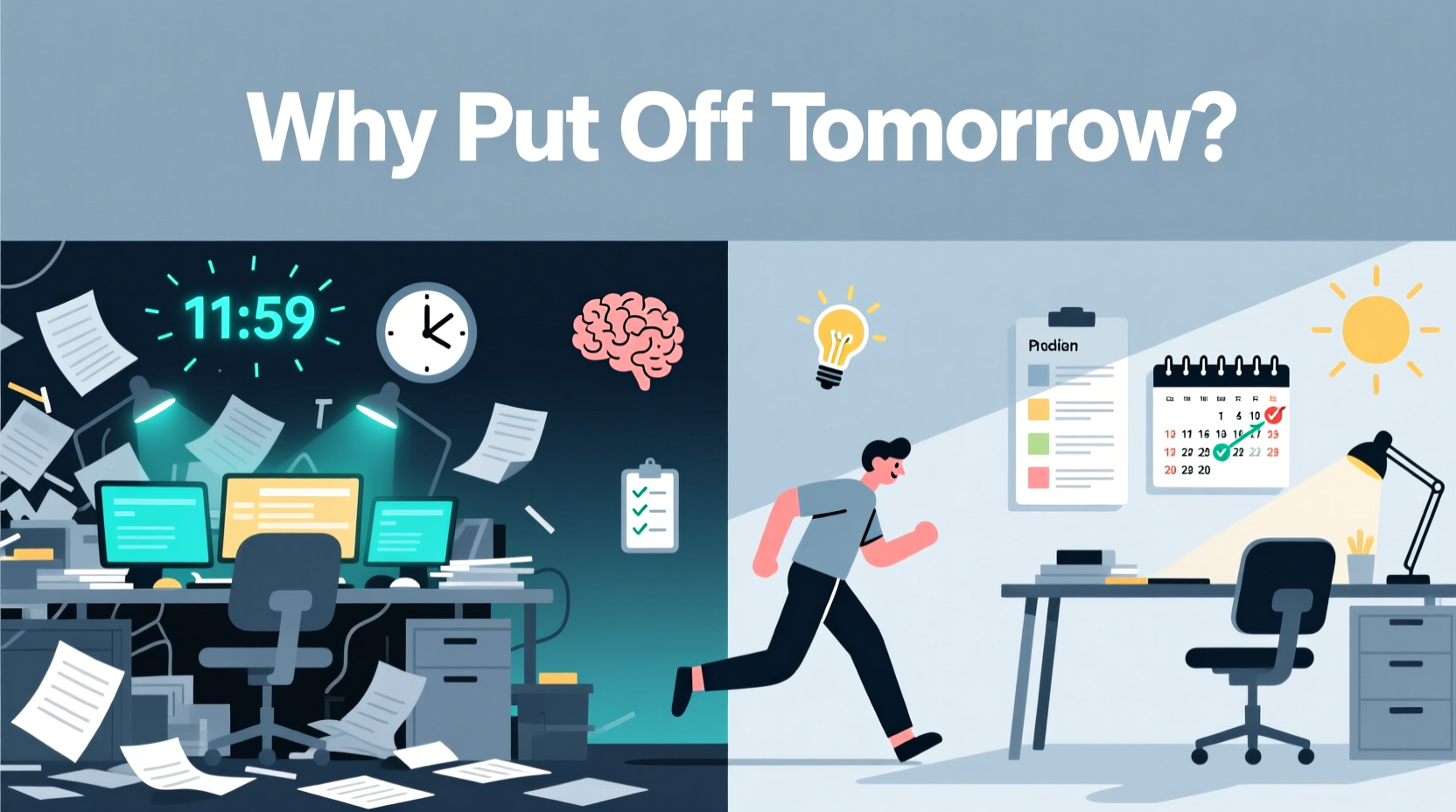
At its core, procrastination is the voluntary delay of an intended task despite expecting to be worse off for the delay. It’s not laziness. In fact, many chronic procrastinators are highly motivated and capable individuals who struggle with initiating or completing tasks due to internal barriers.
Research in behavioral psychology identifies several key drivers:
- Fear of failure: The anticipation of not meeting expectations can paralyze action.
- Perfectionism: Waiting for the “perfect” moment or conditions before starting.
- Task aversion: Dislike or boredom associated with the activity itself.
- Impulsiveness: Preference for immediate rewards (e.g., scrolling social media) over long-term gains.
- Poor self-regulation: Difficulty managing emotions, attention, or impulses.
Dr. Piers Steel, author of *The Procrastination Equation*, explains:
“Procrastination is less about time management and more about mood management. We delay tasks that make us feel anxious, insecure, or bored—even when we know it will hurt us later.”
How Procrastination Undermines Productivity
While occasional delays may seem harmless, habitual procrastination creates a cycle of stress, rushed work, and reduced quality. The consequences extend beyond missed deadlines:
- Increased cortisol levels due to last-minute pressure
- Erosion of self-trust and confidence
- Strained professional and personal relationships
- Lower academic and career achievement
- Greater risk of burnout and mental fatigue
A study published in the Journal of Behavioral Medicine found that chronic procrastinators report higher levels of stress and lower life satisfaction, even when they meet their deadlines. The psychological toll of living under constant time pressure outweighs any short-term relief from avoidance.
Strategies to Break the Cycle
Overcoming procrastination isn’t about willpower—it’s about designing systems that align with how your brain works. Here are proven techniques grounded in cognitive and behavioral science.
1. The Two-Minute Rule
If a task takes less than two minutes, do it immediately. If it takes longer, commit to working on it for just two minutes. This lowers the barrier to entry and often leads to continued momentum.
2. Time Blocking with Realistic Buffers
Schedule specific blocks of time for focused work, but include buffer zones for interruptions or overruns. A packed calendar without flexibility increases resistance.
3. Task Decomposition
Break large, intimidating projects into small, actionable steps. Instead of “write report,” list subtasks like “outline structure,” “gather data,” “draft introduction.”
4. Precommitment Devices
Create accountability by scheduling check-ins, using apps that block distractions, or telling a colleague your deadline. Knowing someone else expects progress increases follow-through.
5. Reframe Your Self-Talk
Replace judgmental thoughts like “I should’ve started earlier” with constructive ones: “What’s one small thing I can do now?” Self-compassion reduces the shame that fuels further delay.
“People who forgive themselves for procrastinating today are less likely to do it again tomorrow.” — Dr. Fuschia Sirois, researcher in procrastination and well-being
Step-by-Step Guide to Overcoming Procrastination
- Identify the trigger: What emotion or thought precedes your delay? Anxiety? Boredom? Uncertainty?
- Name the task clearly: Vague goals like “work on project” invite avoidance. Be specific: “Draft slide 3 of presentation.”
- Set a micro-goal: Commit to 5–10 minutes of focused effort. Use a timer.
- Eliminate distractions: Close unnecessary tabs, silence notifications, use tools like Focus Mode or Freedom.
- Reflect afterward: Note what helped or hindered. Adjust your approach next time.
Do’s and Don’ts of Managing Procrastination
| Do | Don’t |
|---|---|
| Start with the easiest part of the task | Wait for motivation to strike |
| Use implementation intentions: “I will write for 25 minutes at 9 AM at my desk” | Rely on vague plans like “I’ll do it later” |
| Track progress visually (checklists, Kanban boards) | Focus only on completion, ignoring effort |
| Practice self-compassion after setbacks | Criticize yourself harshly for delays |
| Review your environment for friction (clutter, noise) | Assume the problem is lack of discipline |
Real Example: From Chronic Delay to Consistent Action
Sarah, a freelance graphic designer, consistently missed client deadlines despite loving her work. She would open her design software, then switch to browsing inspiration sites—only to realize hours had passed. After tracking her behavior, she noticed a pattern: she delayed starting whenever a project felt ambiguous or high-stakes.
She implemented a new routine: each morning, she spent 10 minutes clarifying the day’s top priority and breaking it into a single, manageable action. She also began using the Pomodoro Technique—25 minutes of work followed by a 5-minute break. Within three weeks, her on-time delivery rate improved from 60% to 95%. More importantly, her anxiety decreased because she no longer faced everything at once.
FAQ
Is procrastination always bad?
Not necessarily. Strategic delay—sometimes called \"productive procrastination\"—can allow ideas to incubate or priorities to clarify. However, chronic, unintentional delay that causes distress or harm is problematic and warrants intervention.
Can ADHD cause procrastination?
Yes. Individuals with ADHD often struggle with executive function, including task initiation, time estimation, and sustained attention. What appears as procrastination may be a neurological challenge rather than poor discipline. Professional support and tailored strategies are essential.
How is procrastination different from laziness?
Laziness implies a lack of desire to act. Procrastination involves intending to act but being unable to due to emotional or cognitive barriers. Procrastinators often work intensely under pressure—they’re not idle; they’re misaligned in timing.
Checklist: Building a Procrastination-Resistant Routine
- ☑ Identify your top 3 recurring tasks you tend to delay
- ☑ Break each into micro-tasks (under 30 minutes)
- ☑ Schedule one micro-task daily for the next week
- ☑ Choose a distraction-blocking tool and use it during work blocks
- ☑ Reflect weekly: What worked? What needs adjustment?
- ☑ Practice self-compassion when you slip up
Conclusion: Start Before You’re Ready
Productivity isn’t about doing more—it’s about acting with intention. Every time you choose to begin instead of wait, you weaken procrastination’s grip and strengthen your sense of agency. The goal isn’t perfection; it’s progress. Small actions compound into meaningful results over time.
You don’t need to overhaul your habits overnight. Pick one strategy from this article—maybe the two-minute rule or a simple checklist—and apply it today. Momentum builds in motion, not in waiting for the perfect plan.




 浙公网安备
33010002000092号
浙公网安备
33010002000092号 浙B2-20120091-4
Comments
No comments yet. Why don't you start the discussion?