
Financial opportunities promising fast returns and passive income flood social media, messaging apps, and even dinner table conversations. Among the most deceptive of these are pyramid schemes—structures that appear lucrative but are built on unsustainable recruitment models rather than real products or services. These operations not only carry significant financial risk but are often illegal, leading to criminal charges and lasting damage to personal reputations. Understanding their mechanics, recognizing warning signs, and knowing how to respond can protect individuals from devastating consequences.
The Hidden Mechanics of Pyramid Schemes
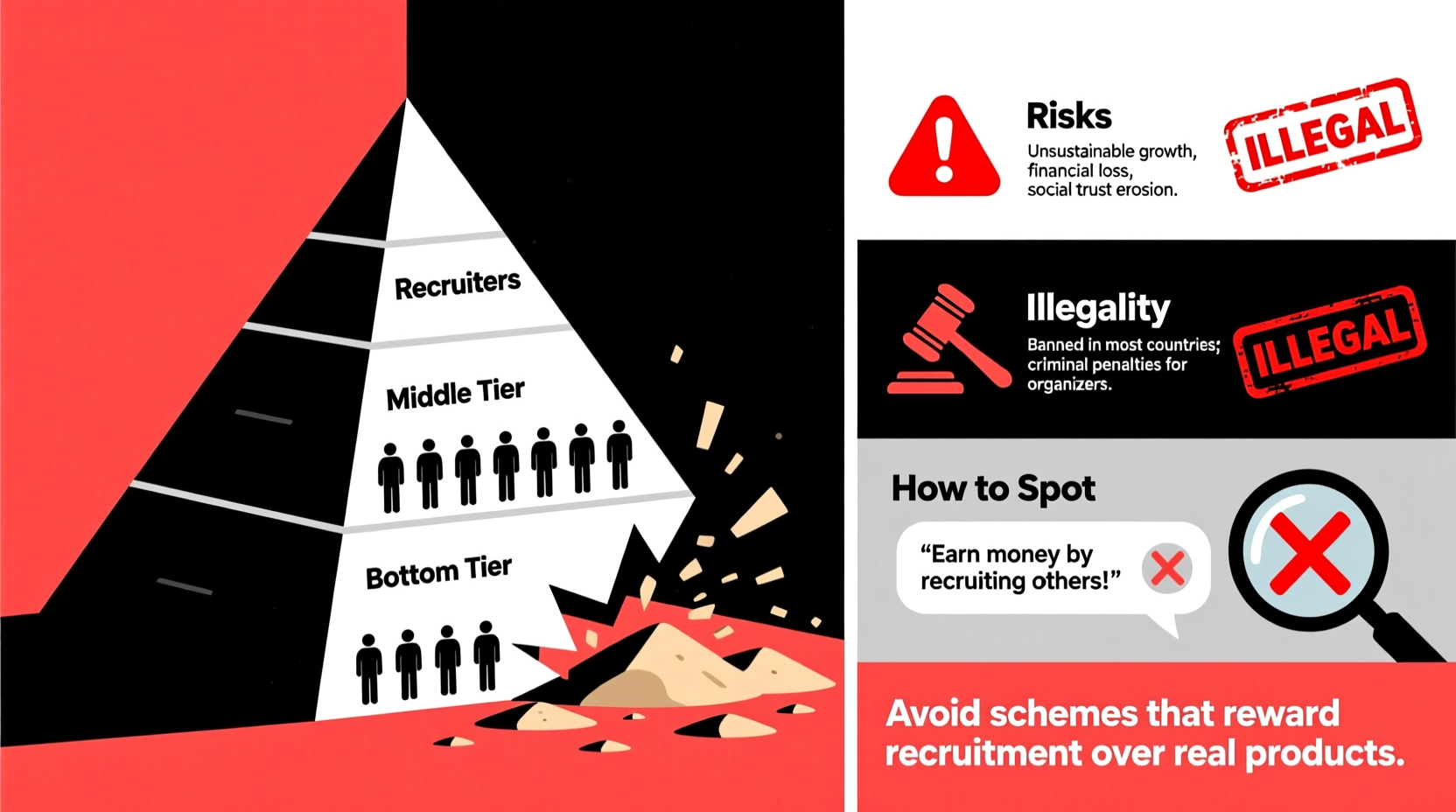
At their core, pyramid schemes rely on recruiting new participants to generate income for those above them in the hierarchy. Unlike legitimate multi-level marketing (MLM) companies, which derive revenue primarily from selling actual products or services, pyramid schemes prioritize recruitment over sales. Money flows upward as new members pay fees or make purchases with the promise of future returns—returns that only materialize if they, in turn, recruit more people.
This model is mathematically unsustainable. Each level requires exponentially more participants: 1 person recruits 5, who each recruit 5 more, resulting in 25 at the next level, then 125, then 625. Within just a few tiers, the number of required recruits exceeds the population of most cities, let alone countries. When recruitment inevitably slows, the bottom layers lose everything while early entrants profit.
“Pyramid schemes don’t create value—they redistribute it from the many to the few at the top.” — Dr. Rebecca Lin, Economist & Fraud Analyst
Why Pyramid Schemes Are Illegal and Financially Dangerous
In most jurisdictions, including the United States, Canada, the UK, and Australia, pyramid schemes are explicitly illegal. Regulatory bodies like the U.S. Federal Trade Commission (FTC) and the Securities and Exchange Commission (SEC) classify them as fraudulent because they misrepresent how income is generated.
The primary legal issue lies in deception. Operators often disguise the scheme as a business opportunity, investment club, or \"gifting circle,\" claiming participants will earn profits through effort or strategy. In reality, earnings depend almost entirely on bringing in new victims. This violates consumer protection laws and securities regulations.
Penalties can be severe. Convictions may result in:
- Fines up to $1 million (or higher for corporate sponsors)
- Criminal charges and imprisonment
- Permanent damage to credit and employment prospects
- Liability for repaying ill-gotten gains
Even for non-organizers, participation carries risk. In some cases, individuals who joined believing the program was legitimate have still been sued or barred from future business ventures due to association.
How to Spot a Pyramid Scheme: Key Warning Signs
Recognizing a pyramid scheme early can prevent financial loss and legal entanglement. Look for these red flags:
- Emphasis on Recruitment: Income promises are tied to how many people you bring in, not what you sell.
- Vague or Overhyped Products: The product—if one exists—is low-quality, overpriced, or rarely sold outside the network.
- High Entry Fees: Participants must pay large upfront costs to join, often justified as “starter kits” or “membership packages.”
- Income Claims Without Proof: Testimonials focus on luxury lifestyles without verifiable earnings data.
- Complex Compensation Plans: Payout structures are confusing, relying on multiple levels of downline commissions.
- Pressure to Act Fast: Urgency is used to bypass critical thinking (“Only 3 spots left!”).
Legitimate MLMs do involve some recruitment, but their success depends on moving real products into the retail market. If inventory turnover happens mainly within the group, not to external customers, it’s likely a pyramid in disguise.
Real-World Example: The Collapse of ZeekRewards
In 2012, ZeekRewards, a North Carolina-based company, collapsed under federal investigation after operating one of the largest pyramid schemes in U.S. history. Promising investors daily returns by bidding on auction points tied to a penny auction site, the company claimed to offer a “revolutionary” online earning model.
However, investigators found that less than 1% of revenue came from actual auctions. Over 99% stemmed from new participant investments. With nearly 1 million members and $900 million collected, the scheme unraveled when recruitment slowed. Thousands lost their savings, and CEO Terry Mullins was sentenced to 15 years in prison.
The case illustrates how sophisticated branding, fake metrics, and emotional appeals can mask a fundamentally fraudulent system. Even financially literate individuals were drawn in by the illusion of legitimacy.
What to Do If You Suspect a Pyramid Scheme
If you encounter a suspicious opportunity—or realize you’ve already joined one—take immediate action:
- Stop Recruiting: Cease inviting others immediately to avoid complicity.
- Document Everything: Save emails, contracts, compensation plans, and promotional materials.
- Report It: File a complaint with your country’s consumer protection agency (e.g., FTC, ACCC, or FCA).
- Withdraw Funds (If Possible): Safely exit any investments, though recovery is often limited.
- Seek Legal Advice: Consult an attorney if you’re being pressured to stay or promote the scheme.
| Aspect | Legitimate Business | Pyramid Scheme |
|---|---|---|
| Revenue Source | Sales to external customers | New participant fees |
| Product Value | Market-priced, functional | Overpriced, irrelevant |
| Earning Potential | Tied to performance/sales | Tied to recruitment volume |
| Longevity | Sustainable with demand | Collapses when growth stalls |
| Regulatory Status | Licensed and compliant | Often unregistered, illegal |
Frequently Asked Questions
Is all multi-level marketing a pyramid scheme?
No. While MLMs use a hierarchical structure, they are legal if they focus on selling real products to consumers outside the network. The key difference is where revenue comes from: retail sales versus recruitment fees.
Can I get in trouble for joining a pyramid scheme?
You typically won’t face criminal charges simply for being a victim. However, if you actively recruited others or misrepresented the opportunity, you could be held civilly liable or prosecuted as a promoter.
Are there any legal pyramid-like structures?
No. Any business model whose profitability depends on endless recruitment rather than product value is inherently unsustainable and illegal. Courts consistently rule against such structures, regardless of branding.
Protect Yourself: A Quick Checklist
- ✅ Does it sell a real product people want?
- ✅ Do distributors earn mostly from retail sales?
- ✅ Can you verify independent customer purchases?
- ✅ Is income potential based on measurable performance?
- ✅ Are there no large upfront fees or inventory loading?
- ✅ Can you easily exit without penalty?
Conclusion: Stay Informed, Stay Safe
Pyramid schemes thrive on hope, urgency, and misinformation. They exploit trust and ambition, turning well-meaning individuals into unwitting participants in illegal networks. The truth is simple: if an opportunity sounds too good to be true and relies on recruiting friends and family, it almost certainly is.
Education is the best defense. By understanding how these schemes operate, recognizing their hallmarks, and knowing where to report them, you protect not only yourself but also your community. Share this knowledge. Question bold claims. Demand transparency. Your financial safety—and integrity—depend on it.




 浙公网安备
33010002000092号
浙公网安备
33010002000092号 浙B2-20120091-4
Comments
No comments yet. Why don't you start the discussion?