
When Robert F. Kennedy Jr. speaks, many listeners immediately notice the unusual quality of his voice—raspy, strained, and often interrupted by involuntary breaks or spasms. This distinctive vocal pattern isn’t due to smoking, illness, or aging, but rather a rare neurological condition known as spasmodic dysphonia. While not widely understood by the general public, this disorder significantly affects speech production and can be misunderstood as nervousness, intoxication, or lack of articulation. In Kennedy’s case, his openness about the condition has helped bring attention to a disorder that impacts thousands yet remains underdiagnosed.
What Is Spasmodic Dysphonia?
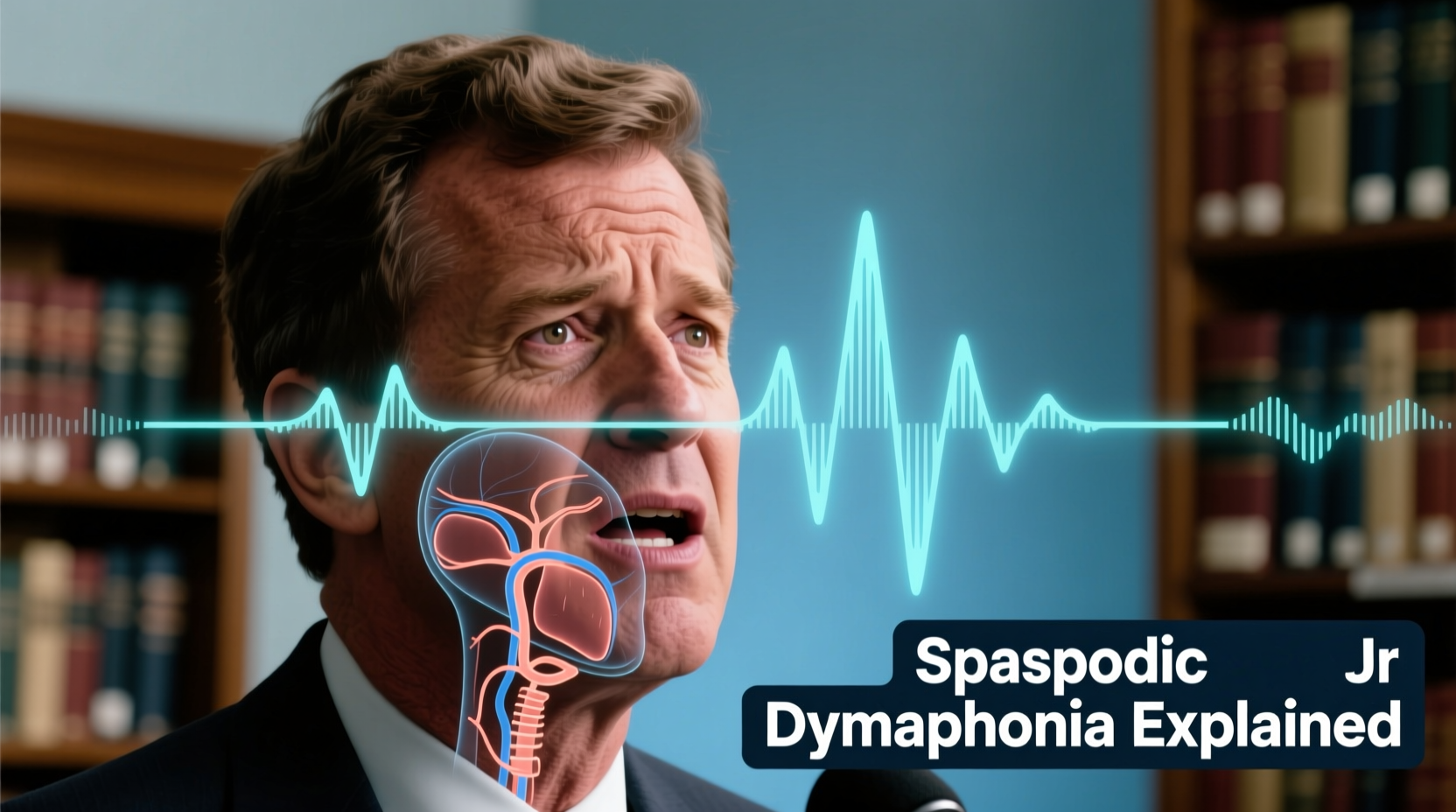
Spasmodic dysphonia (SD) is a chronic neurological movement disorder that affects the muscles of the larynx—the voice box. It causes involuntary muscle contractions during speech, leading to strained, broken, or breathy sounds. These spasms do not occur when singing, whispering, laughing, or speaking at certain pitches, which distinguishes SD from other voice disorders.
The condition is classified into three main types:
- Adductor spasmodic dysphonia: The most common form, where the vocal cords spasm inward, causing a strained, strangled voice with frequent interruptions.
- Abductor spasmodic dysphonia: Vocal cords spasm open, resulting in a weak, breathy voice with sudden drops in volume.
- Mixed spasmodic dysphonia: A combination of both adductor and abductor symptoms.
Despite its impact on communication, spasmodic dysphonia does not affect intelligence, cognition, or the ability to think clearly. It is also not life-threatening, though it can severely impair social interaction, professional performance, and emotional well-being.
How Does Spasmodic Dysphonia Affect RFK Jr.?
Robert F. Kennedy Jr. has publicly discussed his struggle with spasmodic dysphonia for decades. His speech exhibits classic signs of adductor spasmodic dysphonia: a tight, effortful voice with abrupt pauses and tension in vocal delivery. During interviews and public appearances, he frequently stops mid-sentence, restarts words, or appears to struggle with articulation—not due to uncertainty, but because of involuntary muscle spasms.
In a 2010 interview with 60 Minutes, Kennedy described the condition as “like trying to talk with your throat being strangled.” He emphasized that while the disorder makes public speaking more difficult, it doesn’t reflect his mental clarity or preparedness.
“People assume I’m intoxicated or have a speech impediment. But it’s a neurological disorder—it’s my vocal cords locking up. I know exactly what I want to say; my body just won’t let me say it smoothly.” — Robert F. Kennedy Jr.
Kennedy’s visibility has played a crucial role in raising awareness about spasmodic dysphonia. As a high-profile environmental lawyer, author, and political figure, his persistence despite the condition challenges assumptions about vocal authority and credibility.
Causes and Diagnosis of Spasmodic Dysphonia
The exact cause of spasmodic dysphonia remains unclear, but research points to dysfunction in the basal ganglia—a part of the brain responsible for coordinating movement. It is believed to involve a combination of genetic predisposition and environmental triggers, such as upper respiratory infections, voice overuse, or head trauma.
Diagnosis is often delayed because symptoms resemble other voice problems like vocal cord nodules, acid reflux, or psychogenic speech disorders. A correct diagnosis typically requires a multidisciplinary approach involving:
- Laryngologists (ear, nose, and throat specialists)
- Speech-language pathologists
- Neurologists specializing in movement disorders
A key diagnostic tool is fiberoptic laryngoscopy, which allows doctors to observe real-time vocal cord movement during speech. This helps distinguish spasmodic dysphonia from functional voice disorders.
Common Misdiagnoses
| Condition | Similarities to SD | Key Differences |
|---|---|---|
| Vocal Cord Nodules | Raspy voice, hoarseness | Pain with voice use, visible growths on cords |
| Laryngopharyngeal Reflux (LPR) | Chronic hoarseness, throat clearing | Improves with acid-reducing treatment |
| Psychogenic Voice Disorder | Inconsistent voice breaks | No neurological basis; often linked to trauma |
| Multiple Sclerosis or Parkinson’s | Speech disruption, tremor | Broad motor symptoms beyond voice |
Treatment Options and Management Strategies
While there is no cure for spasmodic dysphonia, several treatments can significantly reduce symptoms and improve vocal function. The most effective approach varies depending on the individual and the type of SD.
Primary Treatments
- Botox Injections: The gold standard treatment. Botulinum toxin is injected directly into the affected laryngeal muscles every 3–4 months, temporarily weakening them and reducing spasms. Most patients experience improved voice quality within days, though side effects may include temporary breathiness or swallowing difficulty.
- Speech Therapy: While not curative, specialized therapy can help individuals develop compensatory strategies—such as controlled breathing, pacing, and resonance techniques—to minimize strain and enhance intelligibility.
- Surgical Intervention: Selective laryngeal adduction denervation-reinnervation (SLAD-R) is an option for adductor SD. It involves rerouting nerves to reduce abnormal signals. Success rates are promising, but surgery carries risks and is irreversible.
Emerging Therapies
Research is ongoing into neuromodulation techniques, including deep brain stimulation (DBS), which has shown potential in severe, treatment-resistant cases. Gene therapy and targeted drug delivery systems are also under investigation, though still in early stages.
Living with Spasmodic Dysphonia: A Real-Life Perspective
Consider the case of Maria T., a 45-year-old teacher diagnosed with adductor spasmodic dysphonia after years of being mislabeled as “nervous” or “unqualified” during parent-teacher conferences. Her voice would cut out mid-sentence, leading colleagues to question her confidence. After a proper diagnosis and starting Botox treatments, she regained much of her vocal control. With speech therapy, she learned pacing techniques and now uses a small microphone in class to reduce vocal strain.
Maria’s story mirrors broader challenges faced by people with SD: delayed diagnosis, social stigma, and professional barriers. Yet with appropriate care, many lead full, active lives. RFK Jr.’s public presence underscores this possibility—proving that a compromised voice does not diminish intellect, passion, or leadership.
Frequently Asked Questions
Is spasmodic dysphonia progressive?
Spasmodic dysphonia is generally not progressive in the sense of spreading to other body parts. However, symptoms may worsen over time without treatment, especially with vocal strain or stress.
Can children develop spasmodic dysphonia?
It is rare in children, with most cases emerging between ages 30 and 50. When it occurs earlier, it may be mistaken for stuttering or anxiety-related speech issues.
Does RFK Jr. use Botox for his condition?
While Kennedy hasn’t publicly confirmed the specifics of his treatment, medical experts familiar with his case suggest he likely receives regular botulinum toxin injections, given their widespread use and effectiveness for adductor SD.
Conclusion: Understanding Beyond the Voice
Robert F. Kennedy Jr.’s raspy, halting voice is not a flaw of character or competence—it is the audible signature of a complex neurological condition. Spasmodic dysphonia disrupts the mechanics of speech, but not the mind behind the words. As awareness grows, so should our understanding and patience for those whose voices don’t conform to conventional norms.
For individuals living with SD, early diagnosis, access to specialists, and consistent treatment can transform daily communication. For society, it’s a reminder that clarity of thought and strength of message transcend vocal smoothness.




 浙公网安备
33010002000092号
浙公网安备
33010002000092号 浙B2-20120091-4
Comments
No comments yet. Why don't you start the discussion?