
Bird migration is one of nature’s most awe-inspiring phenomena—millions of birds traverse continents each year, navigating thousands of miles with astonishing precision. Yet not all birds follow this seasonal rhythm. Across forests, wetlands, and urban backyards, many bird species remain in the same region year-round. Understanding why some birds don’t migrate reveals a complex interplay of evolution, ecology, and adaptability. From food availability to energy conservation, several key factors determine whether a bird stays put or embarks on long-distance travel.
Evolutionary Adaptations to Local Environments
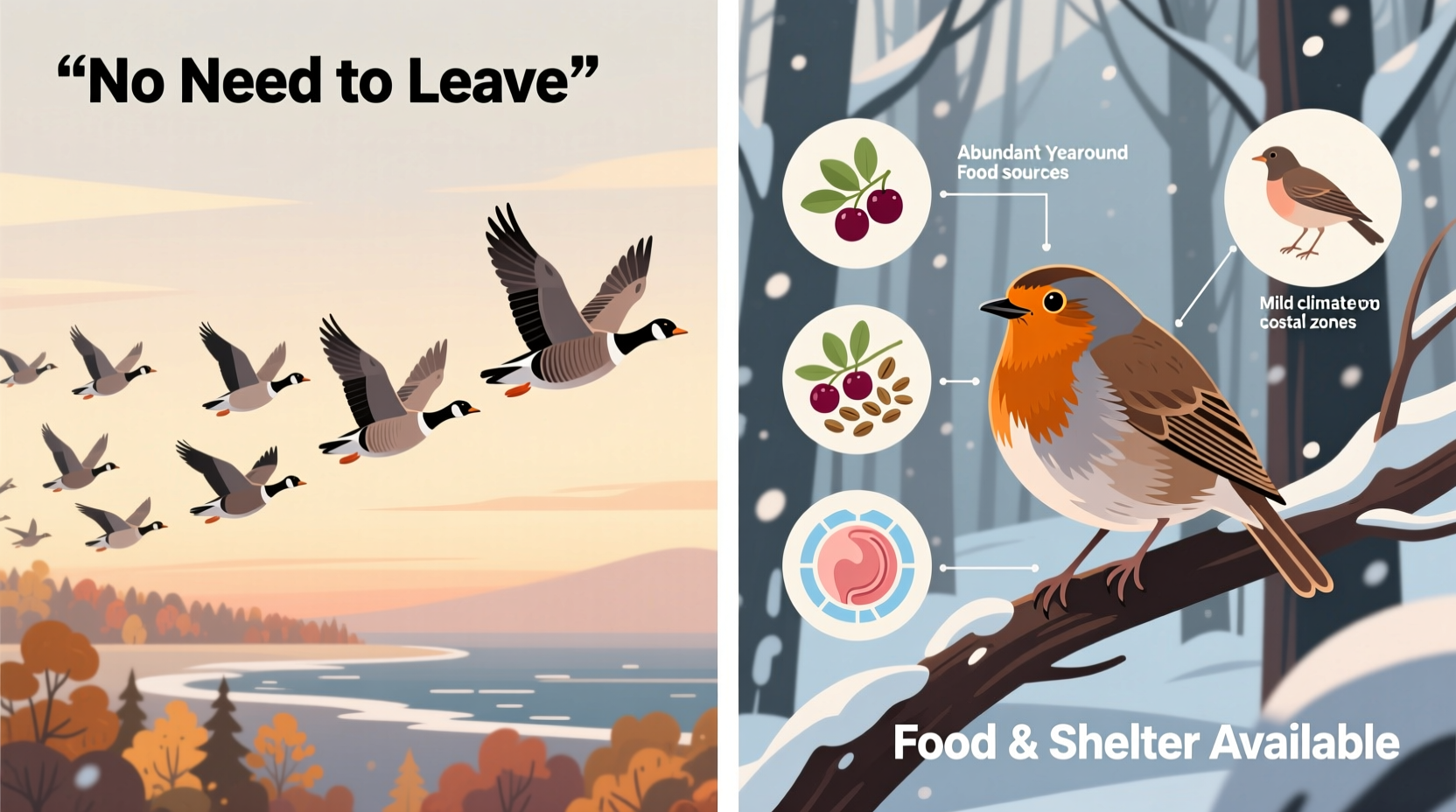
One of the primary reasons certain birds do not migrate lies in their evolutionary history. Species that evolved in relatively stable climates—such as tropical regions or temperate zones with mild winters—often developed traits that allow them to survive without seasonal movement. These birds are adapted to exploit local resources efficiently, reducing the need for energy-intensive migrations.
For example, resident birds like the Northern Cardinal or Black-capped Chickadee have evolved behaviors and physiological mechanisms to endure cold temperatures. They grow denser plumage in winter, increase fat reserves, and use communal roosting to conserve heat. Over generations, natural selection has favored individuals capable of surviving winter conditions rather than those investing energy into migration.
“Migration isn’t an inherent trait—it’s a survival strategy. When staying is safer and more efficient than leaving, evolution favors residency.” — Dr. Lena Torres, Avian Ecologist at Cornell Lab of Ornithology
Food Availability and Foraging Flexibility
Access to food plays a decisive role in migration decisions. Many non-migratory birds thrive because they can switch diets seasonally or rely on reliable food sources that persist through winter.
- Seed-eaters: Birds like finches and sparrows can subsist on seeds from native grasses, weeds, and backyard feeders even when insects vanish.
- Omnivores: American Robins may shift from earthworms in summer to berries and fruit in colder months, allowing them to remain in northern areas.
- Scavengers and predators: Raptors such as Red-tailed Hawks and owls often stay where prey like rodents remain active under snow cover.
In urban and suburban environments, human-provided resources further reduce the necessity of migration. Bird feeders, fruiting ornamental trees, and unfrozen water sources create micro-habitats where birds can survive comfortably without moving south.
Energy Costs vs. Survival Benefits
Migrating is physically demanding. It requires massive energy expenditure, exposes birds to predators, bad weather, and habitat loss along flyways, and increases mortality risk. For some species, the dangers of migration outweigh the benefits of escaping winter.
A robin flying 500 miles might burn up to 10% of its body weight per day. If it can find enough berries locally, staying put conserves energy and avoids these risks. This cost-benefit analysis happens at both individual and population levels—birds that survive winters without migrating pass on genes favoring residency.
| Factor | Migratory Birds | Non-Migratory Birds |
|---|---|---|
| Energy Expenditure | Very high during flight | Low to moderate |
| Predation Risk | Increased during transit | Stable, localized |
| Winter Mortality | High due to exhaustion | Lower if food available |
| Lifetime Reproductive Success | Higher only if migration succeeds | More consistent over years |
Geographic and Climatic Stability
Birds living in regions with minimal seasonal variation rarely migrate. In equatorial zones, temperature and daylight change little throughout the year, maintaining steady food supplies. Tropical species like toucans, hornbills, and many parrots show little migratory behavior because their environment remains hospitable year-round.
Even in temperate regions, milder winters due to climate change are influencing migration patterns. Some traditionally migratory birds now shorten their journeys or skip migration entirely. European Blackcaps, once fully migratory, now include populations that winter in the UK instead of flying to the Mediterranean—thanks to warmer temperatures and garden feeding stations.
Mini Case Study: The American Robin’s Changing Behavior
The American Robin (Turdus migratorius) was long considered a harbinger of spring. However, increasing numbers are now observed across New England and southern Canada throughout winter. Researchers tracking robin movements via GPS tags found that flocks remain northward if berry-producing shrubs like juniper, hawthorn, and crabapple are abundant.
In Ottawa, citizen science data from Project FeederWatch shows a 40% rise in winter robin sightings over the past two decades. This shift reflects both climate warming and expanded access to urban green spaces. The robin hasn’t abandoned migration—but it has added flexibility, demonstrating how behavior evolves in real time.
Step-by-Step: How Scientists Determine Migration Patterns
Understanding whether a bird species migrates involves systematic observation and data collection. Here's how researchers assess avian movement:
- Band and Tag Studies: Attach lightweight bands or GPS trackers to monitor individual movements over time.
- Citizen Science Reporting: Platforms like eBird compile public observations to map seasonal presence.
- Stable Isotope Analysis: Test feathers or blood to identify where a bird spent different seasons based on regional chemical signatures.
- Nighttime Radar Monitoring: Use weather radar to detect large-scale nocturnal migrations.
- Long-term Population Surveys: Compare breeding and winter counts to infer movement trends.
Checklist: Signs a Bird May Be Non-Migratory
- Observed consistently in the same area across all four seasons
- Feeds on seeds, berries, or suet—foods available in winter
- Uses cavities, dense foliage, or man-made structures for shelter
- Participates in winter flocking behavior with other resident species
- Frequently visits bird feeders or urban gardens
FAQ
Do non-migratory birds ever leave their territory?
Yes, but not in the traditional migratory sense. Some perform altitudinal migration—moving from mountains to valleys in winter—or make local dispersals in search of food. These movements are short-range and opportunistic, unlike long-distance seasonal migrations.
Can a bird be both migratory and non-migratory?
Yes. Partial migration occurs within species where some individuals migrate and others remain. For instance, younger robins may migrate while older, more experienced birds stay if resources allow. This flexibility enhances survival across varying conditions.
Are non-migratory birds at greater risk from climate change?
Paradoxically, they may face higher vulnerability. While milder winters benefit some, extreme weather events—like ice storms or sudden cold snaps—can trap resident birds without escape options. Migratory birds can avoid such anomalies by relocating; residents must endure them.
Conclusion
The decision to migrate—or not—is far from arbitrary. It reflects centuries of adaptation, resource calculation, and environmental feedback. Birds that stay behind do so because their ecosystems support them, their bodies are built for resilience, and their behaviors maximize survival without long flights. As climates shift and habitats evolve, the line between migrant and resident continues to blur, revealing nature’s remarkable capacity for adjustment.
Observing non-migratory birds offers a unique window into ecological stability and adaptability. Whether you're watching chickadees at a feeder or hearing a cardinal’s song on a snowy morning, you’re witnessing a successful alternative to one of nature’s grandest journeys.




 浙公网安备
33010002000092号
浙公网安备
33010002000092号 浙B2-20120091-4
Comments
No comments yet. Why don't you start the discussion?