
The catchy opening theme of *Super Why!*—“Why! Fly, fly, why!”—is more than just a playful jingle for preschoolers. It’s a carefully designed linguistic tool that introduces children to phonemic awareness, word recognition, and the foundational mechanics of reading. While it may seem like simple entertainment, the repetition, rhythm, and deliberate spelling embedded in the lyrics serve a deeper educational purpose. Understanding why this song works—and how to decode its structure—can empower parents, educators, and caregivers to leverage its full potential in early literacy development.
The Power of Repetition and Rhythm in Early Learning
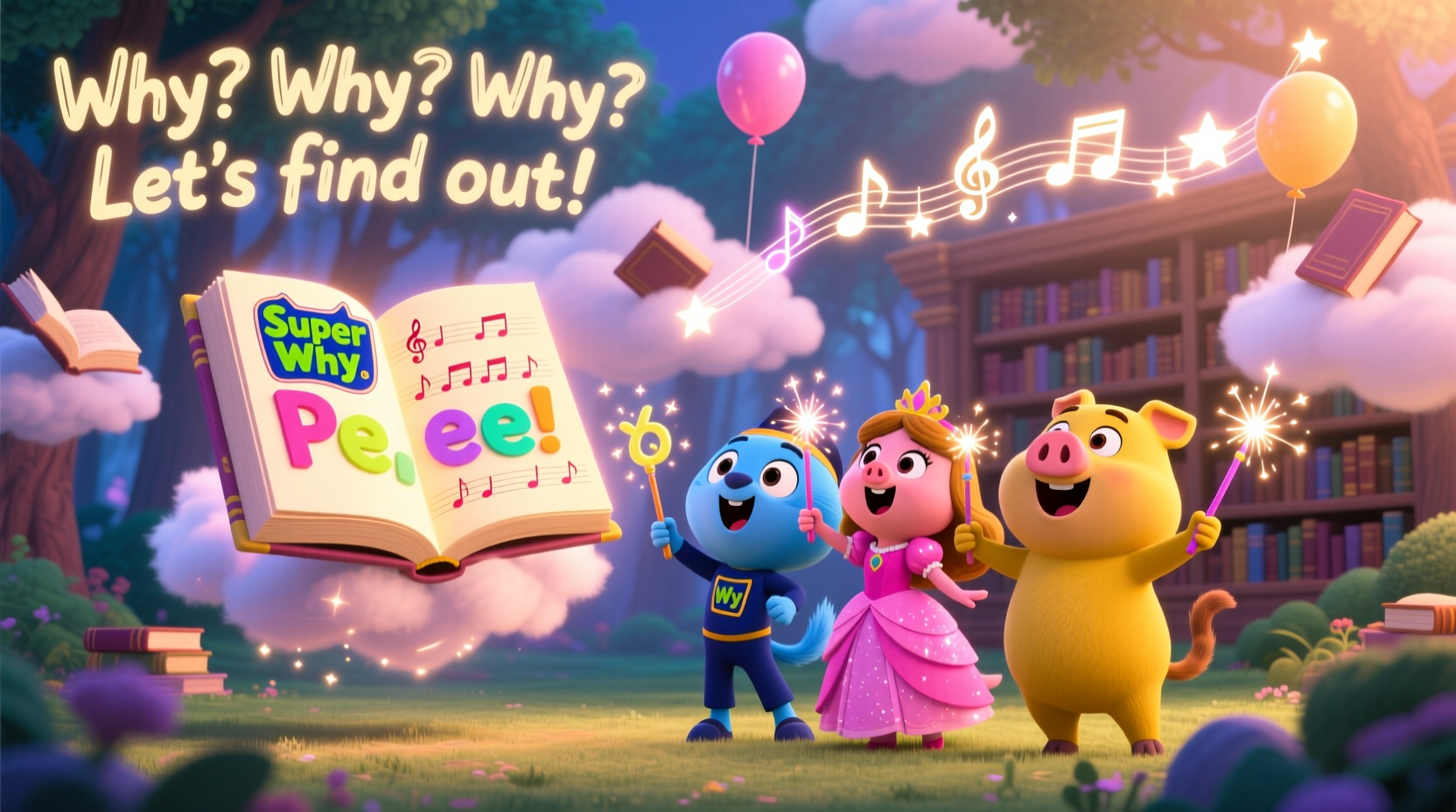
Children’s brains thrive on predictability. Repetitive songs with strong rhythmic patterns help young learners internalize language structures before they can read or write. The *Super Why* theme uses a consistent beat and repeated syllables (“fly, fly, why”) to reinforce auditory memory. This kind of musical scaffolding supports emergent readers by strengthening phonological processing—the ability to hear and manipulate sounds in words.
When a child hears “W-H-Y spells why,” they’re not just memorizing a phrase. They are engaging in sound-letter correspondence, a critical skill in decoding unfamiliar words. The song isolates the word “why” and breaks it into individual letters, modeling the process of sounding out—a technique used in systematic phonics instruction.
How the Lyrics Teach Decoding Skills
Decoding is the ability to translate written words into spoken language using knowledge of letter-sound relationships. The *Super Why* song explicitly demonstrates this process:
“W-H-Y spells why!”
This line performs three essential functions:
- Letter Naming: Children learn the names of the letters W, H, and Y.
- Phonemic Awareness: They begin to connect those letters to their corresponding sounds.
- Blending Practice: When sung fluidly, the sequence models how separate sounds combine into a whole word.
Unlike many children’s shows that rely solely on sight-word recognition (e.g., flashing the word “cat” while saying it), *Super Why* emphasizes the mechanics behind reading. This approach aligns with evidence-based practices endorsed by reading specialists.
“Explicit instruction in phonemic segmentation and blending is one of the strongest predictors of later reading success.” — Dr. Maryanne Wolf, Cognitive Neuroscientist and Author of *Proust and the Squid*
Breaking Down the Full Theme: A Line-by-Line Analysis
To fully appreciate the educational design of the song, consider a detailed breakdown of its lyrics:
| Lyric Line | Educational Function | Real-World Application |
|---|---|---|
| “Come on, it's time to fly!” | Engages attention; uses action verb to stimulate movement and participation. | Encourages physical engagement—jumping or pretending to fly—linking motor skills with language. |
| “We've got a problem to solve today!” | Introduces narrative structure and purpose. | Promotes comprehension skills by framing reading as problem-solving. |
| “So call the letters, call them now!” | Teaches agency in learning; letters are tools. | Empowers children to see themselves as active participants in decoding. |
| “W-H-Y spells why!” | Direct phonics instruction through spelling. | Can be replicated with other CVC or sight words at home. |
| “Super Why, speed away!” | Reinforces character identity and motivation. | Builds narrative memory, aiding recall and sequencing. |
This layered approach ensures that every second of screen time contributes to cognitive and linguistic growth. The show doesn’t just teach letters—it teaches what letters *do*.
Step-by-Step Guide: Using the Song to Boost Literacy at Home
You don’t need a classroom to apply the principles behind the *Super Why* song. Here’s how to turn this short jingle into a powerful daily literacy ritual:
- Play the song regularly. Consistency builds familiarity. Use it as a transition activity—before reading time or after school.
- Sing along and point to each letter. If you have a printed version of the lyrics or write “W-H-Y” on paper, point as you sing.
- Pause after spelling. After “W-H-Y,” stop and ask, “What word did we spell?” Wait for the child to respond.
- Substitute new words. Once comfortable, try “C-A-T spells cat!” using the same melody.
- Incorporate movement. Have your child jump once for each letter, then spin when the word is complete.
- Connect to books. During storytime, pause when you see the word “why” and say, “Hey, that’s Super Why’s word!”
Case Study: Turning Screen Time into Skill Time
Four-year-old Maya watched *Super Why!* two to three times a week but didn’t initially engage with the lyrics. Her mother, Lisa, decided to experiment. For two weeks, she sang the theme song with Maya before each episode, using hand motions for each letter. She also created a “Super Reader” chart where Maya earned stars for identifying letters from the song in books or signs.
By week three, Maya began pausing the show to shout out letters. She started recognizing “why” in bedtime stories and even attempted to spell “fly” using blocks. Her preschool teacher noted improved letter-sound fluency during circle time. What began as passive viewing transformed into active learning—all sparked by intentional interaction with a 30-second song.
Literacy Beyond the Screen: Practical Extensions
The true value of the *Super Why* song lies not in the show itself, but in how adults extend its lessons into everyday contexts. Consider these activities:
- Alphabet Scavenger Hunt: Search for items around the house that start with W, H, or Y.
- Chalk Spelling: Write “W-H-Y” on the sidewalk and have your child hop from letter to letter.
- Sound Sorting: Collect objects or pictures and sort them by initial sound (/w/, /h/, /y/).
- DIY Superhero Letters: Create capes with letters on them. Assign each family member a letter and “call” them like in the show.
“The most effective media for young children are those that invite co-viewing and interaction. A song becomes a tool when adults make it part of a shared experience.” — Dr. Dimitri Christakis, Director of the Center for Child Health, Behavior, and Development
FAQ
Can my child really learn to read from a TV show?
Not from passive watching alone. However, when combined with adult interaction, repetition, and real-world application, shows like *Super Why* can significantly support early literacy. The key is active engagement, not background noise.
Is “why” a good word to teach early if it’s irregularly spelled?
Yes. While “why” doesn’t follow standard phonetic rules (the ‘y’ makes an /ī/ sound), introducing high-frequency irregular words early is recommended. Children encounter “why” often in text, and pairing it with explicit instruction helps them manage exceptions in English spelling.
What if my child isn’t interested in singing along?
Start small. Play the song during playtime without pressure. Use puppets or stuffed animals to “sing” it first. Interest often follows exposure, especially when learning feels like play.
Checklist: Maximize the Educational Impact of the Super Why Song
- ✅ Watch the show together at least once a week.
- ✅ Sing the theme song with clear articulation of each letter.
- ✅ Point to or write the letters W, H, and Y during the spelling line.
- ✅ Ask, “What word did we spell?” after each repetition.
- ✅ Apply the spelling technique to other simple words using the same tune.
- ✅ Praise effort, not just accuracy—encourage risk-taking in sounding out words.
- ✅ Connect the word “why” to questions in daily conversation.
Conclusion
The *Super Why* song is a masterclass in educational design—compact, engaging, and rooted in proven literacy strategies. Its power isn’t in entertainment value alone, but in how it turns abstract concepts like decoding into tangible, memorable actions. When adults understand why the lyrics are structured the way they are, they can transform a simple cartoon theme into a springboard for lifelong reading skills.




 浙公网安备
33010002000092号
浙公网安备
33010002000092号 浙B2-20120091-4
Comments
No comments yet. Why don't you start the discussion?