
English grammar is full of subtle distinctions that can trip up even experienced speakers and writers. One such nuance lies in the use of \"why\" and \"because.\" While they are often used together—especially in questions and answers—they serve very different grammatical roles. Confusing them can lead to awkward phrasing or incomplete thoughts. Understanding when and how to use each correctly enhances clarity, precision, and professionalism in both spoken and written communication.
At first glance, \"why\" asks for a reason; \"because\" provides one. But their interaction runs deeper than that simple exchange. Misuse often occurs in formal writing or when constructing explanations, where people mistakenly begin sentences with \"because\" without completing the thought or improperly answer \"why\" questions with clauses that lack logical structure.
The Grammatical Roles of 'Why' and 'Because'
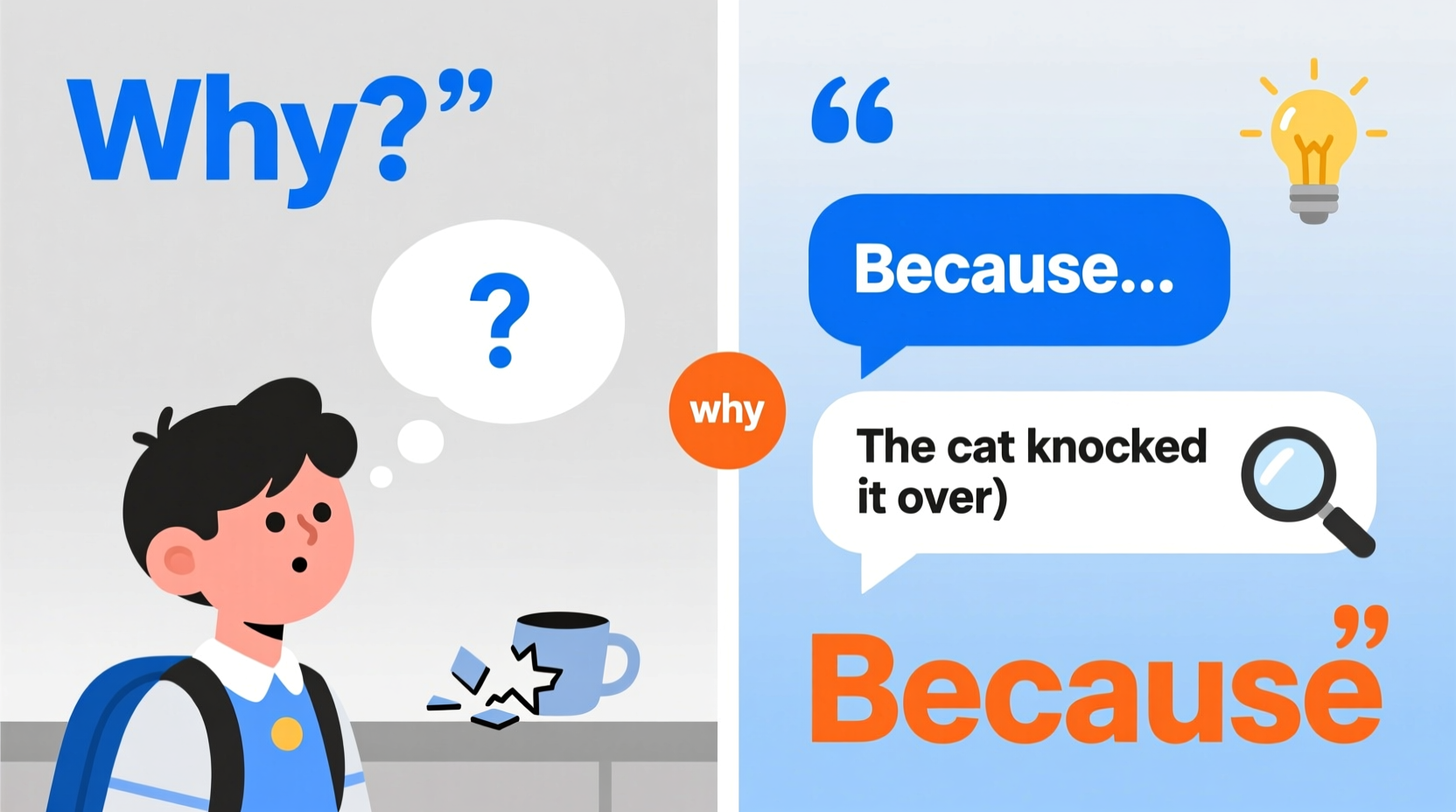
'Why' is an interrogative adverb used to ask about reasons or causes. It initiates questions that seek explanation: “Why did you leave early?” “Why is the sky blue?” In each case, 'why' demands a rationale.
In contrast, 'because' is a subordinating conjunction. It introduces a dependent clause that explains the cause or reason behind the main clause: “I left early because I had a doctor’s appointment.” Here, 'because' links the action (leaving early) to its justification (the appointment).
This fundamental distinction shapes how we construct sentences. You cannot substitute one for the other without altering the sentence's function and meaning.
Common Errors and How to Avoid Them
One of the most frequent mistakes involves answering a 'why' question with a 'because' clause alone. For example:
- Incorrect: Why did you skip class? Because I was sick.
- Correct: Why did you skip class? I skipped class because I was sick.
While the first response is commonly used in casual conversation, it's technically a fragment. In formal writing or academic contexts, complete sentences are expected. The second version maintains grammatical integrity by including a subject and verb before the 'because' clause.
Another error arises when writers start sentences with 'because' and fail to connect them to an independent clause:
- Incorrect: Because it was raining. We stayed indoors.
- Correct: Because it was raining, we stayed indoors.
- Also Correct: It was raining, so we stayed indoors.
The word 'because' cannot stand alone as a sentence—it must be attached to a main clause to form a complete thought.
Using 'Why' and 'Because' Together Effectively
When used in tandem, 'why' and 'because' create a natural flow from inquiry to explanation. However, care must be taken not to create redundancy or circular logic.
Consider this example:
“Why do plants need sunlight?” “Plants need sunlight because they use it for photosynthesis.”
This exchange is clear and effective. The 'why' question prompts a cause-and-effect response introduced by 'because'. The answer includes both the main clause (“Plants need sunlight”) and the explanatory subordinate clause (“because they use it for photosynthesis”).
A poorly constructed version might say: “Why do plants need sunlight? Because they need energy.” While not entirely wrong, it lacks specificity and doesn’t fully resolve the original question. A stronger answer would explain how sunlight provides energy.
| Question (Using 'Why') | Weak Answer | Strong Answer (Using 'Because') |
|---|---|---|
| Why did the project fail? | Because no one worked on it. | The project failed because team members were reassigned without replacement, leading to stalled progress. |
| Why is exercise important? | Because it’s good for you. | Exercise is important because it improves cardiovascular health, strengthens muscles, and supports mental well-being. |
| Why do birds migrate? | Because it gets cold. | Birds migrate because changing seasons reduce food availability, prompting them to move to warmer regions with more resources. |
Expert Insight on Clarity in Explanation
“Precise language separates adequate writing from excellent writing. When students understand that 'why' seeks depth and 'because' delivers it, their arguments become more coherent.” — Dr. Rebecca Langston, Professor of Rhetoric and Composition, University of Toronto
Experts emphasize that mastering these words isn't just about grammar—it's about critical thinking. Asking 'why' pushes us to dig deeper, while using 'because' compels us to articulate our reasoning clearly. This skill is essential in academic essays, business reports, and persuasive communication.
Step-by-Step Guide to Constructing Clear Cause-and-Effect Sentences
To ensure your use of 'why' and 'because' is both grammatically correct and logically sound, follow this five-step process:
- Identify the event or action you want to explain (e.g., “She resigned from her job”)
- Ask 'why' to prompt the reason (“Why did she resign?”)
- Determine the actual cause (“She felt overworked and underappreciated”)
- Link the two using 'because' in a complete sentence: “She resigned from her job because she felt overworked and underappreciated.”
- Revise for clarity and conciseness, removing vague terms like “stuff,” “things,” or “because of that.”
This method ensures that explanations are thorough and structurally sound, avoiding fragments and ambiguity.
Mini Case Study: Improving Student Writing
In a high school English class, students were asked to write a short analysis of a character’s decision in a novel. Many responses began with “Because he was sad,” leaving the main clause implied but unstated. The teacher highlighted this issue and introduced a revision exercise.
Students rewrote their answers using full sentences: “He refused to attend the party because he was still grieving his brother’s death.” The revised versions were clearer, more mature, and earned higher marks. Over time, the class developed a habit of pairing 'because' with a complete independent clause, significantly improving their analytical writing.
Frequently Asked Questions
Can I start a sentence with 'because'?
Yes, you can—and should—start a sentence with 'because' when introducing a reason that follows a previous statement or when emphasizing causality. Just make sure the sentence includes both a dependent clause starting with 'because' and an independent clause. Example: “Because the data was inconclusive, the study was repeated.”
Is it ever acceptable to answer a 'why' question with only a 'because' clause?
In informal speech, yes. Conversational English often allows fragments for brevity and rhythm. However, in formal writing, exams, or professional communication, always provide a complete sentence to maintain clarity and grammatical correctness.
Are 'since' and 'as' interchangeable with 'because'?
Sometimes, but with caution. 'Since' and 'as' can indicate cause, but they also have temporal meanings. For example, “Since we met, I’ve been happier” refers to time, not cause. To avoid ambiguity, especially in formal writing, 'because' is the clearest choice when stating reasons.
Checklist: Using 'Why' and 'Because' Correctly
- ✔ Use 'why' to ask for reasons or motivations
- ✔ Begin explanations with 'because' to introduce causal clauses
- ✔ Never leave a 'because' clause hanging—attach it to a main clause
- ✔ Avoid starting answers with 'because' in formal writing unless embedded in a full sentence
- ✔ Replace vague causes with specific, detailed explanations
- ✔ Proofread for sentence fragments, especially after using 'because'
Conclusion
Mastering the distinction between 'why' and 'because' goes beyond memorizing grammar rules—it sharpens your ability to think critically and communicate effectively. Whether you're writing an essay, explaining a decision at work, or helping someone understand your choices, using these words correctly ensures your message is both logical and persuasive.




 浙公网安备
33010002000092号
浙公网安备
33010002000092号 浙B2-20120091-4
Comments
No comments yet. Why don't you start the discussion?