
Abraham Lincoln remains one of the most revered figures in American history, not only for the dramatic circumstances of his presidency but for the profound and lasting impact he had on the nation’s identity. Rising from humble beginnings to become the 16th President of the United States, Lincoln led the country through its most divisive crisis—the Civil War—and fundamentally reshaped the moral and political fabric of the Union. His commitment to preserving the nation, ending slavery, and redefining democracy continues to influence American values today.
The Journey from Log Cabin to the White House
Lincoln's story is emblematic of the American dream. Born in a one-room log cabin in Kentucky in 1809, he had little formal education and worked as a rail-splitter, postmaster, and lawyer before entering politics. What set him apart was his self-discipline, intellectual curiosity, and powerful oratory skills. He taught himself law by reading books borrowed from friends and eventually established a successful legal career in Illinois.
His political ascent began in the Illinois state legislature, followed by a term in the U.S. House of Representatives. Though his early congressional tenure was unremarkable, his opposition to the expansion of slavery into new territories gained national attention during the 1858 debates with Stephen A. Douglas. These debates showcased Lincoln’s moral clarity and rhetorical brilliance, laying the foundation for his 1860 presidential campaign.
Preserving the Union During the Civil War
Elected in 1860 without carrying a single Southern state, Lincoln faced immediate secession. By the time he took office in March 1861, seven Southern states had formed the Confederate States of America. His primary objective from day one was clear: preserve the Union at all costs.
When Confederate forces attacked Fort Sumter in April 1861, Lincoln responded decisively. He called for 75,000 volunteers to suppress the rebellion, expanded executive power beyond precedent, and suspended habeas corpus in certain areas to maintain order. While controversial, these actions were justified by Lincoln as necessary to prevent the collapse of the United States.
Throughout the war, Lincoln demonstrated strategic patience and adaptability. He cycled through multiple generals before finding effective military leadership in Ulysses S. Grant. He also managed complex political pressures—from Radical Republicans demanding swift emancipation to Northern Democrats advocating peace at any cost.
“With malice toward none, with charity for all… let us strive on to finish the work we are in.” — Abraham Lincoln, Second Inaugural Address, 1865
Emancipation and the End of Slavery
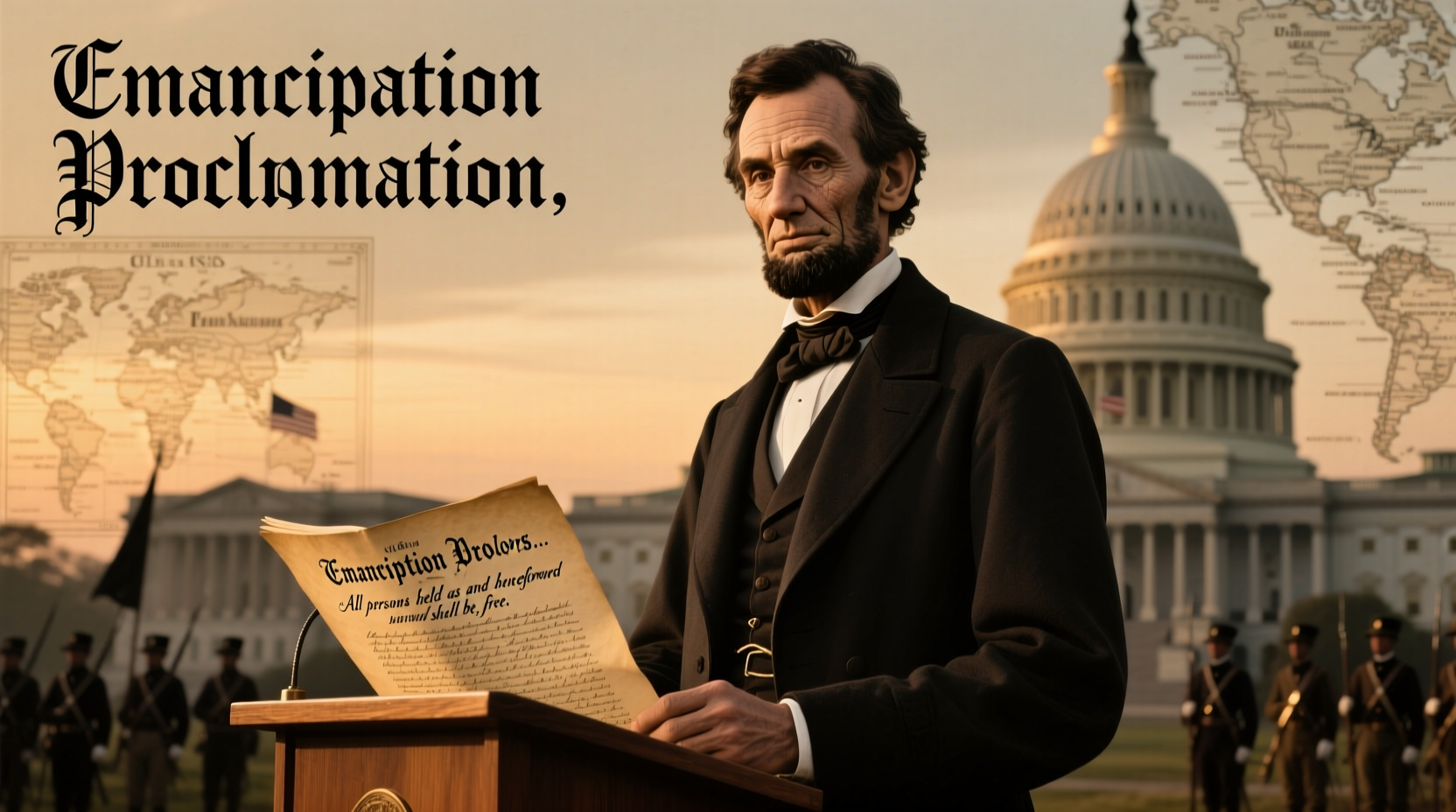
While initially focused on Union preservation, Lincoln gradually recognized that ending slavery was both a moral imperative and a strategic necessity. The Emancipation Proclamation, issued on January 1, 1863, declared freedom for enslaved people in Confederate-held territory. Though it did not immediately free all slaves, it transformed the war into a fight for human liberty and prevented European powers from supporting the Confederacy.
Lincoln then pushed aggressively for a constitutional amendment to abolish slavery nationwide. The 13th Amendment passed Congress in January 1865 and was ratified later that year, months after his death. This achievement marked a turning point in American civil rights and cemented Lincoln’s legacy as the “Great Emancipator.”
| Milestone | Date | Significance |
|---|---|---|
| Emancipation Proclamation | January 1, 1863 | Freed slaves in rebellious states; redefined war’s purpose |
| Gettysburg Address | November 19, 1863 | Reaffirmed democratic ideals and national unity |
| 13th Amendment Passed by Congress | January 31, 1865 | Abolished slavery constitutionally |
| Lincoln Assassinated | April 14, 1865 | Died days after Confederate surrender |
The Gettysburg Address and Redefining Democracy
No speech better encapsulates Lincoln’s vision than the Gettysburg Address. Delivered in November 1863 at the dedication of a soldiers’ cemetery following the Battle of Gettysburg—one of the bloodiest conflicts in American history—the two-minute address redefined the purpose of the war and the meaning of American democracy.
In just 272 words, Lincoln invoked the principles of human equality from the Declaration of Independence, framed the Civil War as a test of whether a nation “conceived in Liberty, and dedicated to the proposition that all men are created equal” could endure, and called for a “new birth of freedom.”
This concise yet powerful message elevated the Union cause beyond mere political survival to a moral crusade for justice and equality. Historians widely regard the Gettysburg Address as one of the most important speeches in American history.
Mini Case Study: The Power of Brevity and Clarity
At the Gettysburg ceremony, Edward Everett, a renowned orator, delivered a two-hour speech prior to Lincoln’s remarks. While meticulously researched and eloquent, it is largely forgotten today. In contrast, Lincoln’s brief address became iconic. This illustrates a timeless communication principle: clarity and emotional resonance often outweigh length and complexity. Leaders across fields—from business to education—can learn from Lincoln’s ability to distill profound ideas into accessible language.
Legacy and Long-Term Impact
Lincoln’s assassination in April 1865, just days after General Robert E. Lee’s surrender at Appomattox, cut short his plans for Reconstruction. Yet his vision shaped the post-war era. His emphasis on reconciliation over vengeance influenced early Reconstruction policies, though Congress later pursued a more punitive approach.
More broadly, Lincoln redefined the role of the federal government. He affirmed that states could not legally secede and that national unity superseded regional interests. His leadership established a precedent for strong executive action during national emergencies—a model future presidents would follow in times of crisis.
Culturally, Lincoln became a symbol of integrity, humility, and moral courage. Statues, schools, currency (the penny and $5 bill), and even a state (West Virginia, admitted during his term) bear his name. His life story continues to inspire generations as a testament to resilience, ethical leadership, and the possibility of transformation.
Expert Insight on Leadership
“Lincoln combined extraordinary resolve with deep compassion. He held firm to his principles while understanding the humanity of his opponents.” — Doris Kearns Goodwin, Pulitzer Prize-winning historian and author of *Team of Rivals*
Frequently Asked Questions
What made Abraham Lincoln such an effective leader?
Lincoln’s effectiveness stemmed from his emotional intelligence, strategic thinking, and moral clarity. He surrounded himself with strong, even rival, voices (his so-called “Team of Rivals”), listened carefully, and made decisions based on long-term vision rather than short-term popularity. His ability to communicate complex ideas simply and inspire hope during despair set him apart.
Did Lincoln always oppose slavery?
Lincoln personally opposed slavery from an early age, calling it a “moral, social, and political wrong.” However, he initially prioritized preventing its expansion over abolishing it where it already existed, believing the Constitution protected it in existing states. Over time, especially during the war, he evolved toward full emancipation as both a moral duty and a military necessity.
How did Lincoln die?
On April 14, 1865, Lincoln was assassinated by John Wilkes Booth, a well-known actor and Confederate sympathizer, while attending a play at Ford’s Theatre in Washington, D.C. Booth shot him in the back of the head and fled, leading to a massive manhunt. Lincoln died the next morning, becoming the first U.S. president to be assassinated.
Conclusion: Why Lincoln Still Matters
Abraham Lincoln’s fame endures because he stood at the crossroads of America’s greatest crisis and chose the path of unity, justice, and renewal. He preserved the Union, ended centuries of legalized slavery, and articulated a vision of democracy that still resonates. In an era of division and uncertainty, his example reminds us that leadership is not about perfection, but about purpose, perseverance, and the courage to do what is right—even when it is difficult.




 浙公网安备
33010002000092号
浙公网安备
33010002000092号 浙B2-20120091-4
Comments
No comments yet. Why don't you start the discussion?