
For decades, the name \"Bombay\" echoed through global conversations as the identity of India’s financial capital and cinematic heart. Then, in 1995, it officially became \"Mumbai.\" The shift wasn’t just administrative—it stirred debate, pride, and resistance across communities. Understanding why Bombay was renamed Mumbai requires delving into colonial legacies, linguistic roots, regional identity, and political transformation. This article unpacks the layers behind one of India’s most symbolic urban rebrandings.
The Colonial Origins of \"Bombay\"
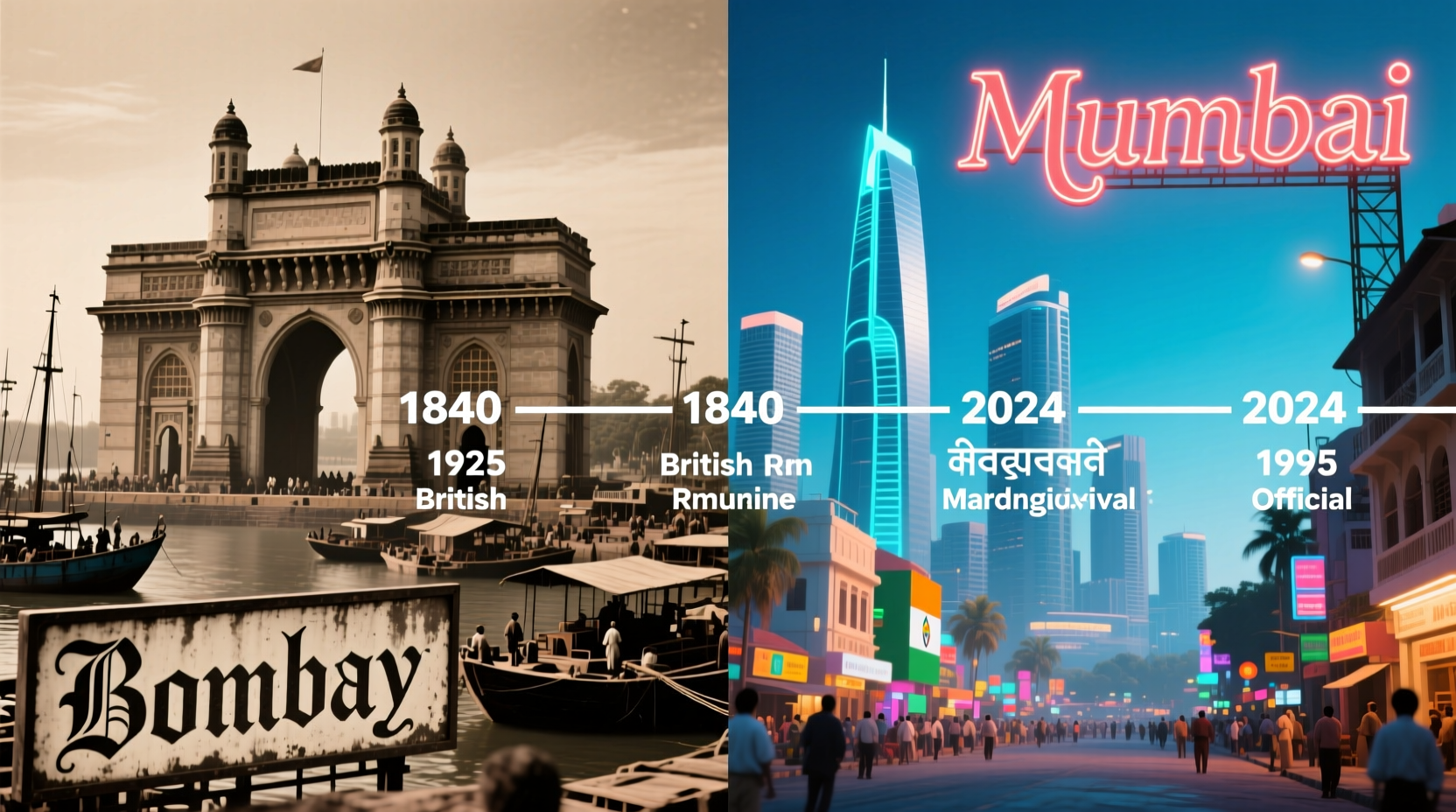
The name \"Bombay\" emerged during Portuguese rule in the 16th century. When the Portuguese took control of the seven islands that now form South Mumbai, they named the settlement \"Bom Bahia,\" meaning \"Good Bay\" in Portuguese. This reflected its strategic coastal location and natural harbor.
In 1661, as part of a royal dowry when Catherine of Braganza married England’s King Charles II, the islands were transferred to British control. The British anglicized \"Bom Bahia\" to \"Bombay,\" a name that stuck throughout nearly two centuries of colonial administration.
Under British rule, Bombay evolved into a major port, industrial hub, and center of trade. Its cosmopolitan character grew with waves of migration—from Parsis and Gujaratis to Marathas and South Indians—each contributing to its economic and cultural fabric. Yet, the name remained a colonial artifact, disconnected from local linguistic traditions.
The Indigenous Roots: Who Was \"Mumbai\"?
The shift to \"Mumbai\" was framed as a return to indigenous identity. The new name honors the city’s patron deity, Mumbadevi, a local goddess worshipped by the Koli fishing community—the original inhabitants of the region. \"Mumba\" is derived from her name, while \"ai\" means \"mother\" in Marathi, making \"Mumbai\" translate to \"Mother Mumba.\"
Long before colonialism, the area was known by various names in regional records—such as Parel, Sashthi, and Ramnath—but no single ancient name dominated. However, by the late 20th century, proponents of renaming argued that \"Mumbai\" better reflected the city’s Marathi heritage and pre-colonial roots.
Linguistically, the transition aligned with a broader trend in India: reclaiming native place names. Calcutta became Kolkata, Madras became Chennai, and Bangalore became Bengaluru—all part of a national effort to shed colonial nomenclature and assert cultural authenticity.
Political Catalyst: The Shiv Sena Movement
The formal push to rename Bombay came not from historians, but from politics. In the 1960s, the regional party Shiv Sena, founded by Bal Thackeray, began advocating for Marathi pride and the rights of local Maharashtrians amid growing migration from other Indian states.
For Shiv Sena, \"Bombay\" symbolized foreign domination and elite cosmopolitanism that marginalized native Marathi speakers. Changing the name to \"Mumbai\" was both a symbolic and practical assertion of regional identity. It was part of a larger agenda that included job reservations for locals and protection of Marathi language in public life.
When Shiv Sena formed a coalition government with the Bharatiya Janata Party (BJP) in Maharashtra in 1995, the name change was swiftly enacted. On November 14, 1995, the state government officially adopted \"Mumbai\" for all administrative purposes, replacing \"Bombay\" on maps, railway stations, and government documents.
“Names are not just labels—they are claims to history and belonging.” — Dr. Amrita Chatterjee, Historian of Urban India
A Timeline of the Name Change
The evolution from Bombay to Mumbai was neither sudden nor universally accepted. Here’s a step-by-step look at key milestones:
- 1500s: Portuguese name the settlement \"Bom Bahia.\"
- 1661: Ceded to Britain; name becomes \"Bombay.\"
- 1960s: Shiv Sena emerges, promoting Marathi identity and criticizing colonial names.
- 1970s–1980s: \"Mumbai\" begins appearing in regional media and literature.
- 1993: After the Bombay riots and bombings, some civic groups call for a symbolic break from the past.
- 1995: Maharashtra government officially renames the city \"Mumbai.\"
- 2006: Indian Railways changes \"Bombay Victoria Terminus\" to \"Chhatrapati Shivaji Maharaj Terminus.\"
- Present: \"Mumbai\" is standard in official use, though \"Bombay\" persists in cultural contexts.
Cultural Duality: Mumbai vs. Bombay Today
Despite the official change, both names coexist in contemporary usage. \"Mumbai\" dominates government, education, and formal discourse. But \"Bombay\" lingers in affectionate expressions: \"Bombay Times,\" \"Bombay Dost\" (a LGBTQ+ magazine), \"Bombay Sapphire\" gin, and Bollywood songs that croon about \"Bombay meri jaan.\"
This duality reflects the city’s complex identity—rooted in Marathi culture yet shaped by global influences. For many residents, using \"Bombay\" isn’t about resisting change, but preserving a sense of nostalgia, inclusivity, and artistic legacy.
A mini case study illustrates this tension: A young software engineer born in Mumbai refers to her city as \"Mumbai\" at work but calls it \"Bombay\" when talking to her grandparents. To them, \"Bombay\" evokes memories of chawls, Irani cafes, and the 1980s textile mills—elements of a vanishing world. Her dual usage isn’t confusion; it’s code-switching between generations and identities.
Do’s and Don’ts: Navigating the Name in Practice
| Do | Don't |
|---|---|
| Use \"Mumbai\" in official, academic, or governmental contexts. | Assume people who say \"Bombay\" are outdated or uninformed. |
| Respect personal preference—many lifelong residents still say \"Bombay.\" | Use the name change to fuel regionalist or exclusionary rhetoric. |
| Recognize both names as valid in different cultural registers. | Dismiss the emotional weight either name carries for locals. |
Frequently Asked Questions
Is Bombay still an acceptable name to use?
Yes, especially in informal, cultural, or nostalgic contexts. Many institutions and brands retain \"Bombay\" in their names. However, in official communication, \"Mumbai\" is preferred.
Did the name change affect postal services or international recognition?
No. While addresses were updated administratively, the transition was smooth. International organizations and airlines adapted quickly. The United Nations and ISO standards now recognize \"Mumbai\" as the official name.
Was the name change only about language, or were there economic motives?
The primary motive was cultural and political, not economic. However, some proponents believed that shedding colonial names would strengthen regional pride, which could indirectly influence investment and governance by fostering local ownership.
Conclusion: More Than Just a Name
The renaming of Bombay to Mumbai was never just about geography. It was a declaration of identity—a reclamation of narrative from colonial hands and a celebration of Marathi heritage. Yet, the enduring presence of \"Bombay\" in everyday speech shows that cities are more than their official designations. They are living entities shaped by memory, migration, and meaning.
Understanding this duality allows for deeper appreciation of Mumbai’s complexity. Whether you call it Bombay or Mumbai, what remains unchanged is its energy, ambition, and ability to reinvent itself—just like the people who call it home.




 浙公网安备
33010002000092号
浙公网安备
33010002000092号 浙B2-20120091-4
Comments
No comments yet. Why don't you start the discussion?