
In February 2017, Senator Cory Booker of New Jersey made headlines with a nearly 15-hour Senate floor speech that many described as a modern-day filibuster. Though not a true filibuster in the procedural sense—since no vote was being blocked—Booker’s marathon address was a powerful act of protest against the direction of U.S. immigration policy under the new Trump administration. The speech wasn’t about delaying legislation through endless debate, but rather about amplifying voices at risk of being erased from national discourse. To understand why Booker took this extraordinary step, it’s essential to examine the political climate, the human stories behind his words, and the symbolic weight of such an action in American democracy.
The Context Behind the Speech
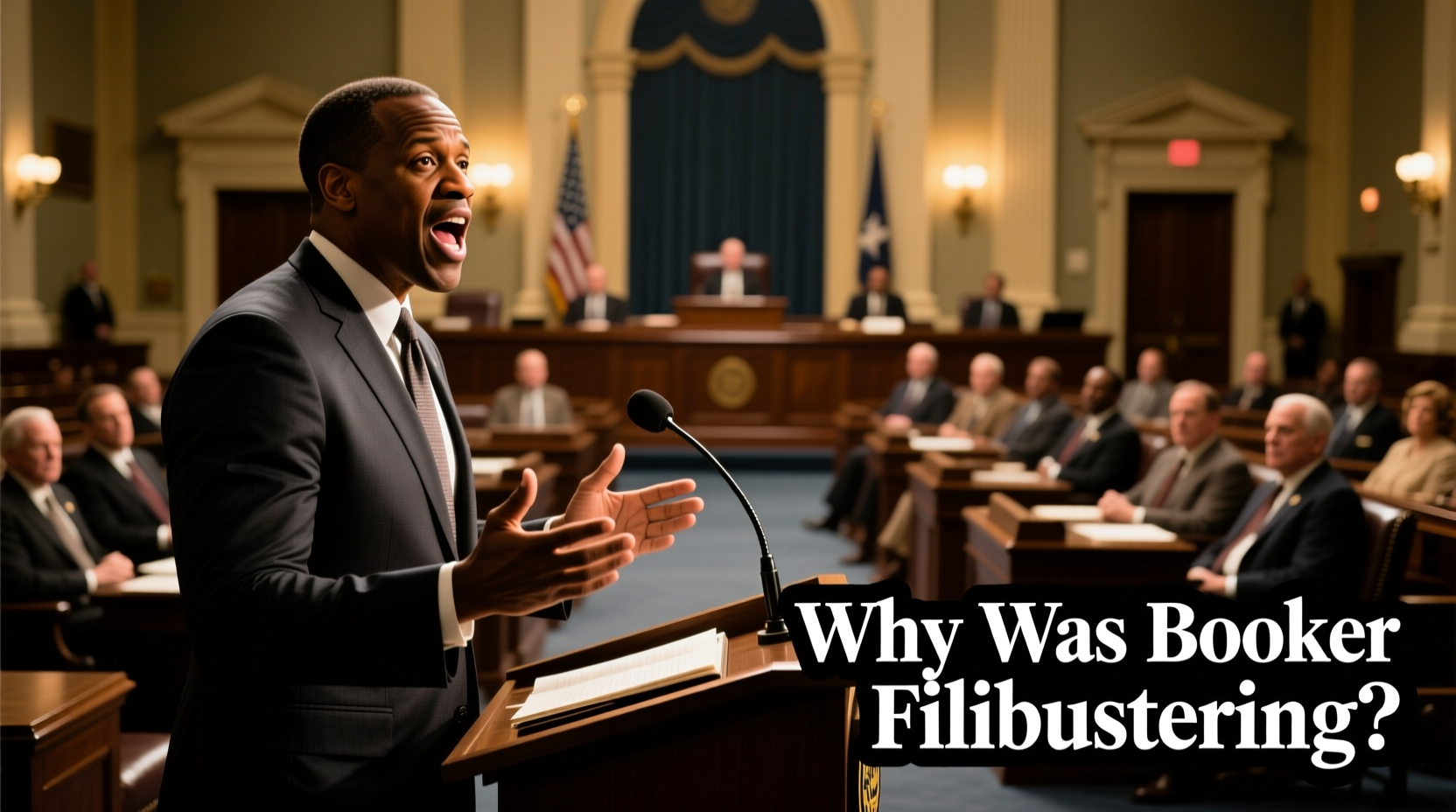
Booker began his speech shortly after President Donald Trump signed Executive Order 13769, commonly known as the \"travel ban,\" which suspended entry into the United States for citizens of seven predominantly Muslim countries. The order sparked widespread protests at airports, legal challenges, and deep concern among immigrant communities. At the same time, Attorney General nominee Jeff Sessions faced opposition due to his controversial record on civil rights and immigration enforcement.
While Sessions’ confirmation was not in immediate danger, Booker used the platform of the Senate floor to deliver a moral argument. He spoke for hours without interruption, sharing personal narratives of immigrants, quoting historical figures like Frederick Douglass and Martin Luther King Jr., and recounting stories of individuals affected by harsh immigration policies. His goal was not procedural delay, but public education and emotional appeal.
“America is at its best when we are opening our arms, not pushing people away.” — Cory Booker, during his 2017 Senate speech
What Is a Filibuster? Clarifying the Term
The word “filibuster” typically refers to a legislative tactic used in the U.S. Senate to extend debate and delay or prevent a vote on a bill. Traditionally, senators must hold the floor continuously, speaking without sitting or yielding, until the majority agrees to end debate via cloture (which requires 60 votes).
However, Booker’s speech did not meet the technical definition of a filibuster. There was no pending vote he was attempting to block, and Senate rules allowed other senators to speak between his remarks. Still, the media and public widely referred to it as a “filibuster” due to its length, intensity, and symbolic resistance.
This distinction matters: Booker wasn’t exploiting Senate procedure—he was using its most visible stage to make a statement. In doing so, he revived a tradition of extended speeches used for moral suasion, akin to Senator Strom Thurmond’s 1957 segregationist filibuster or Senator Bernie Sanders’ 2010 speech against tax cuts for the wealthy.
The Human Stories That Fueled the Speech
What set Booker’s speech apart was its deeply personal tone. Over the course of 14 hours and 49 minutes, he shared stories of real people impacted by deportation, family separation, and systemic injustice. These included:
- A DACA recipient studying nursing who feared losing her ability to work legally.
- A Yemeni-American grocery store owner detained upon returning from visiting sick relatives.
- A Ugandan refugee granted asylum after fleeing persecution, only to face renewed threats under tightened policies.
By centering individual experiences, Booker reframed immigration not as a matter of law enforcement or border security alone, but as a question of human dignity. He emphasized how policies affect real lives—children separated from parents, workers contributing to local economies, families building communities across generations.
Political Strategy and Public Impact
Though the speech did not alter the outcome of Jeff Sessions’ confirmation—he was approved by the full Senate days later—it succeeded in shifting public conversation. Major news outlets covered Booker’s endurance, social media amplified key quotes, and advocacy groups cited his words in subsequent campaigns.
More importantly, the speech positioned Booker as a leading progressive voice on civil rights and immigration. It showcased his rhetorical skill, stamina, and willingness to take bold stands—a moment that foreshadowed his eventual presidential run in 2020.
Political analysts noted that while such speeches rarely change votes, they can influence long-term narratives. As Julian Zelizer, Princeton professor of history and public affairs, observed:
“Extended Senate speeches don’t win legislative battles overnight, but they plant seeds. They define moments, shape legacies, and remind Americans what their values should be.” — Julian E. Zelizer, Historian and Political Analyst
Timeline of Key Events During the Speech
- 7:00 PM (EST): Booker begins speaking on the Senate floor, focusing on the legacy of civil rights leaders.
- 10:30 PM: Shares story of a Guatemalan mother deported after years of lawful residence.
- 1:15 AM: Recites poetry and quotes from Abraham Lincoln on unity and justice.
- 5:00 AM: Describes conditions in immigration detention centers based on firsthand accounts.
- 9:49 AM (next day): Concludes after 14 hours and 49 minutes, receiving applause from colleagues.
Why This Moment Mattered: A Mini Case Study
Consider Maria Gonzalez, a Dreamer living in Newark, New Jersey. After hearing excerpts of Booker’s speech on local radio, she attended a community forum organized by a nonprofit immigrant rights group. Inspired by the senator’s defense of DACA recipients, she applied for public speaking training and later testified before city council in support of a sanctuary city resolution.
While Booker never mentioned her by name, his speech created space for people like Maria to feel seen and empowered. Advocacy organizations reported a 30% increase in volunteer sign-ups in the week following the address. This ripple effect illustrates how symbolic political acts can translate into grassroots mobilization.
Do’s and Don’ts of Using Extended Speeches for Advocacy
| Do’s | Don’ts |
|---|---|
| Center human stories to personalize policy issues | Rely solely on statistics without narrative context |
| Quote historical figures to ground arguments in tradition | Use inflammatory language that alienates moderates |
| Prepare thoroughly to maintain credibility and energy | Exaggerate facts or misrepresent data |
| Leverage media coverage to extend reach beyond the chamber | Ignore follow-up actions needed to sustain momentum |
Frequently Asked Questions
Was Cory Booker’s speech officially a filibuster?
No. While widely called a filibuster in media reports, it did not meet the formal Senate definition. A true filibuster aims to delay a vote, and cloture must be invoked to end it. Booker’s speech occurred during general debate and did not obstruct a specific legislative action.
How long did Cory Booker speak?
He spoke for 14 hours and 49 minutes, starting around 7:00 PM on February 8, 2017, and concluding the next morning at approximately 9:49 AM.
Did the speech stop Jeff Sessions from becoming Attorney General?
No. Jeff Sessions was confirmed as Attorney General two days later by a Senate vote of 52–47. However, the speech elevated national scrutiny of his record on voting rights, racial justice, and immigration enforcement.
Action Steps: How to Respond to Injustices Like Booker Did
Not everyone can take the Senate floor, but civic engagement takes many forms. Here’s a checklist inspired by Booker’s approach:
- 📚 Educate yourself on the history and impact of policies affecting marginalized communities.
- 🗣️ Amplify personal stories by listening to and sharing lived experiences.
- 📰 Contact your representatives regularly—not just during crises.
- 🤝 Support organizations working on immigration, civil rights, and legal aid.
- 📢 Speak publicly when possible, whether at town halls, schools, or online platforms.
Conclusion: Standing Up When It Matters
Cory Booker’s 2017 speech was more than a political gesture—it was a call to conscience. In an era of rapid executive action and polarized debate, he chose to use time itself as a tool: time to reflect, to remember, to imagine a more inclusive America. Whether or not it changed votes, it reminded millions that democracy depends not just on procedures, but on passion, persistence, and presence.




 浙公网安备
33010002000092号
浙公网安备
33010002000092号 浙B2-20120091-4
Comments
No comments yet. Why don't you start the discussion?