
In July 2011, a jury in Orlando, Florida, delivered a verdict that shocked the nation: Casey Anthony was found not guilty of murdering her 2-year-old daughter, Caylee. The case had dominated headlines for years, fueled by emotional media coverage, public outrage, and graphic speculation. Yet despite overwhelming public belief in her guilt, the prosecution failed to secure a conviction on the most serious charges. The outcome hinged not on what many people thought happened, but on what the state could prove beyond a reasonable doubt under the American legal system.
The acquittal sparked intense debate about justice, media influence, and the burden of proof. To understand why the jury reached this decision, it’s essential to examine the core legal principles at play, the evidence (or lack thereof), and the strategic missteps that ultimately shaped the trial’s outcome.
The Presumption of Innocence and Burden of Proof
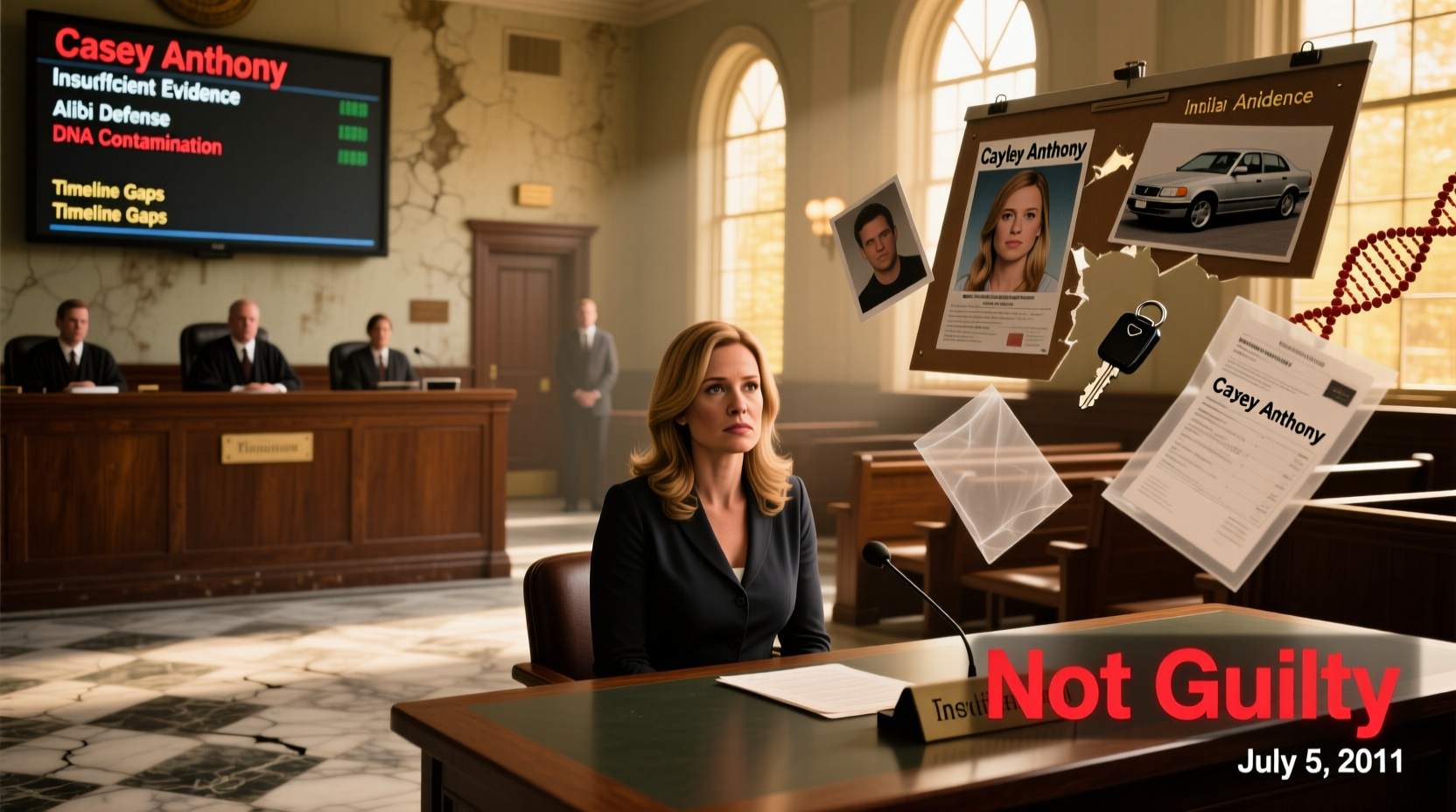
At the heart of the American criminal justice system lies a foundational principle: every defendant is presumed innocent until proven guilty. This means the burden rests entirely on the prosecution to prove each element of a crime beyond a reasonable doubt. In the Casey Anthony case, the stakes were exceptionally high—first-degree murder carries the death penalty in Florida—but the prosecution did not meet this standard.
The defense, led by Jose Baez, repeatedly emphasized this legal truth throughout the trial. They didn’t need to prove Casey’s innocence; they only needed to create enough doubt about the prosecution’s narrative to prevent a conviction.
“Beyond a reasonable doubt isn’t about what we suspect or feel. It’s about what can be proven with credible, admissible evidence.” — Judge Belvin Perry Jr., presiding judge in the Casey Anthony trial
Lack of Physical Evidence Linking Casey to Murder
One of the most critical factors in the not guilty verdict was the absence of direct physical evidence tying Casey Anthony to her daughter’s death. Despite extensive searches, investigators never found:
- A clear cause of death
- DNA linking Casey to the alleged crime scene
- Forensic evidence such as fingerprints, blood, or signs of struggle in the family car or home
- Caylee’s body showed advanced decomposition, making forensic analysis difficult
The medical examiner, Dr. Jan Garavaglia, testified that she could not determine how Caylee died. While she noted chloroform and duct tape impressions, these findings were speculative and not conclusive. Without a confirmed cause of death, the prosecution’s theory of homicide unraveled under cross-examination.
Timeline of Events and Casey’s Behavior
The prosecution argued that Casey murdered Caylee in June 2008, then concealed her death for weeks while living a seemingly carefree life. Key points included:
- Casey did not report Caylee missing for 31 days
- She was seen partying, getting tattoos, and lying to family and authorities
- She falsely claimed to have worked at Universal Studios
While this behavior appeared suspicious and morally indefensible, it did not legally equate to murder. The defense successfully reframed these actions as those of a young, irresponsible mother in denial—not a calculated killer. Jurors were instructed to separate moral judgment from legal proof.
A timeline presented during the trial highlighted inconsistencies in the prosecution’s narrative:
| Event | Date | Significance |
|---|---|---|
| Last confirmed sighting of Caylee | June 16, 2008 | No verified sightings after this date |
| Casey fails to return Caylee to daycare | June 17–July 15, 2008 | Triggered initial concern |
| Body discovered in woods | December 11, 2008 | Found near Casey’s home, wrapped in trash |
| Autopsy inconclusive on cause of death | January 2009 | No evidence of trauma or poisoning |
| Trial begins | May 2011 | Jury selection starts |
| Not guilty verdict | July 5, 2011 | On first-degree murder and aggravated child abuse |
Prosecution Missteps and Overreach
The state’s case suffered from several strategic errors that weakened its credibility. Perhaps the most damaging was the decision to lead with an emotionally charged, speculative theory involving chloroform and suffocation—without definitive scientific backing.
Dr. Werner Spitz, a renowned forensic pathologist not involved in the case, later criticized the prosecution’s reliance on unverified conclusions:
“They built a house of cards based on assumptions. No body, no cause of death, no murder weapon—yet they asked for the death penalty. That’s a recipe for juror skepticism.” — Dr. Werner Spitz, Forensic Pathologist
Additionally, the prosecution failed to effectively counter the defense’s alternative theory: that Caylee accidentally drowned in the family pool, and George Anthony (Casey’s father) helped dispose of the body out of shame. While unproven, this scenario introduced plausible doubt—a threshold the defense only needed to meet, not exceed.
Jury Instructions and Legal Realities
Jurors were explicitly instructed to base their decision solely on the evidence presented in court, not on emotion, media reports, or personal beliefs. The judge reminded them that “not guilty” does not mean “innocent”—only that guilt was not proven beyond a reasonable doubt.
This distinction is crucial. Many observers conflated public outrage with legal certainty. But in a courtroom, sympathy for the victim cannot substitute for evidentiary rigor. One juror later stated in an interview: “We wanted to believe the prosecution, but they just didn’t give us enough. We had to follow the law.”
FAQ
Was Casey Anthony convicted of any charges?
Yes. Although acquitted of murder, she was found guilty on four counts of providing false information to law enforcement. She served three years in jail, including time already served, and was released in 2013.
Why didn’t the duct tape on Caylee’s face lead to a murder conviction?
While the duct tape was disturbing, experts could not confirm whether it was applied before or after death. The prosecution argued it was used to suffocate Caylee, but the defense suggested it could have been placed post-mortem to stabilize remains. Without definitive proof, this became a point of reasonable doubt.
Could new evidence change the outcome today?
Legally, no. Double jeopardy prevents retrial for the same offense after an acquittal. Even if new evidence emerged, Casey Anthony cannot be prosecuted again for Caylee’s murder under the Fifth Amendment.
Key Takeaways: Why the Verdict Made Legal Sense
The Casey Anthony verdict wasn’t about whether she was a good mother or whether her actions were suspicious. It was about whether the prosecution met its burden of proof. Several interconnected factors contributed to the not guilty outcome:
- No body, no cause of death: Without a clear mechanism of death, the murder charge collapsed.
- Weak forensic evidence: Trace elements like chloroform were not conclusively linked to the crime.
- Defense-created doubt: The drowning theory, however unlikely, provided an alternative explanation.
- Prosecution overreach: Presenting speculative science damaged their credibility.
- Jury adherence to the law: Despite public pressure, jurors followed instructions and required proof, not suspicion.
Conclusion
The Casey Anthony trial remains a stark reminder of how the legal system functions differently from public perception. Emotion, morality, and media narratives may shape opinions, but in a courtroom, only evidence and procedure matter. The not guilty verdict wasn’t a declaration of innocence—it was a reflection of the prosecution’s failure to meet the highest standard of proof.
Understanding this case helps clarify the importance of due process, even in the most painful circumstances. Justice isn’t always satisfying, but it must be fair.




 浙公网安备
33010002000092号
浙公网安备
33010002000092号 浙B2-20120091-4
Comments
No comments yet. Why don't you start the discussion?