
In December 2020, one of the most anticipated video games in years—Cyberpunk 2077—launched to a storm of controversy. Developed by CD Projekt Red and published by CD Projekt, the game had been hyped for nearly a decade. However, instead of praise, it faced widespread criticism for its technical instability, especially on last-generation consoles like the PlayStation 4. Within days of release, Sony made an unprecedented move: they removed Cyberpunk 2077 from the PlayStation Store. This was not just a business decision—it was a statement. Understanding why this happened requires examining the game’s troubled development, the expectations set by marketing, and the real-world consequences players experienced.
The Perfect Storm: Hype vs. Reality
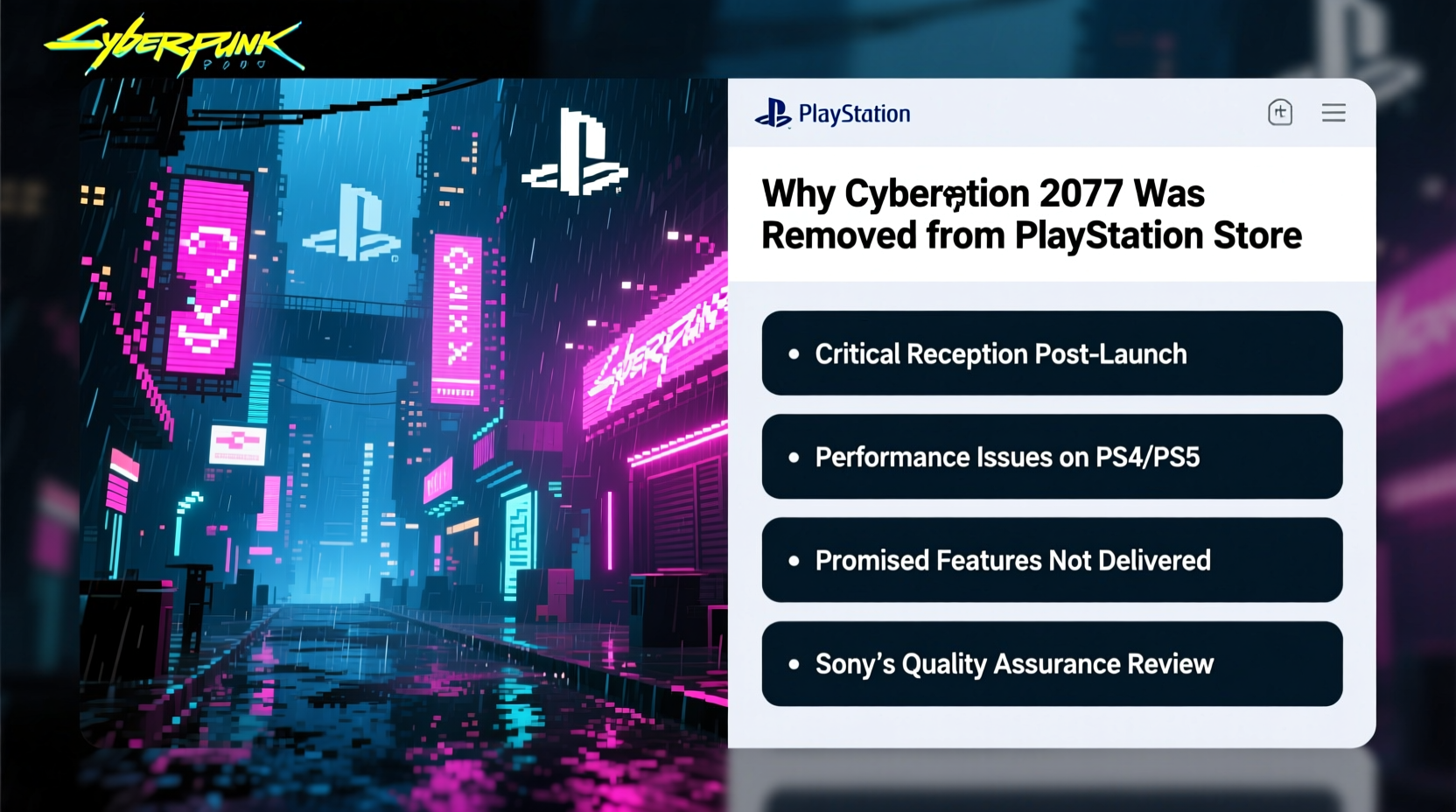
Cyberpunk 2077 was marketed as a revolutionary open-world RPG. Trailers showcased a living, breathing Night City with dynamic AI, deep character customization, and seamless integration between story and environment. The game promised console players an experience on par with high-end PCs. But when it launched on December 10, 2020, the reality was drastically different—especially on PS4 and Xbox One.
Players reported constant crashes, broken quests, missing dialogue, graphical glitches, and severe performance issues. Some missions became unplayable due to bugs that prevented progression. In extreme cases, save files were corrupted, forcing players to restart from earlier checkpoints or abandon progress entirely. These weren’t minor annoyances—they undermined the core gameplay loop.
Sony’s Unprecedented Action
On December 17, 2020—just one week after launch—Sony announced that Cyberpunk 2077 would be temporarily removed from the PlayStation Store. This was a rare move. While games are occasionally delisted for licensing or legal reasons, removing a major AAA title due to quality issues was virtually unheard of.
Sony’s official statement read: “We apologize to our players—out of respect for them, we’re temporarily removing Cyberpunk 2077 from the PlayStation Store until further notice.” The company also offered full refunds to anyone who wanted them, regardless of how much time they’d spent in the game. This gesture underscored the severity of the situation.
The removal wasn’t punitive in the traditional sense. Rather, it served as both consumer protection and a signal to developers about quality standards on the PlayStation platform.
Technical Deficiencies on Last-Gen Consoles
The root of the problem lay in the disparity between hardware capabilities and software demands. The PS4, released in 2013, had limited RAM (8GB), modest GPU power, and slow HDD storage. Cyberpunk 2077, designed for high-fidelity rendering and complex systems, pushed these machines far beyond their limits.
Common issues included:
- Frequent frame rate drops (often below 15 FPS)
- Extended loading times between areas
- Texture pop-in and environmental clipping
- Mission-breaking scripting errors
- AI characters stuck in geometry or failing to respond
While PC and next-gen versions (PS5, Xbox Series X/S) fared better, even those weren’t immune to bugs. But it was the PS4 version that bore the brunt of the backlash, largely because many players still relied on older hardware at the time.
“Releasing a game in such a state does a disservice to players and damages trust in the entire ecosystem.” — Shawn Layden, Former Chairman of SIE Worldwide Studios
A Timeline of Key Events
The removal didn’t happen in isolation. It followed a rapid sequence of events that highlighted growing frustration from both players and the platform holder.
- December 10, 2020: Cyberpunk 2077 launches globally. Immediate reports of bugs flood social media.
- December 11–13: Major gaming outlets publish scathing reviews citing poor optimization and instability on PS4.
- December 14: CD Projekt Red issues an apology, acknowledging the game’s state and promising fixes.
- December 15: Sony begins offering automatic refunds through its support channels.
- December 17: Game is pulled from the PlayStation Store.
- January 2021: CD Projekt Red releases patch 1.05, addressing critical bugs and improving stability.
- June 2021: Game returns to the PlayStation Store with updated warnings about performance on PS4.
This timeline shows how quickly the situation escalated. What began as typical post-launch feedback spiraled into a crisis of confidence.
The Role of Marketing and Misleading Expectations
One of the most controversial aspects of the Cyberpunk 2077 saga was the disconnect between marketing materials and the final product. Trailers shown at E3 and other expos featured smooth gameplay, advanced lighting, and responsive AI—all running on unspecified hardware. Many fans assumed these visuals represented what would be possible on consoles.
However, internal reports later revealed that CD Projekt Red had been showing PC-footage during presentations, sometimes using pre-rendered sequences passed off as real-time gameplay. While common in early development, doing so close to launch without clear disclaimers contributed to player disillusionment.
As one former developer anonymously told Bloomberg: “We knew the console versions weren’t ready. There was pressure to keep promoting the dream, even when the reality couldn’t match it.”
| Aspect | Promised Experience | Actual Console Experience (PS4) |
|---|---|---|
| Visual Fidelity | Ray tracing, ultra textures, dense crowds | Low-resolution assets, sparse NPCs, flat lighting |
| Performance | Smooth 30 FPS, fast load times | Frequent dips below 20 FPS, long loads |
| Stability | Seamless world interaction | Crashes every 20–30 minutes, quest blockers |
| AI Behavior | Dynamic reactions, realistic routines | Glitchy navigation, repetitive loops |
CD Projekt Red’s Response and Damage Control
Facing intense scrutiny, CD Projekt Red took several steps to regain trust:
- Issued public apologies from top executives, including CEO Adam Kiciński.
- Released a series of patches aimed at stabilizing the game.
- Announced that all paid DLC would be free for six months.
- Halted internal bonuses for leadership while rewarding QA testers.
- Committed to rebuilding the PS4 version from the ground up.
Perhaps most significantly, the studio acknowledged that rushing the release to meet investor expectations had been a mistake. In a shareholder letter, they admitted: “We focused too much on meeting the release date and not enough on ensuring the quality bar was met.”
Mini Case Study: A Player’s Experience
Take the case of Mark T., a long-time PlayStation user and sci-fi enthusiast. He pre-ordered Cyberpunk 2077 six months in advance, excited to dive into Night City on his PS4 Pro. On launch day, he downloaded the game and started playing.
Within two hours, he encountered three crashes, missed key dialogue due to audio bugs, and found himself stuck in a wall during a main quest. After trying restarts and reinstalling the game, he contacted Sony Support and received a full refund.
“I didn’t want to return it,” Mark said. “I love the concept, the world, the characters. But I couldn’t justify paying $60 for something that felt unfinished. I’ll try it again when it’s actually playable.”
His experience mirrored thousands of others. For many, the issue wasn’t just bugs—it was the feeling of being disregarded as customers.
Long-Term Impact on the Industry
The Cyberpunk 2077 debacle had ripple effects across the gaming industry:
- Increased scrutiny on game previews: Publishers now face pressure to disclose which platform footage is captured on.
- Greater emphasis on post-launch support: Players expect transparency about roadmaps and patch timelines.
- Shift in consumer behavior: More gamers are waiting for “version 1.1” before purchasing highly anticipated titles.
- Regulatory attention: Authorities in Poland investigated CD Projekt for potential investor misinformation.
Additionally, Sony tightened its certification processes for third-party titles, reportedly requiring more rigorous testing for performance consistency across devices.
“The Cyberpunk incident reset expectations. Players no longer accept ‘we’ll fix it later’ as an excuse for shipping broken products.” — Sarah Nguyen, Games Industry Analyst at Ampere Analysis
FAQ
Was Cyberpunk 2077 permanently banned from the PlayStation Store?
No. The game was temporarily removed in December 2020 but returned in June 2021 after significant updates improved stability. Sony reinstated it with clear warnings about performance on PS4.
Did CD Projekt Red face financial consequences?
Yes. The company’s stock price dropped over 40% in the weeks following launch. They also incurred millions in refund costs and invested heavily in post-launch patches and staffing changes.
Is Cyberpunk 2077 playable on PS4 now?
Yes, especially after the 2.0 update and the release of the Phantom Liberty expansion. While still not as smooth as next-gen versions, the PS4 edition is vastly improved and considered functional by most players.
Checklist: What to Consider Before Buying a Major Release
To avoid disappointment, use this checklist when evaluating new game launches:
- ✅ Check reviews from multiple sources, especially console-specific critiques
- ✅ Look for patch notes or developer statements about known issues
- ✅ Research whether the game runs well on your specific hardware
- ✅ Wait 1–2 weeks post-launch if possible, allowing time for critical fixes
- ✅ Verify refund policies on your platform (e.g., PlayStation, Steam)
Conclusion
The removal of Cyberpunk 2077 from the PlayStation Store was a landmark moment in gaming history. It wasn’t merely about bugs—it was about accountability. Sony’s decision sent a clear message: player experience matters more than sales hype. For CD Projekt Red, it was a painful but necessary wake-up call about the dangers of prioritizing deadlines over quality.
Today, Cyberpunk 2077 has undergone a remarkable transformation. With dedicated updates, a successful expansion, and renewed community trust, it’s becoming the game it always promised to be. But the scars remain—a reminder that no amount of marketing can replace a polished, stable product.




 浙公网安备
33010002000092号
浙公网安备
33010002000092号 浙B2-20120091-4
Comments
No comments yet. Why don't you start the discussion?