
On June 6, 1944, the largest amphibious invasion in history unfolded along the northern coast of France. Known as D-Day, this operation—codenamed Operation Overlord—marked the beginning of the end for Nazi Germany’s occupation of Western Europe. More than just a military campaign, D-Day reshaped the trajectory of World War II. Its success allowed the Allies to establish a critical foothold on the continent, break through German defenses, and begin the long push toward Berlin. The scale, coordination, and courage involved made it not only a tactical triumph but also a pivotal moment in global history.
The Strategic Context: Why D-Day Was Necessary
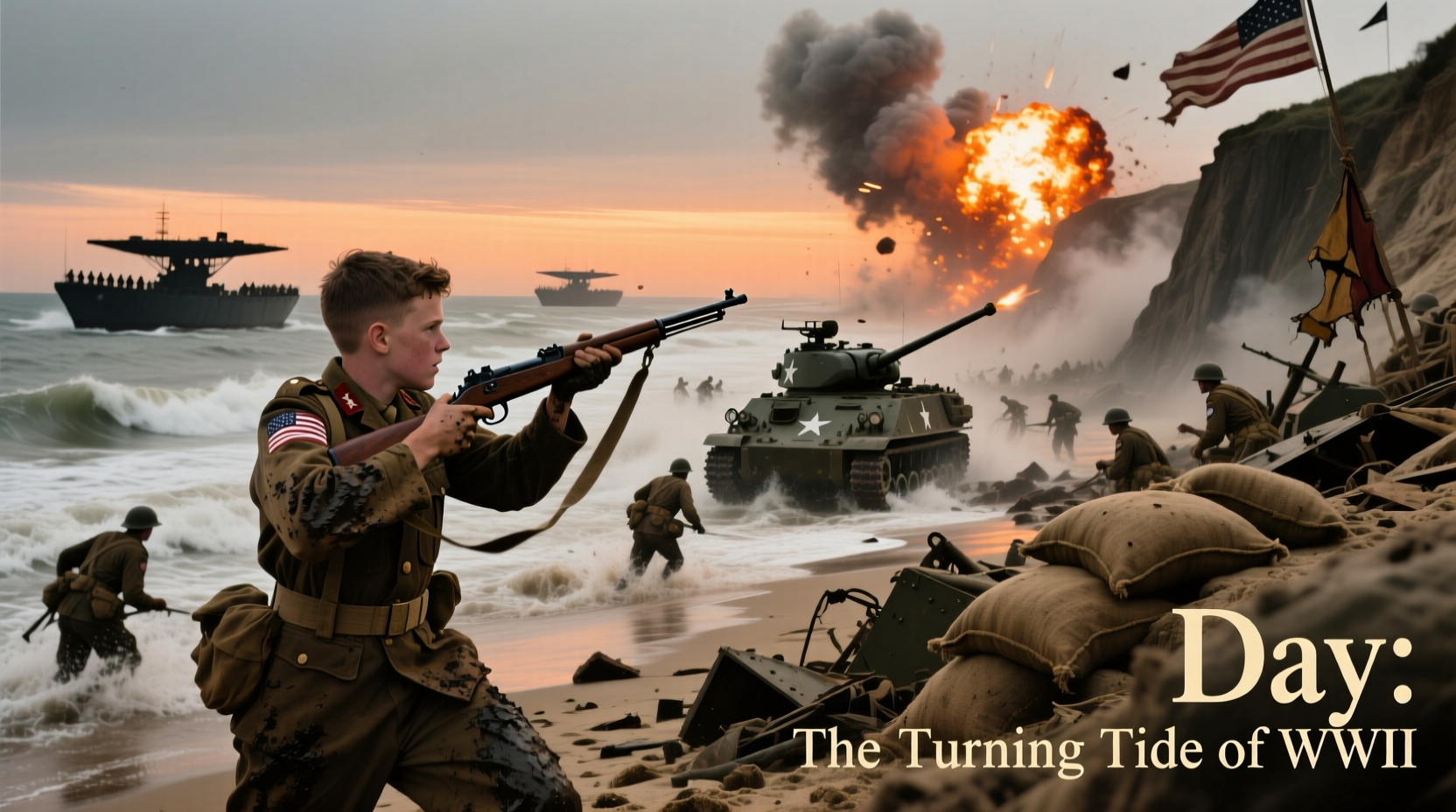
By 1944, Nazi Germany had controlled much of continental Europe for over four years. Despite Soviet advances in the East, the Western Allies needed to open a new front to relieve pressure on the Red Army and prevent Germany from concentrating all its forces in one theater. The idea of a cross-Channel invasion had been discussed since 1942, but logistical challenges, weather concerns, and the formidable Atlantic Wall fortifications delayed action.
British and American planners recognized that liberating Western Europe required a massive, coordinated assault on heavily defended French beaches. Without such an operation, Germany could continue to exploit occupied territories for resources, manpower, and strategic positioning. D-Day was not merely about reclaiming land—it was about dismantling Hitler’s grip on Europe and accelerating the collapse of his regime.
The Execution: How the Invasion Unfolded
D-Day began in the early hours of June 6 with airborne drops behind enemy lines, followed by a naval bombardment and the landing of over 156,000 troops across five beaches: Utah, Omaha, Gold, Juno, and Sword. Each beach presented unique challenges:
- Utah Beach: Lighter resistance allowed U.S. forces to secure their objectives quickly.
- Omaha Beach: Fierce German defenses led to heavy casualties, but determined efforts by American infantry eventually secured the beachhead.
- Gold, Juno, and Sword (British and Canadian sectors): Mixed outcomes with strong opposition, though coordination and armor support enabled gradual progress inland.
The element of surprise was achieved through elaborate deception operations like Operation Fortitude, which misled German intelligence into believing the invasion would occur at Pas-de-Calais, not Normandy. This misdirection delayed the reinforcement of German units in Normandy, giving the Allies crucial time to consolidate their positions.
“D-Day was the most difficult operation ever undertaken, and its success depended on precision, courage, and unity.” — Dwight D. Eisenhower, Supreme Allied Commander
Immediate and Long-Term Impact of D-Day
The successful establishment of beachheads in Normandy broke the myth of German invincibility in Western Europe. Within weeks, hundreds of thousands of troops, tanks, and supplies poured into France, enabling rapid expansion of the front line. By late August 1944, Paris was liberated, and Allied forces were advancing toward the German border.
Key consequences included:
- Opening of the Western Front: Forced Germany to fight a two-front war, stretching its already strained military resources.
- Momentum Shift: After D-Day, the initiative passed permanently to the Allies; retreat became the norm for German forces in the West.
- Psychological Blow: The failure to repel the invasion demoralized both the German high command and civilian population.
- Liberation of Occupied Nations: Countries like France, Belgium, and the Netherlands were freed from Nazi rule in the months following D-Day.
Perhaps most significantly, D-Day demonstrated the effectiveness of multinational cooperation. American, British, Canadian, Free French, and other Allied forces operated under a unified command structure—a model of alliance warfare that proved essential to ultimate victory.
Timeline of Key Events Following D-Day
A clear sequence of events shows how D-Day catalyzed the end of the war in Europe:
| Date | Event |
|---|---|
| June 6, 1944 | Allied landings begin in Normandy (D-Day) |
| June 12, 1944 | All five beachheads linked into a continuous front |
| July 25, 1944 | Operation Cobra launches, breaking German lines in Normandy |
| August 25, 1944 | Paris is liberated by Allied and French Resistance forces |
| September 1944 | Belgium and Luxembourg liberated; advance into Germany begins |
| December 1944 – January 1945 | German counteroffensive in the Battle of the Bulge fails |
| May 7, 1945 | Germany surrenders unconditionally (V-E Day) |
This timeline underscores how swiftly the tide turned after D-Day. What began as a fragile beachhead evolved into a full-scale liberation campaign within three months.
Why D-Day Was Decisive for Allied Victory
While battles like Stalingrad and El Alamein were turning points in their own right, D-Day uniquely combined strategic necessity, operational complexity, and symbolic weight. It was the only viable path to defeating Nazi Germany without relying solely on Soviet forces—an outcome Western leaders wanted to avoid for political and humanitarian reasons.
Moreover, D-Day ensured that Western Europe would be liberated by democratic nations rather than falling entirely under Soviet influence. This geopolitical dimension played a crucial role in shaping the postwar order, including the formation of NATO and the eventual division of Europe during the Cold War.
From a military standpoint, the invasion forced Germany into a defensive posture it could not sustain. With supply lines stretched and industrial capacity declining, the Wehrmacht lost the ability to mount effective counterattacks after mid-1944. The momentum generated by D-Day carried Allied forces across France, through the Low Countries, and ultimately into Germany itself.
Mini Case Study: The Role of Omaha Beach in Securing Victory
At Omaha Beach, U.S. forces faced some of the fiercest resistance of the entire invasion. Units landing in the first wave suffered devastating losses due to mislandings, rough seas, and well-entrenched German machine gun nests. At one point, commanders considered aborting the assault.
Yet through individual acts of bravery and small-unit leadership, American soldiers gradually advanced up the bluffs. Engineers cleared paths through minefields, and naval gunfire support intensified. By nightfall, despite losing over 2,000 men, a tenuous foothold had been established.
This example illustrates how localized resilience contributed to overall success. Had Omaha failed, the entire invasion might have unraveled. Instead, its partial success allowed reinforcements to land the next day, proving that determination under fire could overcome even the strongest defenses.
Frequently Asked Questions
What does “D-Day” actually mean?
“D-Day” is a military term used to designate the day on which an operation begins. It does not stand for “Decision Day” or “Deliverance Day,” as sometimes believed. In this case, June 6, 1944, was simply D-Day for Operation Overlord.
Were there alternatives to invading Normandy?
Yes, planners considered other locations, including the Pas-de-Calais (closer to England) and southern France (later used in Operation Dragoon). However, Normandy offered less fortified beaches, sufficient space for airfields and ports, and the advantage of surprise due to its distance from expected targets.
How many lives were lost on D-Day?
Estimates suggest between 10,000 and 12,000 Allied casualties on June 6, including approximately 4,414 confirmed deaths. German casualties are less precisely recorded but likely ranged between 4,000 and 9,000.
Checklist: Key Factors That Made D-Day Successful
- ✅ Extensive planning and rehearsal across multiple nations
- ✅ Effective deception operations (e.g., fake armies, radio traffic)
- ✅ Air and naval superiority over the English Channel
- ✅ Use of specialized engineering vehicles (Hobart’s Funnies)
- ✅ Courage and adaptability of frontline troops under extreme conditions
- ✅ Favorable weather window chosen by Eisenhower despite risks
Conclusion: A Legacy of Unity and Resolve
D-Day was more than a military operation—it was a testament to international cooperation, meticulous planning, and human courage. Its success laid the foundation for the defeat of Nazi Germany and the restoration of freedom to millions. Without the breakthrough at Normandy, the war in Europe might have dragged on for months longer, costing countless additional lives.
Today, D-Day stands as a reminder of what can be achieved when nations unite for a common cause. The lessons of leadership, sacrifice, and strategic foresight remain relevant far beyond the battlefield. As we reflect on its significance, we honor not only those who fought but also the enduring value of peace built on collective resolve.




 浙公网安备
33010002000092号
浙公网安备
33010002000092号 浙B2-20120091-4
Comments
No comments yet. Why don't you start the discussion?