
The term \"Cold War\" evokes images of nuclear brinkmanship, espionage, ideological battles, and decades of global tension — yet no direct large-scale fighting ever occurred between the two main adversaries: the United States and the Soviet Union. So why call it a \"war\" at all? And why \"cold\"? The answer lies in a complex mix of post-World War II politics, military strategy, propaganda, and the very real fear of global annihilation. Understanding the origins and meaning of the Cold War requires unpacking not just events, but language, intent, and the psychological climate of an era defined by silent confrontation.
Origins of the Term \"Cold War\"
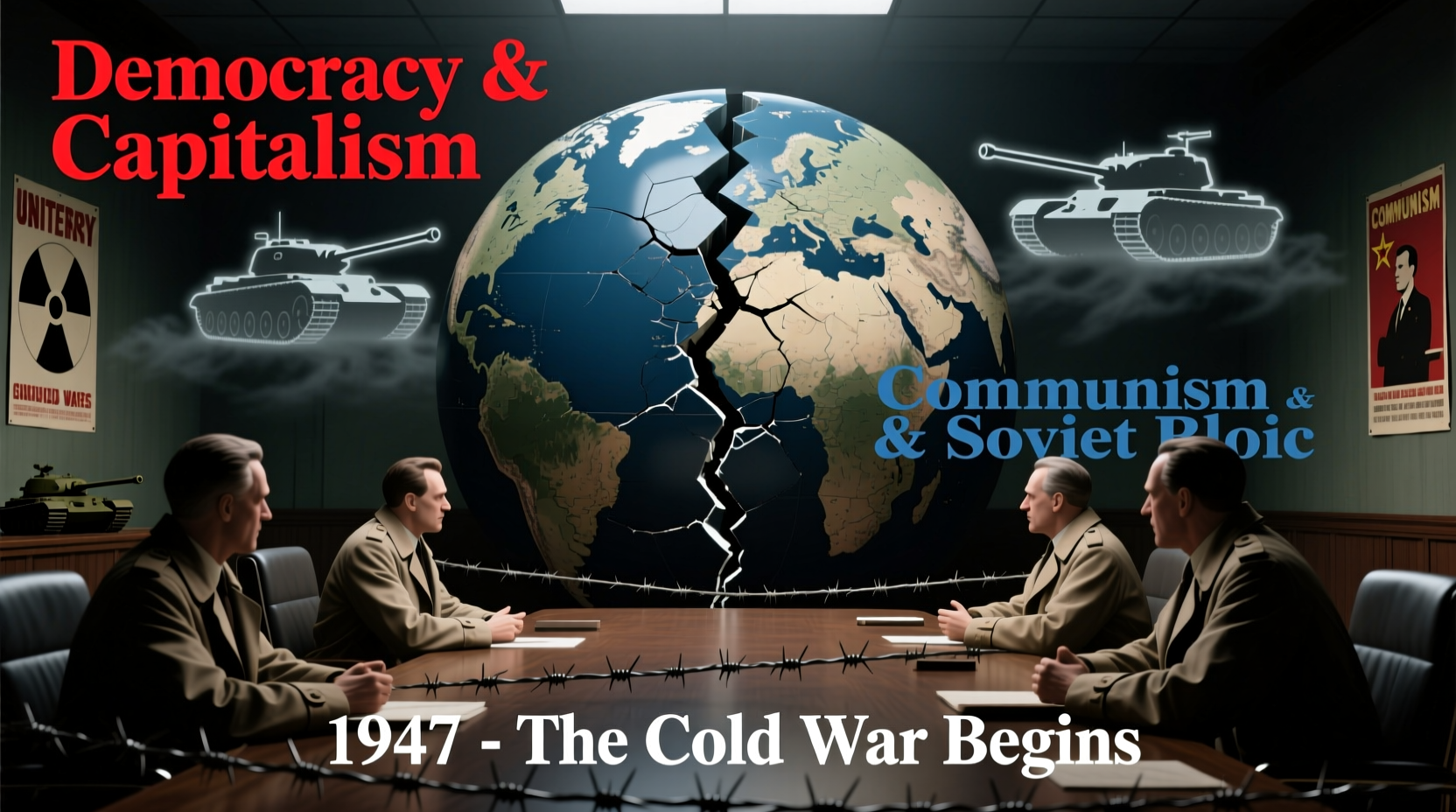
The phrase \"Cold War\" did not emerge spontaneously after World War II. It was coined earlier and gained traction through key political figures and journalists. In 1945, George Orwell used the term in his essay \"You and the Atomic Bomb,\" warning of a world living under the shadow of nuclear weapons where \"a peace that is no peace\" would dominate. He described a \"permanent cold war\" — a state of constant tension without open warfare.
However, it was journalist Walter Lippmann who popularized the term in 1947 with his book *The Cold War*, written in response to U.S. diplomat George F. Kennan’s \"Long Telegram\" from Moscow. Kennan argued that the Soviet Union was inherently expansionist and must be contained through sustained political, economic, and military pressure. Lippmann applied the term \"Cold War\" to describe this new form of non-shooting conflict — one fought through alliances, propaganda, espionage, and proxy wars rather than direct combat.
“From Stettin in the Baltic to Trieste in the Adriatic, an iron curtain has descended across the Continent.” — Winston Churchill, 1946
Churchill’s famous speech in Fulton, Missouri, in 1946, though not using the exact term \"Cold War,\" laid the ideological groundwork. His \"iron curtain\" metaphor crystallized Western fears of Soviet domination in Eastern Europe and signaled the end of wartime alliance between the USSR and the Anglo-American powers.
Why \"Cold\"? The Meaning Behind the Name
The word \"cold\" stands in stark contrast to \"hot war\" — a conventional, violent, battlefield conflict. The Cold War was \"cold\" because there was no direct military engagement between the primary belligerents. Despite massive arms buildups, thousands of nuclear warheads, and numerous close calls (such as the Cuban Missile Crisis), the U.S. and USSR never went to war against each other directly.
This restraint stemmed from the doctrine of Mutually Assured Destruction (MAD). Both superpowers knew that a full-scale war would likely escalate to nuclear exchange, resulting in catastrophic losses on both sides. Thus, the conflict remained \"cold\" — frozen in a state of high-alert standoff.
Instead of tanks and troops clashing on shared borders, the Cold War was waged through:
- Proxy wars (Korea, Vietnam, Afghanistan)
- Arms and space races
- Diplomatic maneuvering in the United Nations
- Intelligence operations and espionage
- Ideological competition (capitalism vs. communism)
- Economic sanctions and aid programs
Key Events That Marked the Beginning of the Cold War
The Cold War didn’t begin on a single date, but several pivotal moments between 1945 and 1949 solidified the division between East and West:
- Yalta and Potsdam Conferences (1945): Allied leaders met to shape the post-war world. Disagreements over the future of Eastern Europe, especially Poland, revealed growing mistrust between Stalin and the Western Allies.
- Soviet Expansion in Eastern Europe: By 1948, the USSR had installed communist governments in Poland, Hungary, Czechoslovakia, Romania, and East Germany, creating a buffer zone often referred to as the Eastern Bloc.
- Truman Doctrine (1947): President Harry S. Truman pledged to support nations resisting communist insurgencies, marking a formal U.S. policy of containment.
- Marshall Plan (1948): The U.S. provided over $13 billion in economic aid to rebuild Western Europe, countering poverty and instability that could fuel communist movements.
- Berlin Blockade and Airlift (1948–1949): The Soviets blockaded West Berlin; the U.S. and allies responded with a year-long airlift to supply the city, demonstrating resolve without escalating to war.
- NATO Formation (1949): The North Atlantic Treaty Organization united Western democracies in a military alliance, prompting the USSR to form the Warsaw Pact in 1955.
Cold War Timeline: Major Phases and Turning Points
| Period | Key Event | Significance |
|---|---|---|
| 1947–1953 | Truman Doctrine, Korean War | Containment policy begins; first major proxy war erupts. |
| 1953–1962 | Hungarian Uprising, Cuban Missile Crisis | Soviet crackdown in Eastern Europe; closest brush with nuclear war. |
| 1963–1979 | Vietnam War, Détente | Heightened conflict in Asia; temporary easing of tensions in late 1960s–70s. |
| 1979–1985 | Soviet invasion of Afghanistan, Reagan buildup | New phase of hostility; massive U.S. military spending. |
| 1985–1991 | Gorbachev reforms, Fall of Berlin Wall | Perestroika and glasnost lead to collapse of Eastern Bloc and USSR. |
Mini Case Study: The Cuban Missile Crisis – A Cold War Flashpoint
In October 1962, American reconnaissance discovered Soviet nuclear missiles being installed in Cuba, just 90 miles from Florida. President John F. Kennedy demanded their removal and imposed a naval blockade. For 13 days, the world stood on the brink of nuclear war.
Rather than launching a direct attack, Kennedy pursued a diplomatic solution, negotiating secretly with Soviet Premier Nikita Khrushchev. The crisis ended when the USSR agreed to withdraw the missiles in exchange for a public U.S. pledge not to invade Cuba and a secret agreement to remove American missiles from Turkey.
This episode exemplifies the Cold War’s essence: extreme tension held in check by rational diplomacy and the shared understanding that escalation meant mutual destruction. It was \"cold\" not because emotions were absent, but because direct war was avoided despite overwhelming pressure.
Expert Insight: How Historians View the Cold War
“The Cold War was less about armies and more about ideas. It was a battle for the future of civilization — democracy and individual freedom versus centralized control and state dominance.” — Dr. Margaret Beale, Cold War Historian, Princeton University
Historians continue to debate whether the Cold War was inevitable. Some argue that ideological differences between capitalism and communism made conflict unavoidable. Others suggest that miscommunication, fear, and power vacuums after WWII allowed suspicion to harden into systemic rivalry.
What is clear is that the Cold War shaped nearly every aspect of international relations for over four decades — influencing foreign policies, technological development (especially in aerospace and computing), and even sports and culture.
Frequently Asked Questions
Did any fighting happen during the Cold War?
Yes, but not between the U.S. and USSR directly. Conflicts such as the Korean War (1950–1953), Vietnam War (1955–1975), and Soviet-Afghan War (1979–1989) were \"proxy wars\" where the superpowers supported opposing sides with weapons, funding, and advisors — but did not engage each other militarily.
When did the Cold War end?
The Cold War is generally considered to have ended between 1989 and 1991. Key milestones include the fall of the Berlin Wall (1989), the collapse of communist regimes across Eastern Europe, and the dissolution of the Soviet Union in December 1991.
Could a Cold War happen again today?
Some analysts see parallels in current U.S.-China relations or NATO-Russia tensions. While full-scale war is unlikely, a new era of strategic competition — involving cyber warfare, economic coercion, and influence campaigns — suggests elements of cold conflict may persist in the 21st century.
Conclusion: Why the Cold War Still Matters
The name \"Cold War\" captures a unique phenomenon in human history: a global struggle that stopped short of total war, yet affected billions. It was a war of nerves, ideologies, and influence — fought in backrooms, airwaves, and distant battlefields. Understanding why it was called \"cold\" helps us grasp how diplomacy, deterrence, and fear can coexist in shaping world order.
The lessons of the Cold War remain vital. They remind us that even in deep disagreement, communication and restraint can prevent catastrophe. As new geopolitical tensions emerge, recognizing the patterns of the past can guide wiser decisions for the future.




 浙公网安备
33010002000092号
浙公网安备
33010002000092号 浙B2-20120091-4
Comments
No comments yet. Why don't you start the discussion?