
The term “Cold War” evokes images of nuclear brinkmanship, espionage, ideological battles, and geopolitical tension that spanned nearly half a century. Yet, despite its intensity, no formal declaration of war was ever issued, and the two primary adversaries— the United States and the Soviet Union—never engaged in direct large-scale military conflict. So why call it a war at all? And more specifically, why “cold”? The answer lies not just in semantics but in the unique nature of 20th-century global power struggles, where warfare evolved beyond battlefields into economic, political, and psychological arenas.
The Origin of the Term \"Cold War\"
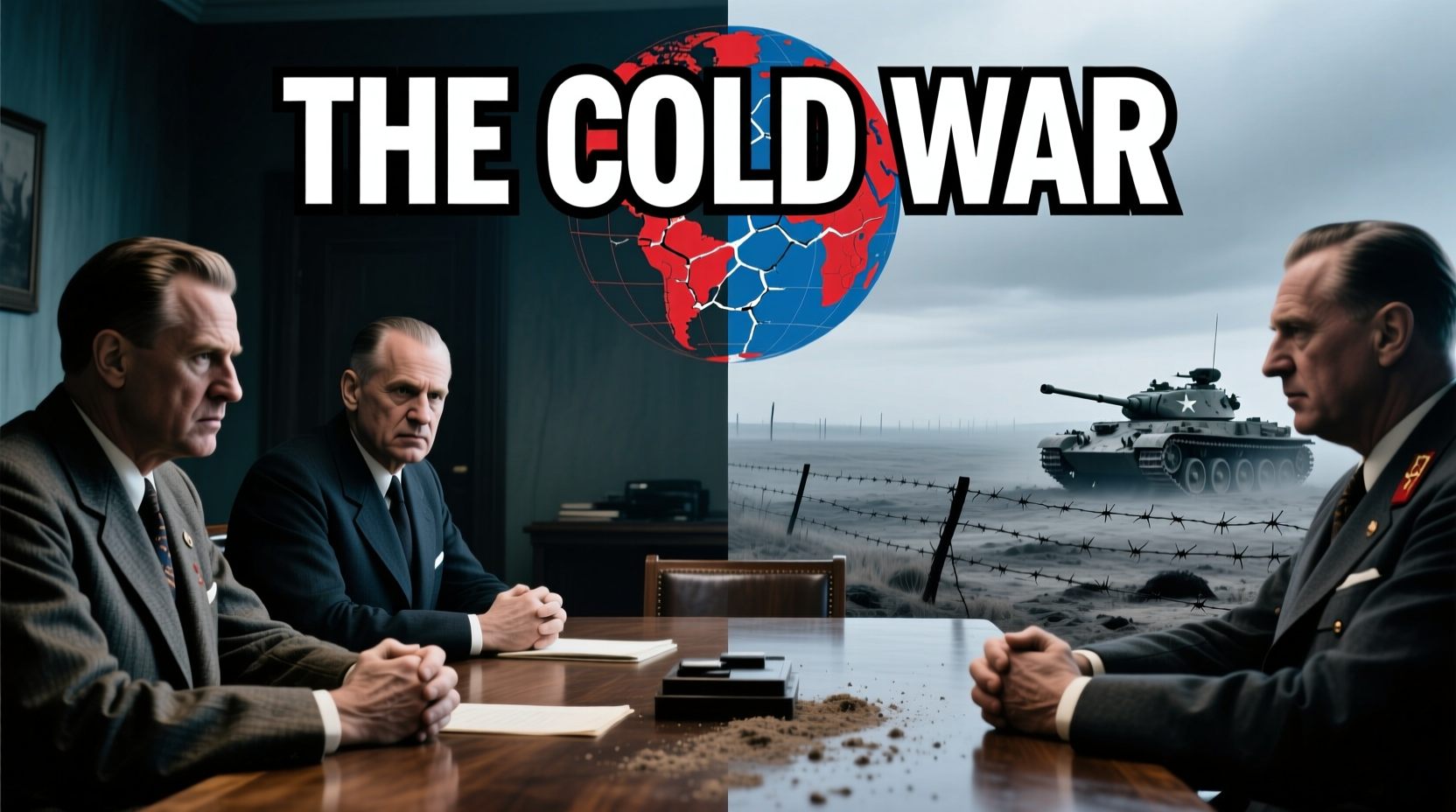
The phrase “Cold War” did not originate with historians or politicians during the height of U.S.-Soviet tensions. Instead, it was popularized by American journalist Walter Lippmann in 1947, following British statesman Winston Churchill’s famous “Iron Curtain” speech in 1946. Churchill described how an invisible divide had descended across Europe, separating Western democracies from Soviet-controlled Eastern bloc nations.
Lippmann used the term to critique U.S. containment policy toward the USSR, arguing that this new form of conflict—marked by suspicion, propaganda, arms buildup, and proxy wars—was neither hot (active warfare) nor peaceful, but something in between: a sustained state of hostility without open fighting. As he wrote, “It is a cold war because there is no peace, but also no war.”
“From Stettin in the Baltic to Trieste in the Adriatic, an iron curtain has descended across the Continent.” — Winston Churchill, 1946
Why \"Cold\"? Defining the Absence of Direct Combat
The adjective “cold” distinguishes this conflict from traditional “hot” wars, where armies clash directly on battlefields. In the Cold War, such direct engagement was avoided due to the catastrophic risks posed by nuclear weapons. Both superpowers possessed enough atomic firepower to destroy each other multiple times over—a doctrine known as Mutually Assured Destruction (MAD).
This reality created a tense equilibrium. While the U.S. and USSR competed fiercely for influence worldwide, they exercised extreme caution to prevent escalation into full-scale war. Conflicts occurred through intermediaries—such as in Korea, Vietnam, and Afghanistan—but American and Soviet troops rarely faced one another directly.
Key Characteristics of Cold War Conflict
The Cold War was fought on multiple fronts, none of which involved declared warfare between the main powers. Its defining features included:
- Arms Race: Massive investment in nuclear and conventional weapons to maintain deterrence.
- Space Race: Competition for technological supremacy, symbolized by milestones like Sputnik and the Apollo moon landing.
- Propaganda Campaigns: Media efforts to promote capitalism in the West and communism in the East.
- Proxy Wars: Military interventions in third countries, such as the Korean War (1950–1953) and the Soviet invasion of Afghanistan (1979).
- Intelligence Operations: Espionage, surveillance, and covert actions conducted by agencies like the CIA and KGB.
- Alliance Systems: Formation of NATO (1949) and the Warsaw Pact (1955), cementing bloc loyalties.
These dimensions illustrate how warfare had transformed. National security now depended less on battlefield victories and more on ideological appeal, technological edge, and strategic positioning.
A Timeline of Escalation and Détente
To understand how the Cold War remained “cold,” consider its major turning points—moments when the world stood on the brink of becoming “hot.”
- 1947 – Truman Doctrine: U.S. pledges to contain communism globally, marking the start of active geopolitical rivalry.
- 1948–1949 – Berlin Blockade and Airlift: First major crisis; Soviets cut off West Berlin, prompting a year-long Allied airlift. Conflict resolved without shots fired.
- 1950–1953 – Korean War: Proxy war ends in stalemate; demonstrates limits of direct intervention.
- 1962 – Cuban Missile Crisis: 13-day standoff over Soviet missiles in Cuba brings world closest to nuclear war. Resolution achieved via backchannel diplomacy.
- 1970s – Détente: Period of eased tensions, including arms control agreements like SALT I.
- 1979–1989 – Renewed Tensions: Soviet invasion of Afghanistan and U.S. response under Reagan reignite hostilities.
- 1985–1991 – Endgame: Gorbachev’s reforms (glasnost and perestroika), fall of the Berlin Wall (1989), and dissolution of the USSR (1991) conclude the era.
This timeline underscores the precarious balance maintained throughout the period. Even at peak tensions, both sides pulled back from the edge, reinforcing the “cold” nature of the conflict.
Comparison: Hot War vs. Cold War
| Aspect | Hot War (e.g., WWII) | Cold War |
|---|---|---|
| Direct Combat | Yes – armies engage openly | No – avoided due to nuclear risk |
| Formal Declarations | Common | None between U.S. and USSR |
| Primary Tools | Military force, invasions, bombings | Diplomacy, espionage, aid, propaganda |
| Frontlines | Geographic battle zones | Ideological, technological, economic spheres |
| Outcome Measurement | Territory gained, surrender signed | Influence expanded, systems survived |
Mini Case Study: The Cuban Missile Crisis
In October 1962, U.S. reconnaissance flights revealed Soviet missile installations under construction in Cuba, just 90 miles from Florida. President John F. Kennedy responded with a naval blockade and demanded their removal. For 13 days, the world watched anxiously as the two superpowers edged toward nuclear war.
Behind closed doors, intense negotiations unfolded. Ultimately, the crisis was resolved when Khrushchev agreed to dismantle the missiles in exchange for a public U.S. pledge not to invade Cuba—and a secret agreement to remove American missiles from Turkey.
This episode exemplifies the essence of the Cold War: high-stakes confrontation managed through restraint, communication, and compromise. It was “cold” not because emotions were absent, but because war was deliberately averted.
Expert Insight: How Historians View the Term
Scholars continue to debate whether “Cold War” accurately captures the complexity of the era. Some argue the term downplays the violence experienced in proxy conflicts, where millions died in Korea, Vietnam, Angola, and elsewhere.
“The Cold War was anything but cold for the people living in the crossfire. To them, the war was devastatingly hot.” — Dr. Mary Elise Sarotte, historian and author of *Not One Inch: America, Russia, and the Making of Post-Cold War Stalemate*
Nonetheless, the label persists because it reflects the central dynamic between the two superpowers: enduring hostility without direct war.
Frequently Asked Questions
Did any fighting happen during the Cold War?
Yes—extensively, but not between the U.S. and USSR directly. Fighting occurred in proxy wars such as Korea, Vietnam, Afghanistan, and various African and Latin American conflicts, where each superpower supported opposing sides.
Could the Cold War have turned into a hot war?
It came close, especially during the Cuban Missile Crisis. However, both sides recognized that nuclear war would likely result in mutual annihilation, creating strong incentives to avoid direct conflict.
When did the Cold War officially end?
There was no formal treaty, but most historians mark the end between 1989 (fall of the Berlin Wall and collapse of Eastern European communist regimes) and December 1991 (dissolution of the Soviet Union).
Conclusion: Why the Name Still Matters
The term “Cold War” endures because it encapsulates a fundamental shift in how nations wage conflict. It reminds us that war is not always declared, visible, or fought with tanks and soldiers. Sometimes, it unfolds in laboratories, newsrooms, embassies, and underground intelligence cells.
Understanding why it was called “cold” helps clarify the delicate balance of power that prevented global catastrophe while shaping the modern world order. Today, as geopolitical tensions rise anew—with cyber warfare, disinformation campaigns, and renewed great-power competition—the lessons of the Cold War remain critically relevant.




 浙公网安备
33010002000092号
浙公网安备
33010002000092号 浙B2-20120091-4
Comments
No comments yet. Why don't you start the discussion?