
In the autumn of 1888, five women were brutally murdered in the Whitechapel district of London. The identity of their killer—dubbed “Jack the Ripper”—remains one of history’s most infamous unsolved mysteries. Despite widespread public fear, intense media coverage, and a massive police investigation, the perpetrator was never apprehended. Over 130 years later, historians, criminologists, and amateur sleuths continue to debate why justice was never served. The answer lies not in a single factor, but in a complex web of social conditions, investigative limitations, and possible deliberate evasion.
The State of Policing in Victorian London
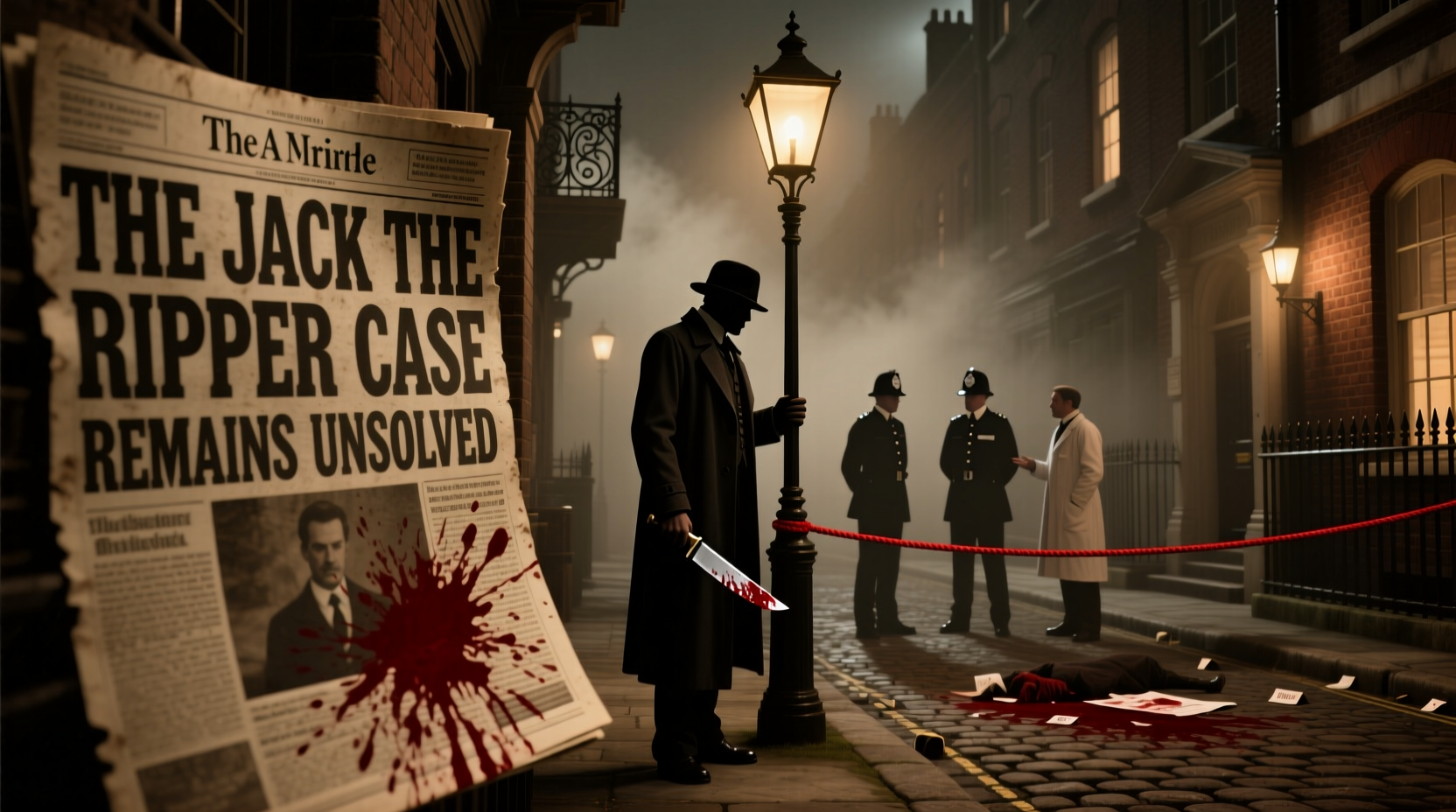
In 1888, modern forensic science did not exist. Fingerprinting had not yet been adopted, DNA analysis was decades away, and criminal profiling was in its infancy. The Metropolitan Police, though established in 1829, still operated with limited resources and outdated methods. Detectives relied heavily on witness testimony, physical surveillance, and confessions—none of which were forthcoming in the Ripper case.
Whitechapel itself was a densely populated, impoverished area rife with crime, overcrowding, and vice. Prostitutes were frequently victimized, and murders often went uninvestigated. The Ripper killings stood out due to their brutality and surgical precision, but even then, police struggled to prioritize leads amid a sea of misinformation and false confessions.
Prominent Theories Explaining the Escape
Scholars and investigators have proposed numerous explanations for why Jack the Ripper evaded capture. These range from institutional failures to speculative conspiracies involving high-ranking officials.
1. Lack of Forensic Technology
Without tools like fingerprint databases or blood typing, linking a suspect to a crime scene was nearly impossible. The Ripper left behind no verifiable biological evidence that could be preserved or analyzed. Even if he had touched objects at the scenes, there was no way to extract identifying traces.
2. Mismanagement and Jurisdictional Conflicts
The Metropolitan Police and the City of London Police operated independently, creating communication gaps. Whitechapel fell under the Met, but confusion over boundaries and responsibilities led to duplicated efforts and missed opportunities. Senior officers also withheld information from junior detectives, fearing leaks to the press.
3. The Killer Was Highly Intelligent or Skilled
Several victims suffered precise abdominal mutilations, suggesting anatomical knowledge. This led to speculation that the killer might have been a doctor, butcher, or someone familiar with human anatomy. Such expertise would have allowed him to operate quickly and quietly, minimizing the chance of interruption.
“Whoever committed these murders possessed sufficient knowledge of human anatomy to avoid major arteries initially, prolonging the suffering and enabling deeper cuts. That level of skill is not common.” — Dr. Thomas Bond, Home Office Surgeon, 1888
4. The Killer Blended In Perfectly
Whitechapel teemed with transient workers, immigrants, and laborers. A man walking late at night with bloodied hands or clothes would raise suspicion—but not necessarily alarm. The Ripper may have used disguises, changed clothing after attacks, or lived locally, allowing him to vanish into the urban fabric.
5. Royal or Medical Conspiracy Theories
One of the most controversial theories involves Sir William Gull, physician to Queen Victoria, allegedly covering up the crimes due to Prince Albert Victor’s involvement. Proponents argue that royal scandal prompted a cover-up, halting the investigation. However, most historians dismiss this as lacking credible evidence. Gull was elderly and ill during the murders, and no documentation supports his involvement.
Evidence and Investigative Failures
The police received over 2,000 letters claiming responsibility, including the infamous “Dear Boss” letter that coined the name “Jack the Ripper.” Most were hoaxes. Genuine clues were buried under noise. For example:
- The “Double Event” of September 30, 1888 (the murders of Elizabeth Stride and Catherine Eddowes) occurred within an hour and less than a mile apart, suggesting the killer moved freely through the streets without detection.
- No eyewitness provided a reliable description. Some reported a man in a surgeon’s coat; others saw someone in workman’s attire.
- The “Goulston Street Graffito,” a chalk message found near a piece of Eddowes’ apron, was erased before it could be properly photographed or analyzed—possibly due to fears of anti-Semitic riots.
| Failure | Impact on Investigation |
|---|---|
| Lack of forensic tools | No way to match blood, fingerprints, or trace evidence to suspects |
| Jurisdictional overlap | Miscommunication between Met and City Police slowed response |
| Media sensationalism | Distorted public perception and pressured police into premature conclusions |
| Destroyed or ignored evidence | Goulston Street message erased; other clues dismissed |
| Overreliance on confessions | Dozens of false confessions wasted investigative time |
A Real Case: The Suspect Who Wasn’t Pursued
In 1891, a Polish immigrant named Aaron Kosminski was admitted to an asylum after exhibiting violent behavior toward women. He had lived in Whitechapel during the murders and reportedly refused to speak to male attendants, fearing they were police. Decades later, former Chief Inspector Donald Swanson named Kosminski as the likely Ripper in private notes, citing surveillance and behavioral patterns.
Despite this, no formal charges were ever brought. Why? Because by the time suspicion arose, Kosminski was mentally incapacitated. Authorities may have believed pursuing a trial against a madman would yield nothing—and risk exposing investigative incompetence. His case illustrates how psychological red flags were noted but not acted upon in time.
Timeline of Key Events and Missed Opportunities
- August 31, 1888: Mary Ann Nichols murdered. No suspect identified despite post-mortem showing surgical precision.
- September 8: Annie Chapman killed. Local rumors grow; police increase patrols but lack coordination.
- September 30: Double murder of Stride and Eddowes. Police fail to connect the rapid succession of attacks.
- October 1: “Saucy Jacky” letter received, referencing the double event—suggesting insider knowledge.
- November 9: Final canonical victim, Mary Jane Kelly, murdered indoors. Killer had more time, indicating growing boldness.
- 1891: Kosminski institutionalized. Leads go cold as public interest wanes.
Modern Reassessments and DNA Claims
In 2014, author Russell Edwards claimed to have matched mitochondrial DNA from a shawl attributed to Catherine Eddowes to descendants of Aaron Kosminski. While widely publicized, many forensic experts criticized the methodology, citing contamination risks and the unreliability of mtDNA for definitive identification. The scientific community remains divided.
Nonetheless, advances in genetic genealogy have reinvigorated interest. Projects like the Jack the Ripper Genealogical Research Project aim to reconstruct potential family trees of suspects using archival records and DNA. While conclusive proof remains elusive, these efforts reflect how modern technology continues to interrogate historical mysteries.
Frequently Asked Questions
Was Jack the Ripper really never caught?
There is no verified record of Jack the Ripper being arrested or convicted. While several suspects were investigated—including Montague Druitt, Francis Tumblety, and Michael Ostrog—none were formally charged. The consensus among historians is that he escaped justice.
How many victims did Jack the Ripper have?
The “canonical five” victims recognized by most scholars are Mary Ann Nichols, Annie Chapman, Elizabeth Stride, Catherine Eddowes, and Mary Jane Kelly. However, some researchers argue the number could be higher, including earlier or later unsolved murders with similar characteristics.
Could Jack the Ripper have stopped killing on his own?
It’s possible. Serial killers sometimes cease activity due to imprisonment for other crimes, death, mental deterioration, or relocation. Given the abrupt end to the murders after November 1888, some believe the Ripper may have died, been institutionalized, or left London.
Conclusion: Why the Mystery Endures
The failure to catch Jack the Ripper was not due to a single oversight, but a convergence of technological limits, systemic flaws, and the killer’s apparent ability to exploit both. Victorian policing lacked the tools and coordination needed to track a stealthy, intelligent offender in one of London’s most chaotic neighborhoods. Whether he was a skilled professional, a disturbed loner, or protected by powerful interests, one fact remains: he vanished without a trace.
Yet the pursuit of answers continues—not just to solve a crime, but to understand how society responds to fear, injustice, and the unknown. Every theory, failed lead, and new hypothesis adds depth to our understanding of one of history’s darkest enigmas.




 浙公网安备
33010002000092号
浙公网安备
33010002000092号 浙B2-20120091-4
Comments
No comments yet. Why don't you start the discussion?