
The story of Lucifer’s expulsion from heaven is one of the most compelling and debated narratives in religious theology. While not explicitly detailed in a single passage, the fall of Lucifer emerges from symbolic language in scripture, centuries of interpretation, and theological reflection. Understanding why Lucifer was cast out involves examining themes of pride, free will, rebellion, and divine justice. This article explores the scriptural foundations, historical interpretations, and spiritual implications behind the downfall of what was once considered the most exalted of angels.
The Biblical Foundations of Lucifer’s Fall
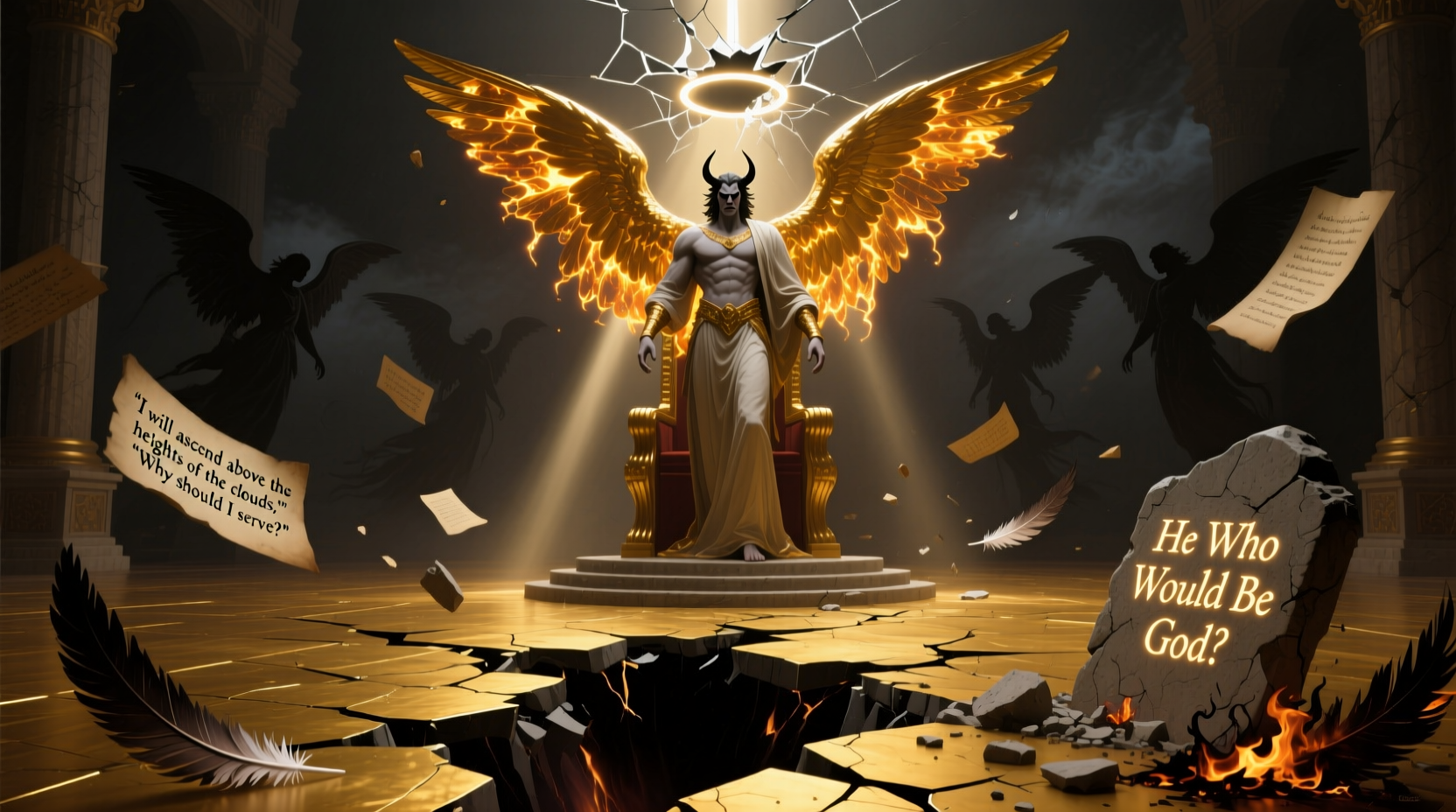
The term “Lucifer” appears only once in traditional English Bible translations—specifically in the King James Version of Isaiah 14:12: “How art thou fallen from heaven, O Lucifer, son of the morning! How art thou cut down to the ground, which didst weaken the nations!” The Hebrew word translated as “Lucifer” here is *Helel ben Shachar*, meaning “shining one, son of the dawn.” This passage originally referred to the king of Babylon, using poetic imagery to describe his arrogance and eventual downfall. However, early Church Fathers like Origen and Augustine interpreted this verse typologically—as a reference to Satan’s pre-fall glory and rebellion.
In Ezekiel 28:12–17, another passage often linked to Lucifer, the prophet addresses the king of Tyre with language that transcends mere human rulership: “You were the seal of perfection, full of wisdom and perfect in beauty. You were in Eden, the garden of God… You were anointed as a guardian cherub.” The description includes being on the holy mountain of God and walking among fiery stones—language suggestive of a heavenly being. Yet the text states he became filled with violence and sinned, leading to his expulsion.
“Your heart became proud on account of your beauty, and you corrupted your wisdom because of your splendor.” — Ezekiel 28:17
Though these passages address earthly kings, their elevated, almost supernatural descriptions led theologians to see them as veiled references to the origin of evil—the moment a created being chose to oppose the Creator.
Pride: The Root of Rebellion
At the core of Lucifer’s fall is pride. Christian doctrine consistently identifies pride as the first and most serious of the seven deadly sins—not because it is loud or violent, but because it distorts the proper relationship between creature and Creator. Lucifer, described in tradition as the most beautiful and intelligent of the angels, allowed his gifts to become sources of self-exaltation rather than gratitude.
According to St. Thomas Aquinas in the *Summa Theologica*, angels were created with intellect and will, and they made an immediate choice for or against God. Lucifer, seeing his own excellence, concluded he did not need to submit to divine authority. His sin was not gradual but decisive—a single act of defiance rooted in arrogance.
The five “I will” statements in Isaiah 14:13–14 reveal the depth of his rebellion:
- I will ascend into heaven
- I will exalt my throne above the stars of God
- I will sit also upon the mount of the congregation
- I will ascend above the heights of the clouds
- I will be like the Most High
This crescendo of ambition illustrates a complete rejection of humility and dependence on God. To desire equality with God is not aspiration—it is idolatry of the self.
The Nature of Free Will and Celestial Conflict
One of the most profound theological questions raised by Lucifer’s fall is why God would allow such rebellion. The answer lies in the nature of free will. For love and obedience to be genuine, they must be freely chosen. Even in the heavenly realm, beings endowed with rational will had the capacity to choose loyalty or defiance.
Revelation 12:7–9 describes a war in heaven: “And there was war in heaven: Michael and his angels fought against the dragon; and the dragon fought and his angels, and prevailed not; neither was their place found any more in heaven.” This cosmic conflict resulted in Satan (the dragon) and his followers being cast down to earth. The passage confirms that Lucifer’s rebellion was not solitary—he persuaded a third of the angels to join him (Rev. 12:4).
This suggests that evil did not originate in humanity but in the spiritual realm. Humanity’s fall in Genesis 3 mirrors Lucifer’s: both involve temptation, doubt in God’s goodness, and a desire to “be like God.” The serpent in Eden is later identified in Revelation as “that ancient serpent called the devil, or Satan, who leads the whole world astray” (Rev. 12:9).
Timeline of Lucifer’s Fall
- Creation: Lucifer created as a high-ranking angel, possibly a cherub, perfect in wisdom and beauty.
- Temptation of Self: He becomes enamored with his own gifts, leading to pride.
- Decision to Rebel: He resolves to exalt himself above God, rallying other angels.
- War in Heaven: Michael and loyal angels confront the rebels; Lucifer is defeated.
- Expulsion: Cast out of heaven, taking residence in the earthly realm.
- Ongoing Influence: Continues to oppose God’s purposes through deception and temptation.
Theological Perspectives Across Traditions
Different branches of Christianity interpret Lucifer’s fall with varying emphasis:
| Tradition | View on Lucifer’s Fall | Key Emphasis |
|---|---|---|
| Catholicism | Fell due to pride before creation of humanity | Moral order, hierarchy, and the danger of sin |
| Eastern Orthodoxy | Rebellion stemmed from jealousy of humanity | Divine economy and theosis |
| Protestantism | Literally fell after aspiring to usurp God’s throne | Sola Scriptura, authority of biblical text |
| Judaism | No formal doctrine of Lucifer; Satan as servant of God | Testing humans, not independent evil |
| Islam | Iblis refused to bow to Adam out of pride | Disobedience to Allah’s command |
While Islam does not use the name “Lucifer,” the story of Iblis (Satan) in the Qur’an (Surah 7:11–18) closely parallels the Judeo-Christian narrative. When God commands angels to bow to Adam, Iblis refuses, claiming superiority because he was created from fire while Adam was made from clay. This act of defiance results in his eternal banishment—again highlighting pride as the root sin.
“Pride is the demon’s virtue. It is the one sin that cannot lead to repentance, because it denies the very need for grace.” — C.S. Lewis, *Mere Christianity*
Common Misconceptions About Lucifer’s Fall
Popular culture often misrepresents the nature of Lucifer’s fall. Clarifying these misconceptions helps deepen understanding:
- Myth: Lucifer was God’s equal before the fall.
Truth: No created being can be equal to God. Lucifer was exalted, but still a creature dependent on divine will. - Myth: He was cast out immediately after thinking rebellious thoughts.
Truth: Traditional theology holds that angels made a definitive choice early in their existence—once made, their decision was irrevocable. - Myth: God was surprised or threatened by the rebellion.
Truth: God’s omniscience means He foresaw the fall, yet permitted it to preserve true freedom and ultimately display greater glory through redemption.
Practical Implications for Spiritual Life
The story of Lucifer is not merely ancient myth—it offers enduring lessons for personal spirituality. Pride remains the most insidious obstacle to growth. Whether in leadership, relationships, or faith, the desire to be seen, praised, or independent of guidance can erode integrity.
Checklist: Guarding Against Spiritual Pride
- Regularly examine motives behind achievements
- Give credit to others and to God
- Accept correction without defensiveness
- Practice humility in service, especially when unseen
- Avoid comparing yourself to others in spiritual progress
- Confess pride as a sin, not just a flaw
FAQ
Was Lucifer an angel or a man?
Scripture and tradition identify Lucifer as a celestial being—an angel, specifically a high-ranking cherub. He existed before humanity and fell due to rebellion in the spiritual realm.
Did God create evil by allowing Lucifer to fall?
No. God created free will, not evil. Evil arose when a free creature misused his will. God permits evil temporarily but redeems it through Christ’s work.
Can fallen angels repent?
Traditional theology holds that angels’ choice was immediate and final. Unlike humans, they do not have ongoing opportunity for repentance. Their state is fixed.
Conclusion
The casting out of Lucifer is more than a dramatic tale of celestial war—it is a foundational narrative about the dangers of pride, the sanctity of free will, and the unyielding holiness of God. Lucifer’s tragedy was not in his power or beauty, but in his refusal to acknowledge their source. His fall serves as a solemn warning: no gift, no position, no intelligence can justify standing apart from God.
Understanding this story invites introspection. Where do we seek to elevate ourselves? What areas of life resist submission to truth and grace? By embracing humility and recognizing our dependence on the divine, we avoid the same fate—not of physical expulsion, but of spiritual isolation.




 浙公网安备
33010002000092号
浙公网安备
33010002000092号 浙B2-20120091-4
Comments
No comments yet. Why don't you start the discussion?