
In 2012, the National Football League (NFL) faced one of its most controversial scandals in modern history—Bountygate. At the center of it all was Sean Payton, the head coach of the New Orleans Saints, who received an unprecedented suspension for his role in a secret program that rewarded players for injuring opponents. This article breaks down the full story behind the scandal, why Payton was suspended, the league’s response, and the lasting impact on NFL culture and accountability.
The Origins of the Saints’ Bounty Program
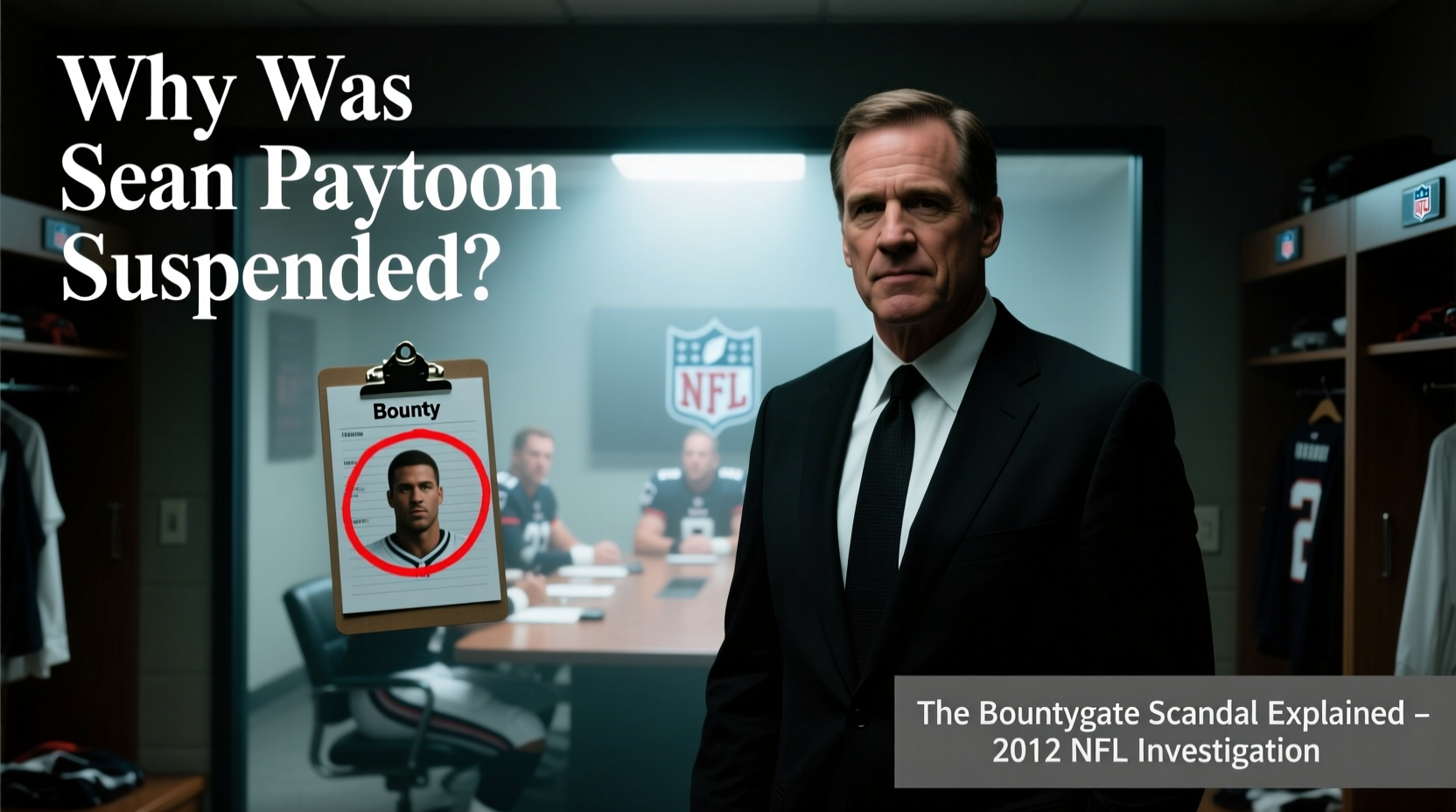
The New Orleans Saints’ bounty program began during the 2009 season, under defensive coordinator Gregg Williams. According to NFL investigations, the scheme involved offering cash incentives to players for knocking opposing players out of games or targeting specific individuals. These payments were not sanctioned by the NFL and operated in direct violation of league rules designed to protect player safety.
The bounties were tracked through a system known as “the money pool.” Players earned money based on performance—$1,500 for knocking out a quarterback, $1,000 for causing a fumble, and even more for eliminating key players from playoff matchups. Payments were made after games, often using cash collected from fines imposed within the team for mistakes during play.
While such informal reward systems had existed in various forms across football for decades, the organized, sustained, and incentivized nature of this program crossed ethical and regulatory lines. What made this case different was the documentation and testimony confirming leadership involvement—including coaching staff and front office personnel.
How the Scandal Was Exposed
The NFL launched an investigation in March 2012 after former Saints linebacker Jonathan Vilma sued the league, claiming he was wrongfully accused of placing a $10,000 bounty on then-Vice President of Football Operations Ray Anderson and NFL Commissioner Roger Goodell. This lawsuit triggered internal scrutiny and led to the release of investigative findings in March 2012.
The league concluded that at least 27 defensive players were involved in the bounty program over three seasons (2009–2011). More damningly, evidence showed that assistant coaches helped administer the fund, and head coach Sean Payton was aware of the program and failed to stop it. General Manager Mickey Loomis was also found to have been informed but did not take corrective action.
“Coaches created a system that encouraged players to try to injure opponents. That is unacceptable and cannot be tolerated in any form.” — Roger Goodell, NFL Commissioner
Disciplinary Actions and Payton’s Suspension
On March 21, 2012, the NFL announced sweeping penalties:
- Sean Payton: Suspended for the entire 2012 season without pay—the first time an NFL head coach had ever received a full-season ban.
- Mickey Loomis: Suspended for eight games.
- Joe Vitt: Assistant head coach suspended for six games.
- Gregg Williams: Suspended indefinitely (later reinstated in 2013).
- New Orleans Saints organization: Fined $500,000 and stripped of second-round draft picks in 2012 and 2013.
- Players: Four players (Vilma, Fujita, Hargrove, Smith) initially suspended, though these were later overturned due to lack of concrete evidence and procedural concerns.
Payton’s suspension was particularly significant because it signaled a shift in how the NFL handled misconduct. For years, the league had enforced rules primarily against players. Now, for the first time, top-level coaches were being held personally accountable for fostering toxic team cultures.
A Timeline of Key Events
Bountygate unfolded over several years. Here's a step-by-step breakdown:
- 2009: Gregg Williams becomes defensive coordinator; bounty program begins.
- 2010: Program continues into Super Bowl-winning season. Increased focus on injuring key quarterbacks like Kurt Warner and Brett Favre.
- January 2011: Post-Super Bowl, reports surface about aggressive defensive tactics, but no formal investigation launched.
- March 2012: NFL opens investigation after media reports and internal leaks.
- March 21, 2012: NFL releases findings; suspensions announced.
- April 2012: Sean Payton accepts responsibility and steps away from the team.
- September 2012 – January 2013: Payton serves full-year suspension while Saints struggle under interim coach Aaron Kromer.
- January 2013: Payton reinstated; returns to Saints for 2013 season.
- 2015: NFL admits errors in player discipline process; vacates all player suspensions.
Why Was Payton Held Responsible?
Sean Payton wasn’t accused of creating the bounty program, nor was he directly managing payouts. However, the NFL determined he violated two fundamental principles:
- Failure to Prevent Wrongdoing: Payton knew about the program and did nothing to stop it, despite multiple warnings from team executives and league officials.
- Obstruction of Justice: During the investigation, Payton admitted he misled investigators and instructed others to remain silent. He later called this a “terrible mistake.”
Roger Goodell emphasized that head coaches are ultimately responsible for the culture of their teams. By allowing a system that endangered players to persist, Payton breached his duty as a leader.
As one former NFL executive put it: “You don’t need to sign every check to be accountable. If you’re the boss and something toxic grows under your watch, you own it.”
Impact on the NFL and Player Safety
Bountygate became a turning point for the NFL’s approach to player conduct and safety. In the years following the scandal:
- The league strengthened rules around targeting defenseless players.
- Fines and suspensions for dangerous hits increased significantly.
- Emphasis grew on promoting sportsmanship and reducing long-term brain injuries (CTE).
- Coaching staff came under greater scrutiny for influencing team ethics.
The scandal also prompted criticism of the NFL’s disciplinary process. Some argued that while Payton deserved accountability, the punishment was excessive compared to other infractions. Others pointed out inconsistencies—such as shorter suspensions for domestic violence cases at the time—as evidence of uneven enforcement.
Mini Case Study: The Falcons Game and the \"Knockout\" Target
One of the most cited incidents occurred during the 2010 NFC Divisional Playoff game between the Saints and Minnesota Vikings. Former linebacker Scott Fujita testified that Williams specifically targeted Vikings QB Brett Favre, calling him a “bounty magnet” and offering extra rewards for taking him out.
Favre left the game with a shoulder injury after a hard hit. While the hit itself was legal, the context raised red flags. Audio recordings and notes from internal meetings later revealed terms like “cart-off” and “knockout” being used to describe desired outcomes.
This case exemplifies how incentive structures can distort competitive intent. What began as motivation to play aggressively escalated into deliberate attempts to injure—a clear line-crossing moment in professional sports ethics.
Do’s and Don’ts: Leadership Lessons from Bountygate
| Do | Don’t |
|---|---|
| Promote a culture of accountability and transparency | Ignore unethical behavior to maintain team cohesion |
| Encourage aggressive—but legal—play | Allow informal systems that reward harm |
| Respond immediately to compliance concerns | Delay action or cover up issues |
| Support player safety initiatives | Prioritize winning over integrity |
Frequently Asked Questions
Did Sean Payton admit guilt?
Yes. Payton publicly accepted responsibility in a press conference, stating he “failed as a leader” and took full accountability for not stopping the program. He did not contest his suspension.
Was the bounty program unique to the Saints?
While informal rewards existed elsewhere, the Saints’ program was the only one documented with systematic tracking, coaching involvement, and multi-year operation. No other team has faced similar penalties for a structured bounty system.
Did Payton’s career recover after the suspension?
Yes. After returning in 2013, Payton led the Saints to multiple playoff appearances and remained head coach until 2021. He later served as head coach of the Denver Broncos (2023), showing that redemption is possible with accountability and sustained performance.
Conclusion: Accountability Shapes Legacy
The Bountygate scandal remains one of the darkest chapters in recent NFL history—not because of isolated acts of aggression, but because of the systemic failure of leadership. Sean Payton’s suspension wasn’t just about punishment; it was a message that culture starts at the top.
Sports thrive on competition, but never at the cost of integrity or human safety. The lessons from Bountygate extend beyond football: leaders must act when standards are compromised, even when it’s inconvenient. Silence enables corruption; action restores trust.




 浙公网安备
33010002000092号
浙公网安备
33010002000092号 浙B2-20120091-4
Comments
No comments yet. Why don't you start the discussion?