
The First Battle of Bull Run, also known as the First Battle of Manassas, was fought on July 21, 1861, near Manassas, Virginia. It marked the first major land engagement of the American Civil War and shattered any illusions that the conflict would be brief or bloodless. What many expected to be a swift Union victory turned into a chaotic retreat, revealing the war’s complexity and setting the tone for four years of brutal conflict. This battle was more than just a military clash—it was a turning point in public perception, strategy, and national resolve.
The Road to Bull Run: A Nation Divided
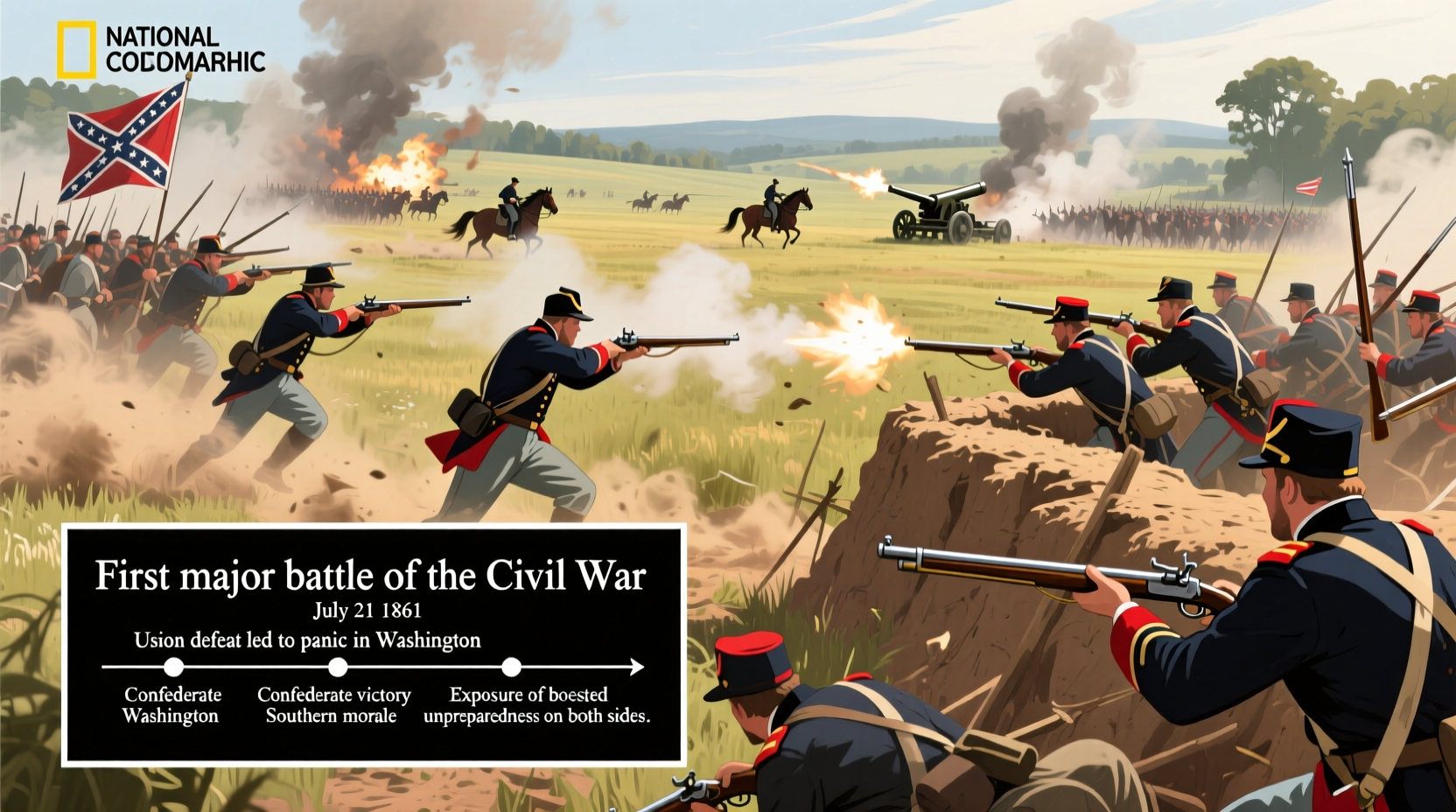
By the summer of 1861, seven Southern states had seceded from the Union following Abraham Lincoln’s election. The Confederate States of America had formed, and Fort Sumter had already been attacked, officially beginning hostilities. Both North and South believed the war would end quickly. In Washington, D.C., political pressure mounted to take decisive action. Union General Irvin McDowell, though aware his troops were untrained, was ordered to advance on the Confederate capital of Richmond, Virginia.
The Confederates, under General P.G.T. Beauregard and later reinforced by General Joseph E. Johnston, took defensive positions near Manassas Junction. The proximity to Washington made the area strategically significant. Public enthusiasm ran high—civilians from the capital even packed picnic baskets and traveled by train to watch what they assumed would be a heroic Union triumph.
Key Events of the Battle
The Union launched their attack at dawn on July 21, aiming to flank the Confederate left. Initial progress seemed promising as Federal forces pushed back Confederate lines near Matthews Hill. However, disorganization quickly set in. Units lacked coordination, officers struggled with command, and fatigue spread through the ranks due to the summer heat and long march.
The tide turned when Confederate reinforcements arrived via railroad from the Shenandoah Valley—marking one of the first strategic uses of rail transport in American warfare. Brigadier General Thomas J. Jackson earned his famous nickname “Stonewall” during this phase, as General Barnard Bee reportedly rallied his men by shouting, “There stands Jackson like a stone wall!”
As Union momentum stalled, Confederate counterattacks drove the Federals back in confusion. What began as an orderly withdrawal devolved into a panicked rout along the road to Washington. Soldiers abandoned equipment, and civilians fleeing in carriages added to the chaos. The Union army did not regroup until it reached the defenses of the capital.
“There is no use crying over spilled milk. Let us dry up our tears and settle down to work.” — President Abraham Lincoln, reflecting on the aftermath of Bull Run
Why Was the Battle of Bull Run Important?
The First Battle of Bull Run was pivotal for several interconnected reasons. Its importance lies not only in the immediate military outcome but in how it reshaped expectations, strategy, and national consciousness on both sides of the conflict.
1. Shattered Illusions of a Quick War
Prior to Bull Run, both governments and populations believed the war would last only months. The defeat forced the North to confront the reality that defeating the Confederacy would require extensive planning, resources, and time. As historian James M. McPherson notes, “Bull Run taught Americans that this war would be longer, bloodier, and more divisive than anyone had imagined.”
2. Revealed the Need for Professional Armies
The battle exposed the lack of training, discipline, and logistical readiness in both armies. Volunteers on both sides were enthusiastic but unprepared for real combat. In response, the Union significantly expanded its military structure, extended enlistments, and began systematic training under General George B. McClellan. The Confederacy followed suit, formalizing its conscription efforts in 1862.
3. Elevated Key Military Leaders
Thomas \"Stonewall\" Jackson emerged as a hero of the Confederacy, symbolizing steadfast resistance. On the Union side, while McDowell was blamed and replaced, leaders like McClellan gained prominence. The battle highlighted the importance of leadership, logistics, and battlefield adaptability—lessons that shaped future campaigns.
4. Demonstrated Strategic Use of Railroads
The timely arrival of Johnston’s troops via the Manassas Gap Railroad proved decisive. This was one of the earliest examples of rail mobility altering the outcome of a battle, foreshadowing the industrialized nature of modern warfare. Future campaigns would increasingly rely on rail networks for troop movement and supply.
5. Impacted Public Morale and Political Will
In the North, the defeat led to soul-searching and a renewed commitment to win the war, rather than conciliate. In the South, victory boosted morale and confidence, reinforcing belief in their cause. However, it also bred overconfidence that delayed necessary preparations for a prolonged struggle.
Military Comparison: Union vs. Confederate Forces at Bull Run
| Aspect | Union Army | Confederate Army |
|---|---|---|
| Commander | Brig. Gen. Irvin McDowell | Gen. P.G.T. Beauregard, supported by Gen. Joseph E. Johnston |
| Troop Strength | Approx. 35,000 | Approx. 32,000 (combined forces) |
| Casualties | ~2,896 (killed, wounded, missing) | ~1,982 (killed, wounded, missing) |
| Experience Level | Largely untrained volunteers | Mix of volunteers and militia; slightly better cohesion |
| Key Advantage | Numerical superiority, initial surprise | Defensive positioning, interior lines, rail reinforcement |
Timeline of Key Moments
- July 16, 1861: Union forces begin advance from Washington toward Manassas.
- July 18: Skirmishes at Blackburn’s Ford; McDowell gains false confidence.
- July 20: Confederate forces consolidate at Henry House Hill.
- July 21, 9:30 AM: Union artillery opens fire; flanking maneuver begins.
- 11:00 AM–2:00 PM: Union pushes Confederates back from Matthews Hill.
- 3:00 PM: Jackson’s brigade arrives and holds the line; Johnston’s reinforcements join.
- 4:00 PM: Confederate counterattack begins; Union lines falter.
- 5:00 PM: Full Union retreat turns into a disorganized rout.
- July 22: Last Union stragglers return to Washington; government braces for crisis.
Frequently Asked Questions
What was the main cause of the Union defeat at Bull Run?
The primary causes were poor coordination among Union units, lack of battlefield experience, overextended supply lines, and the unexpected arrival of Confederate reinforcements via railroad. Additionally, overly complex battle plans failed under real combat conditions.
Did civilians really watch the battle?
Yes. Hundreds of spectators, including politicians, journalists, and curious citizens, traveled from Washington, D.C., expecting a spectacle. Many brought food and binoculars, believing they would witness a quick Union victory. When the tide turned, these same civilians fled in panic, clogging roads and worsening the Union retreat.
Was Bull Run a turning point in the Civil War?
While not a strategic turning point like Gettysburg or Vicksburg, Bull Run was a psychological and organizational turning point. It ended hopes for a short war, prompted serious military reforms, and signaled that both sides would need to commit fully to a long-term effort.
Actionable Checklist: Lessons from Bull Run for Modern Strategy
- ✅ Never underestimate your opponent’s will or capability.
- ✅ Train thoroughly before deployment—readiness matters more than numbers.
- ✅ Maintain flexible command structures to adapt to changing conditions.
- ✅ Leverage logistics and transportation (like railroads) for strategic advantage.
- ✅ Prepare the public for setbacks—managing expectations is crucial in any large endeavor.
A Real Example: The Myth of Easy Victory
Consider the case of Congressman Elmer Ephraim Ellsworth, a close friend of President Lincoln and a celebrated drillmaster of volunteer troops. Before Bull Run, Ellsworth embodied the Northern belief in rapid success through patriotic fervor. He trained the Fire Zouaves, a colorful volunteer unit, and was hailed as a national hero. But within months, he was killed during a minor skirmish in May 1861—becoming one of the war’s first notable casualties. His death, like the defeat at Bull Run, illustrated that emotion and enthusiasm alone could not win wars. Strategy, preparation, and endurance were essential.
Conclusion: Why Bull Run Still Matters Today
The First Battle of Bull Run was not won by superior tactics or overwhelming force, but by resilience, timing, and the harsh awakening it delivered to a divided nation. It reminded leaders and citizens alike that profound challenges cannot be resolved through wishful thinking. The battle laid bare the cost of unpreparedness and the necessity of sustained commitment.
Understanding Bull Run is not just about remembering a historical event—it’s about recognizing the patterns of human miscalculation, the value of adaptability, and the importance of realistic planning. Whether in leadership, project management, or personal goals, the lessons of Bull Run remain relevant: never rush into action without preparation, expect the unexpected, and persevere when things go wrong.




 浙公网安备
33010002000092号
浙公网安备
33010002000092号 浙B2-20120091-4
Comments
No comments yet. Why don't you start the discussion?