
The Battle of Gettysburg, fought from July 1 to July 3, 1863, stands as one of the most decisive confrontations in American history. More than just a three-day clash between Union and Confederate forces, it marked a turning point in the Civil War. To understand why this battle occurred, one must examine the broader military, political, and ideological currents that led two armies to collide in a small Pennsylvania town. The conflict did not arise spontaneously—it was the culmination of strategic decisions, regional tensions, and the Confederacy’s bid for independence.
Strategic Objectives Behind Lee’s Invasion of the North
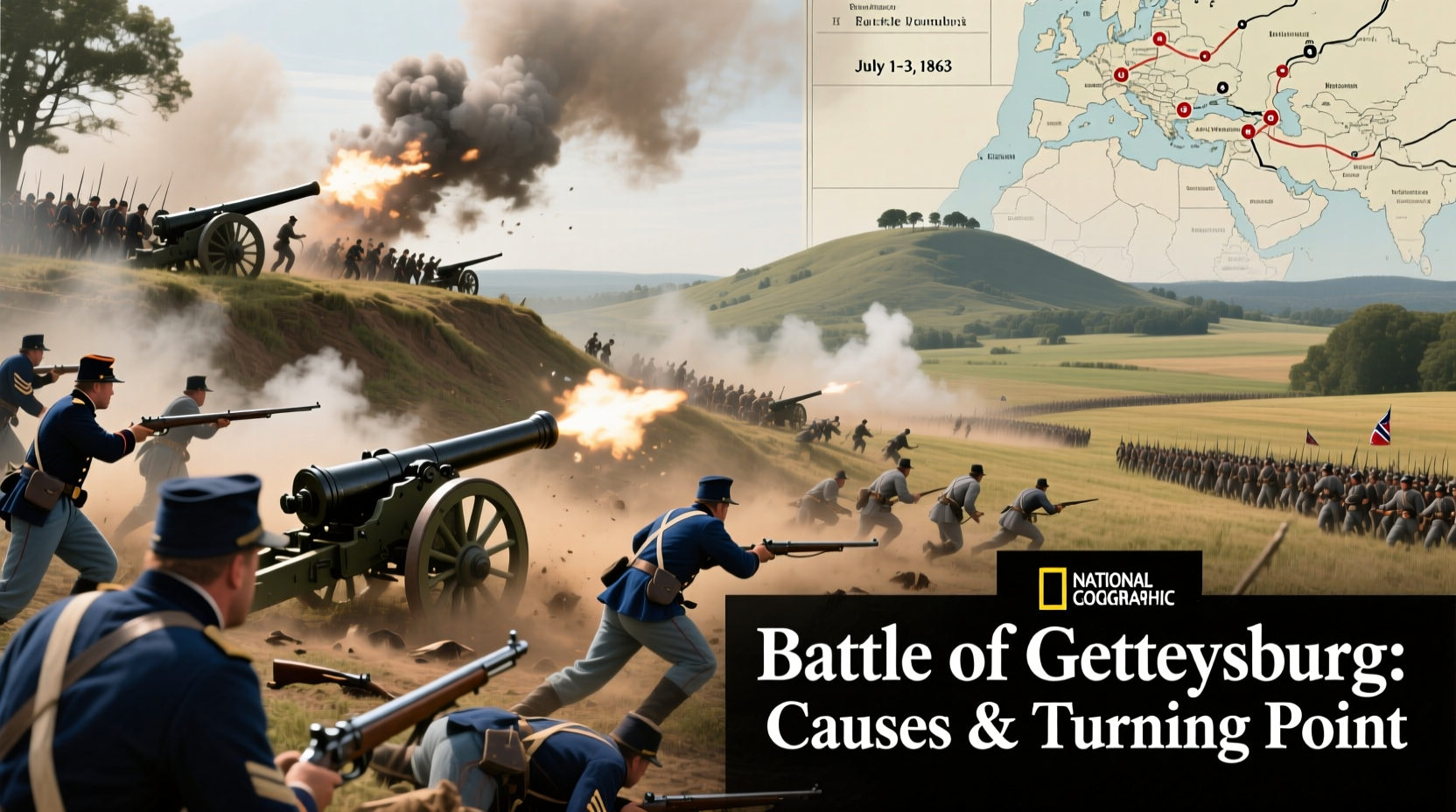
General Robert E. Lee’s decision to lead the Army of Northern Virginia into Union territory in June 1863 was not impulsive. After victories at Fredericksburg and Chancellorsville, Lee believed the time was right to carry the war beyond Southern borders. His campaign had several interlocking goals:
- To relieve pressure on war-torn Virginia by shifting fighting northward.
- To disrupt Union supply lines and threaten major cities like Harrisburg, Philadelphia, or even Washington, D.C.
- To influence Northern public opinion, hoping war-weariness would grow and prompt calls for peace negotiations.
- To secure foreign recognition of the Confederacy by demonstrating military strength on Union soil.
Lee understood that prolonged war favored the industrialized North. By taking the offensive, he aimed to force a decisive victory that might break the Union’s will to continue. This bold move set the stage for an inevitable confrontation with Union General George G. Meade’s Army of the Potomac.
Political and Diplomatic Motivations
Beyond battlefield tactics, the Battle of Gettysburg was shaped by high-stakes diplomacy. In 1863, the Confederacy sought formal recognition from Britain and France, both of which had economic interests in Southern cotton. However, neither nation had yet committed to supporting the South, partly due to moral opposition to slavery.
A major Confederate victory on Northern soil could have changed that calculus. As historian James M. McPherson notes:
“Had Lee triumphed at Gettysburg, European powers might have viewed the Confederacy as a viable, independent nation worthy of diplomatic relations.” — James M. McPherson, *Battle Cry of Freedom*
This potential for international legitimacy made the outcome of the Pennsylvania campaign not just a military concern, but a geopolitical one. The Lincoln administration was acutely aware of this risk, heightening the urgency to repel Lee’s invasion.
Escalating Tensions and the Path to Conflict
The roots of Gettysburg extend far beyond 1863. Decades of sectional strife over slavery, states’ rights, and economic disparity created a fractured nation. The election of Abraham Lincoln in 1860 triggered Southern secession. By 1861, full-scale war had erupted.
By mid-1863, both sides were locked in a brutal struggle for survival. The Union sought to preserve the United States; the Confederacy fought to establish itself as a sovereign nation. Each army’s movement reflected these opposing visions. Lee’s northern advance was not merely tactical—it symbolized the Confederacy’s aspiration to win freedom through force.
The immediate spark for Gettysburg came on June 30, when Confederate troops advancing toward Gettysburg in search of shoes encountered Union cavalry. What began as a minor skirmish quickly escalated as both armies rushed reinforcements. Within hours, what could have been a reconnaissance clash became the largest battle ever fought in North America.
Key Events Leading to the Battle: A Timeline
Understanding the causes of Gettysburg requires tracing the sequence of decisions and movements that brought the two armies together:
- May 1863: Lee wins the Battle of Chancellorsville, boosting Southern morale despite heavy losses, including Stonewall Jackson.
- June 3–15: Lee begins moving his army north through the Shenandoah Valley, avoiding detection.
- June 28: Union General Joseph Hooker resigns; George G. Meade is appointed commander of the Army of the Potomac.
- June 30: Confederate infantry enters Gettysburg, encounters Union cavalry under General John Buford.
- July 1: Full engagement begins as both sides commit more troops. Confederates push Union forces back through the town to defensive positions on Cemetery Hill.
- July 2–3: Intense fighting on both flanks—Little Round Top, the Wheatfield, Pickett’s Charge—ends in Union victory.
This timeline illustrates how operational momentum, intelligence gaps, and leadership changes contributed to the collision at Gettysburg. Neither side initially intended to fight a decisive battle there, but once contact was made, retreat became politically and militarily untenable.
Comparative Strengths and Strategic Mistakes
The outcome at Gettysburg was influenced not only by numbers and terrain but also by command decisions. The following table summarizes key factors affecting each side:
| Factor | Union (Army of the Potomac) | Confederacy (Army of Northern Virginia) |
|---|---|---|
| Troop Strength | ~93,000 | ~75,000 |
| Command Leadership | Newly appointed Meade, but cohesive corps leadership | Experienced Lee, but loss of Jackson affected coordination |
| Defensive Position | Held high ground: Cemetery Ridge, Little Round Top | Forced into costly frontal assaults |
| Logistics | Shorter supply lines from Northern rail hubs | Extended, vulnerable supply lines from Virginia |
| Critical Error | Delayed pursuit after July 1 | Pickett’s Charge—ill-fated assault on July 3 |
The Union’s ability to consolidate on strong defensive terrain proved decisive. Meanwhile, Lee’s decision to launch a massive frontal assault on the third day—despite objections from subordinates—has been widely criticized as a strategic miscalculation.
Real Example: The Defense of Little Round Top
One moment encapsulates the stakes of Gettysburg: the defense of Little Round Top on July 2. Colonel Joshua Lawrence Chamberlain, commanding the 20th Maine Infantry, held the extreme left flank of the Union line. With ammunition nearly exhausted and his men outnumbered, Chamberlain ordered a bayonet charge down the hill—an unorthodox move that routed the attacking 15th Alabama.
This action prevented the Confederates from flanking the entire Union army. Had they succeeded, the outcome of the battle—and perhaps the war—might have been different. Chamberlain’s initiative highlights how individual courage and quick thinking, rooted in the larger cause of preserving the Union, helped turn the tide.
Frequently Asked Questions
Was the Battle of Gettysburg planned in advance?
No. While Lee planned an invasion of the North, the exact location of the battle was not predetermined. Gettysburg became the site due to chance encounters between cavalry units and the rapid convergence of both armies.
How many casualties were there at Gettysburg?
Approximately 51,000 soldiers were killed, wounded, captured, or missing—23,000 Union and 28,000 Confederate. It remains the bloodiest battle in American history.
Did slavery play a role in causing the battle?
Yes. While the immediate trigger was military strategy, the underlying cause of the war—and thus the battle—was the conflict over slavery. The Confederacy fought to preserve it; the Union increasingly fought to end it, especially after the Emancipation Proclamation.
Conclusion: Why Gettysburg Still Matters
The Battle of Gettysburg was fought because two visions of America collided—union versus secession, freedom versus slavery, democracy versus aristocracy. Though sparked by military maneuver, its causes were deeply rooted in decades of national division. The Union victory halted Lee’s boldest northern campaign, dashed Confederate hopes for foreign recognition, and reinvigorated the North’s commitment to see the war through.
In November 1863, Lincoln consecrated the battlefield cemetery with words that reframed the struggle: “that this nation, under God, shall have a new birth of freedom.” Gettysburg was not just a turning point in war—it became a symbol of national renewal.




 浙公网安备
33010002000092号
浙公网安备
33010002000092号 浙B2-20120091-4
Comments
No comments yet. Why don't you start the discussion?