
When the United States Constitution was first drafted in 1787, it established a strong federal government with defined powers. However, many citizens and state leaders were deeply concerned that this new framework did not explicitly protect individual liberties. The absence of clear guarantees for freedoms like speech, religion, and due process sparked widespread resistance during the ratification debates. To address these fears and secure broader support, James Madison introduced a series of amendments—what we now know as the Bill of Rights. These ten amendments were ratified in 1791 and became the cornerstone of American civil liberties.
The inclusion of the Bill of Rights was not just a political compromise; it was a foundational act rooted in historical experience, philosophical ideals, and practical governance. Understanding why it was added requires examining the context of its creation, the concerns of Anti-Federalists, and the enduring principles it enshrines.
Historical Context: From Revolution to Ratification
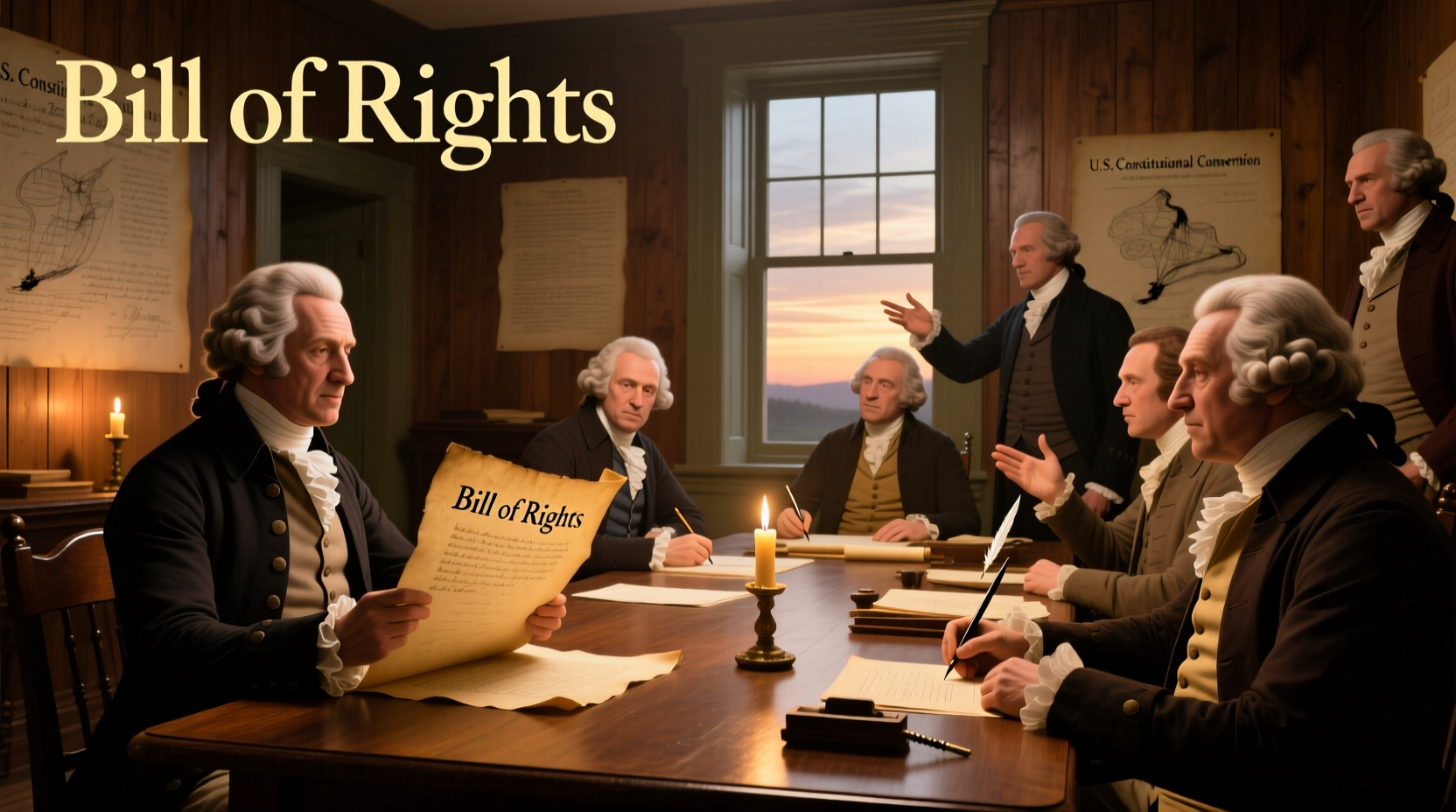
In the aftermath of the American Revolution, colonists remained deeply suspicious of centralized authority. Their fight against British rule had been fueled by grievances such as arbitrary searches, quartering of soldiers, lack of trial by jury, and suppression of dissent. These experiences shaped a collective belief that unchecked government power inevitably leads to tyranny.
When the Constitutional Convention convened in Philadelphia in 1787, the primary goal was to replace the weak Articles of Confederation with a more effective national government. The resulting Constitution created three branches of government and outlined their powers—but said nothing about individual rights. This omission alarmed many Americans who feared that a powerful central government could replicate the abuses they had fought to escape.
During the ratification process, several states—including Virginia, New York, and Massachusetts—conditionally supported the Constitution only if amendments would be added to safeguard personal freedoms. These demands came largely from the Anti-Federalists, who argued that without explicit protections, the government might gradually erode citizens’ rights.
“We have no security for liberty or property unless the people retain the right to restrain their rulers.” — Patrick Henry, Anti-Federalist Leader
The Role of James Madison and Federalist Compromise
James Madison, initially skeptical of the need for a bill of rights, believed that structural safeguards within the Constitution—such as separation of powers and checks and balances—were sufficient to prevent abuse. He also worried that listing certain rights might imply that unlisted rights were unprotected.
However, after being elected to the First Congress in 1789, Madison recognized the political necessity of addressing public concern. Drawing heavily from state constitutions (especially Virginia’s Declaration of Rights) and proposals submitted by various states, he drafted nineteen amendments. After debate and revision in Congress, twelve were sent to the states for ratification. Ten were ultimately approved by December 15, 1791, becoming the Bill of Rights.
Madison's shift illustrates a key principle of democratic governance: even well-designed institutions must respond to the will and worries of the people. His leadership transformed opposition into consensus, ensuring broader acceptance of the Constitution while embedding essential liberties into law.
Core Freedoms Protected by the Bill of Rights
The first ten amendments provide specific protections that define American freedom. Each addresses a different aspect of civic life and personal autonomy. Below is a summary of the key rights guaranteed:
| Amendment | Right Protected |
|---|---|
| First | Freedom of religion, speech, press, assembly, and petition |
| Second | Right to keep and bear arms |
| Third | Protection against quartering of soldiers |
| Fourth | Protection against unreasonable searches and seizures |
| Fifth | Due process, protection against self-incrimination, double jeopardy |
| Sixth | Right to a fair and speedy trial, legal counsel, confrontation of witnesses |
| Seventh | Right to jury trial in civil cases |
| Eighth | Prohibition of excessive bail, fines, and cruel/unusual punishment |
| Ninth | Recognition that rights not listed are still retained by the people |
| Tenth | Reservation of powers to states and the people |
This structure ensures both enumerated rights and acknowledges that the list is not exhaustive. The Ninth and Tenth Amendments, often overlooked, reinforce the idea that government has limited authority and individuals possess inherent rights beyond those specifically named.
Why the Bill of Rights Was Essential: Four Key Reasons
The inclusion of the Bill of Rights served multiple purposes—legal, political, philosophical, and practical. Here are four major reasons why it was necessary:
- To Protect Individual Liberties: Without written guarantees, there was no enforceable barrier preventing the federal government from infringing on basic freedoms such as expression, conscience, and privacy.
- To Gain Public Trust: Many citizens distrusted distant authority. Explicitly stating rights helped reassure them that the new government respected their autonomy.
- To Limit Government Power: By defining what the government cannot do, the Bill of Rights acts as a check on overreach, especially in law enforcement and judicial proceedings.
- To Fulfill State Demands: Several key states refused to ratify the Constitution without promised amendments. Including the Bill of Rights was crucial for national unity.
“The way to have good and safe government is not to trust it all to one, but to divide it among the many.” — Thomas Jefferson
Mini Case Study: The Impact of the Fourth Amendment Today
Consider a modern scenario: A local police department conducts a warrantless search of a suspect’s smartphone based on vague suspicion. Under the Fourth Amendment, which protects against unreasonable searches and seizures, this action could be challenged in court. If the evidence obtained is deemed illegally gathered, it may be excluded from trial—a doctrine known as the \"exclusionary rule.\"
This example shows how the Bill of Rights remains active and relevant. What began as a reaction to British general warrants (like writs of assistance) now protects digital privacy in the 21st century. Courts continue to interpret these original principles in light of evolving technology and social norms, demonstrating the enduring flexibility of the amendments.
Step-by-Step: How the Bill of Rights Became Law
- 1787: The U.S. Constitution is drafted at the Philadelphia Convention without a bill of rights.
- 1787–1788: Anti-Federalists lead opposition during ratification, demanding explicit protections.
- 1789: James Madison introduces proposed amendments in the First Congress.
- September 1789: Congress approves twelve amendments and sends them to the states.
- 1790–1791: States begin ratifying the amendments.
- December 15, 1791: Virginia becomes the 10th of 14 states to ratify ten of the twelve amendments, officially adopting them as the Bill of Rights.
Checklist: Understanding the Legacy of the Bill of Rights
- ☑ Recognize that the Bill of Rights emerged from public demand, not elite design.
- ☑ Know that the first eight amendments protect specific individual rights.
- ☑ Understand that the Ninth and Tenth Amendments preserve unenumerated and state-level rights.
- ☑ Be able to explain how the Bill of Rights limits federal power.
- ☑ Apply historical knowledge to current issues involving free speech, privacy, or due process.
Frequently Asked Questions
Didn’t the Constitution already protect rights before the Bill of Rights?
The original Constitution included some protections—such as habeas corpus, prohibition of bills of attainder, and ex post facto laws—but these were limited. Most fundamental rights, like free speech and religious liberty, were not mentioned. The Bill of Rights filled that gap by explicitly enumerating them.
Why weren’t these rights included in the original Constitution?
Many framers believed structural safeguards were enough. Others assumed that since the federal government had only delegated powers, it couldn’t infringe on rights unless explicitly authorized. But critics rightly pointed out that assumptions aren’t enforceable—clear language is.
Do the protections apply to everyone equally today?
Originally, the Bill of Rights applied only to the federal government and didn’t fully extend to women, enslaved people, or Native Americans. Over time, through amendments like the Fourteenth and landmark Supreme Court decisions, most protections have been “incorporated” to apply to state governments and cover all citizens.
Conclusion
The Bill of Rights was included in the Constitution because liberty without guarantee is fragile. It stands as both a legal shield and a moral statement: that certain freedoms are so fundamental they must be beyond the reach of majority rule or governmental convenience. Its creation was a triumph of dialogue between opposing factions, proving that a nation can strengthen itself not by silencing dissent, but by responding to it.
Today, every citizen benefits from the foresight of those early debates—from the protester exercising free speech to the defendant receiving legal counsel. These rights are not self-enforcing; they require vigilance, education, and civic engagement to preserve.




 浙公网安备
33010002000092号
浙公网安备
33010002000092号 浙B2-20120091-4
Comments
No comments yet. Why don't you start the discussion?