
In November 1620, a group of English Separatists—later known as the Pilgrims—anchored off the coast of what is now Massachusetts, far north of their intended destination in Virginia. Facing uncertainty, internal dissent, and the absence of any governing authority, they made a decision that would echo through centuries of democratic development: they drafted and signed the Mayflower Compact. This simple document, just over 200 words long, became one of the foundational texts in the evolution of self-government in America. Its creation was not merely a reaction to circumstance but a deliberate step toward order, unity, and collective responsibility.
The Historical Context Behind the Signing
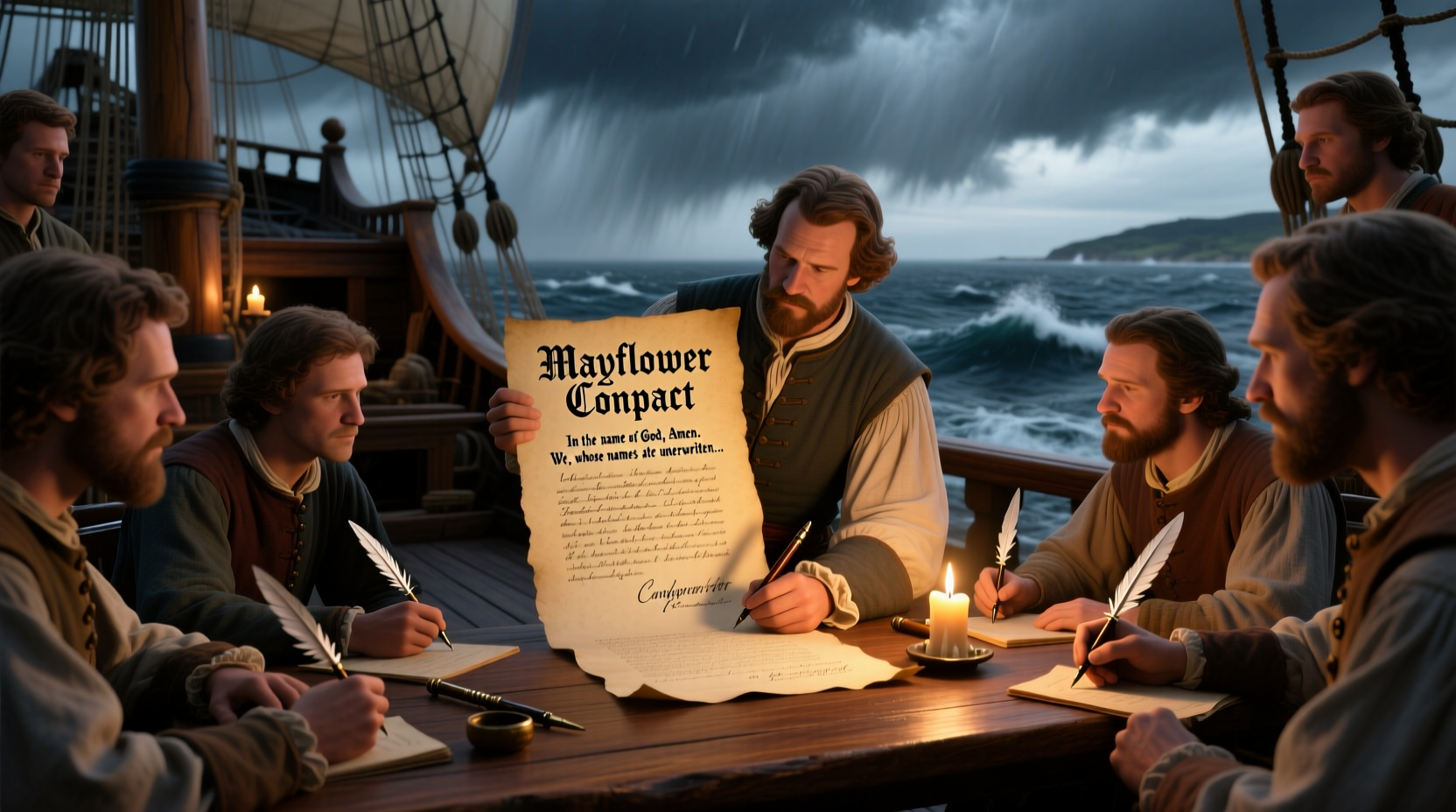
The Mayflower set sail from Plymouth, England, in September 1620 with 102 passengers, including religious dissenters seeking freedom from the Church of England and others drawn by economic opportunity. The ship was bound for the northern part of the Virginia Colony, under the jurisdiction of the London Company, which had granted them legal permission to settle. However, navigational errors and rough seas led them to land at Cape Cod, outside the company’s charter.
This geographical deviation created a crisis. Without official authority from the Crown or a colonial charter, some passengers—particularly those who were not part of the Separatist congregation—argued that they were no longer bound by any rules. As William Bradford, governor of Plymouth Colony, later wrote, there were “mutinous speeches” among non-Separatists who claimed they “would use their own liberty” upon landing.
Faced with potential chaos and the collapse of their mission, the colony’s leaders realized a formal agreement was necessary to prevent disunity and ensure survival in an unforgiving wilderness.
The Purpose of the Mayflower Compact
The primary purpose of the Mayflower Compact was to establish a temporary, self-imposed system of governance based on the consent of the governed. It was designed to:
- Prevent dissent and maintain order among diverse passengers
- Create a binding agreement for civil rule in the absence of royal or corporate authority
- Ensure collective commitment to the success of the colony
- Legitimize leadership decisions through majority rule
The document begins with a statement of faith and loyalty to King James I, followed by a pledge from the signers to form “a civil Body Politick” for the “general good of the Colony.” From this body, they promised to enact “just and equal Laws… for the general good of the Colony.” This marked a radical departure from hierarchical rule—it was governance by mutual agreement, not divine right or inherited power.
“We, whose names are underwritten… do by these presents, solemnly and mutually in the Presence of God and one another, covenant and combine ourselves together into a civil Body Politick.” — Excerpt from the Mayflower Compact (1620)
Significance in the Development of American Democracy
The Mayflower Compact did not create a democracy in the modern sense, but it introduced principles that would become central to American political life:
- Consent of the governed: Authority derived from the people, not imposed from above.
- Rule of law: Leaders were subject to laws created collectively.
- Civil covenant: A social contract where individuals agree to abide by shared rules for common benefit.
- Self-governance: The right of a community to manage its own affairs.
Though initially a pragmatic response to immediate danger, the Compact planted seeds for future institutions. Over a century later, revolutionary leaders like John Adams and Thomas Jefferson referenced its spirit when arguing for representative government. John Quincy Adams called it “the only instance in human history of that positive, original social compact which speculative philosophers have imagined as the only legitimate foundation of government.”
A Timeline of Key Events Surrounding the Compact
Understanding the sequence of events helps clarify why the Compact was both urgent and unprecedented.
- September 6, 1620: The Mayflower departs Plymouth, England.
- Mid-October 1620: Signs of unrest emerge among non-Separatist passengers who question authority after missing Virginia.
- November 9, 1620: The ship sights Cape Cod. The decision is made not to sail further south due to dangerous conditions.
- November 11, 1620 (Old Style Date): The Mayflower Compact is drafted and signed aboard the ship while anchored in Provincetown Harbor.
- December 25, 1620: The settlers begin building Plymouth Colony.
- 1621: First successful harvest leads to the celebration now remembered as the first Thanksgiving.
- 1691: Plymouth Colony merges with the Massachusetts Bay Colony, but the legacy of self-rule persists.
Comparison: The Mayflower Compact vs. Later Governing Documents
| Document | Year | Key Principle | Scope of Governance | Long-Term Influence |
|---|---|---|---|---|
| Mayflower Compact | 1620 | Consent of the governed | Local colony (Plymouth) | Model for self-rule; precursor to constitutionalism |
| Magnus Carta | 1215 | Limits on monarchical power | England | Influenced due process and legal rights |
| Massachusetts Body of Liberties | 1641 | Individual rights and legal protections | Massachusetts Bay Colony | Early colonial bill of rights |
| U.S. Constitution | 1787 | Separation of powers, federalism | National government | Foundation of American law and governance |
Real-World Example: Unity in Crisis
Consider the situation faced by the Mayflower passengers: stranded in an unfamiliar land, facing winter without shelter, supplies dwindling, and factions forming. One passenger, John Billington, later became the first colonist executed for murder in 1630—proof that even under a compact of order, tensions could erupt. But because the initial framework established lawful authority, disputes could be addressed through trial rather than vengeance.
In this way, the Compact wasn’t just symbolic—it provided a mechanism. When disagreements arose over land distribution or leadership roles, the colony referred back to the principle of collective decision-making. This precedent allowed Plymouth to survive its first brutal winter, during which nearly half the settlers died, and go on to thrive for over 70 years as an independent entity.
Expert Insight on the Compact’s Legacy
“The Mayflower Compact was not a constitution, but it was the first act of constitutionalism in America. It showed that free men could bind themselves together by law, voluntarily, for the sake of order and justice.” — Dr. Joyce Oldham Appleby, Historian of Early American Republics
Frequently Asked Questions
Was the Mayflower Compact a constitution?
No, it was not a full constitution. It lacked detailed structures of government, separation of powers, or enumerated rights. However, it functioned as a foundational covenant establishing self-rule and the rule of law—key elements later embedded in constitutions.
Who signed the Mayflower Compact?
Forty-one adult male passengers signed the document, including Separatists (Pilgrims) and non-Separatists (often called \"Strangers\"). Women, children, and servants did not sign, reflecting the social norms of the time.
Why is the Mayflower Compact still studied today?
It is studied because it represents the earliest example of democratic self-governance in English North America. Educators and historians view it as a symbolic beginning of American civic tradition—the idea that government arises from the people, not imposed upon them.
How to Apply the Principles Today: A Civic Checklist
The values behind the Mayflower Compact—responsibility, cooperation, and respect for shared rules—are timeless. Here’s how individuals can honor that legacy in modern life:
- Participate in local government meetings or school boards
- Vote in every election, even local ones
- Engage in civil discourse, especially with those who disagree
- Support community initiatives that promote fairness and inclusion
- Educate others about foundational civic documents and their meaning
Conclusion: A Foundation Built on Agreement
The Mayflower Compact was born of necessity, forged in uncertainty, and sustained by shared commitment. It was not perfect—its signers were limited by the era’s social hierarchies and religious exclusivity—but its core idea endures: that people can come together, despite differences, to create a just and orderly society through mutual agreement.
In a world where trust in institutions wavers and polarization grows, revisiting the spirit of the Compact reminds us that governance works best when rooted in collective responsibility. The Pilgrims didn’t wait for permission to build a functioning society. They took initiative. So can we.




 浙公网安备
33010002000092号
浙公网安备
33010002000092号 浙B2-20120091-4
Comments
No comments yet. Why don't you start the discussion?