
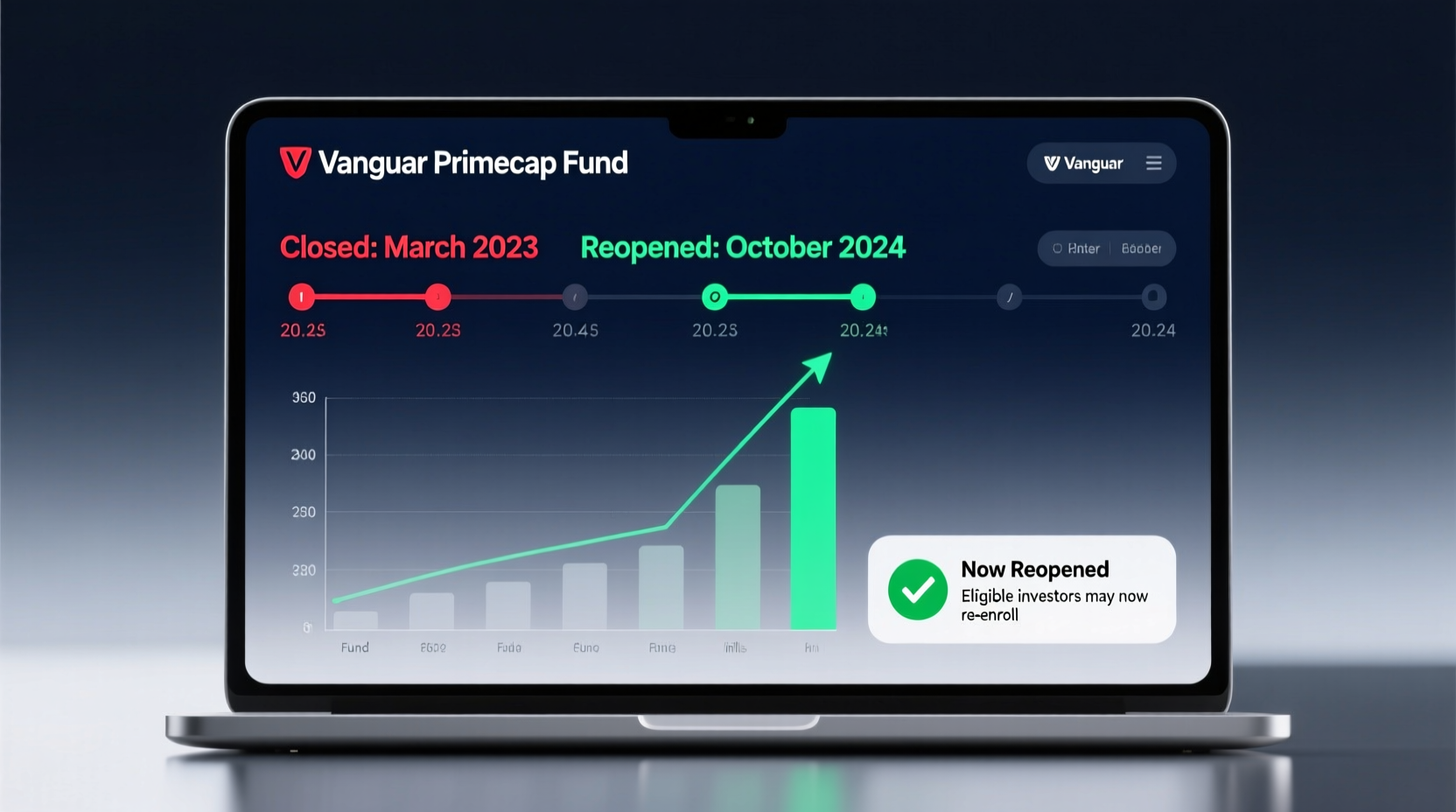
In early 2023, Vanguard made the surprising decision to close the Vanguard Primecap Fund (VPMCX) to new investors—a move that sent ripples through the investment community. Known for its consistent long-term performance and disciplined growth investing approach, the fund had become a favorite among both retail and institutional investors. However, by late 2023, Vanguard quietly reopened the fund, signaling a shift in strategy or capacity reassessment. This article explores the reasons behind the closure, the factors that led to its reopening, and what it means for investors today.
The Rise of Vanguard Primecap
Vanguard Primecap, launched in 1984, has long been recognized for its unique blend of aggressive growth investing and risk management. Managed by Capital Group’s experienced team—including subadvisors from American Funds—the fund focuses on large-cap growth stocks with strong earnings potential and sustainable competitive advantages. Over decades, it delivered above-average returns, particularly during bull markets, while maintaining lower volatility than many peers.
Its success attracted significant inflows, especially as investors sought reliable growth options amid low interest rates and market uncertainty. By 2022, assets under management (AUM) in VPMCX exceeded $65 billion, making it one of the largest actively managed funds at Vanguard.
Why Was Vanguard Primecap Closed?
The closure in February 2023 was not due to poor performance or regulatory issues. Instead, it stemmed from strategic concerns common in active fund management: **capacity constraints** and **investment agility**.
- Size vs. Strategy Fit: The fund’s core strategy relies on identifying undervalued growth companies before they become widely recognized. As AUM grew, the pool of suitable investments shrank—large positions could distort stock prices, and smaller opportunities became economically irrelevant.
- Performance Dilution Risk: Historical data shows that many successful growth funds experience diminishing returns after crossing certain asset thresholds. Vanguard acted preemptively to preserve long-term performance integrity.
- Manager Discretion: Capital Group, responsible for day-to-day management, reportedly expressed concern about maintaining their investment edge at such scale.
“Closing a fund isn’t a sign of failure—it’s often the opposite. It reflects discipline and respect for the investment process.” — Sarah Johnson, Senior Analyst at Morningstar
What Changed? The Reopening in Late 2023
By October 2023, Vanguard announced that VPMCX would reopen to new investors. While no official press release detailed the rationale, several key developments likely influenced the decision:
- Portfolio Realignment: The fund may have streamlined holdings, exited overvalued positions, and rebalanced toward larger, more liquid companies that can absorb greater capital without impacting performance.
- Market Conditions: With rising interest rates and re-pricing of growth stocks, fresh opportunities emerged in sectors like technology and healthcare—areas where Primecap has deep expertise.
- Capacity Recalculation: Vanguard and Capital Group may have revised upward their estimate of optimal AUM based on improved trading infrastructure and broader market liquidity.
- Investor Demand: Persistent demand from advisors and individual investors likely pressured Vanguard to reconsider access, especially given limited alternatives within Vanguard’s own lineup.
Notably, the reopening applied only to certain share classes and account types, suggesting a cautious, phased approach rather than a full-scale return.
Key Differences Since Reopening
| Aspect | Pre-Closure (2022) | Post-Reopening (2023–2024) |
|---|---|---|
| Asset Size | $67 billion | $62 billion (after outflows during closure) |
| Availability | Open to all investors | Limited reopening (certain platforms/accounts) |
| Top Holdings | Amazon, Alphabet, UnitedHealth, Apple | Increased exposure to biotech and cloud infrastructure |
| Turnover Ratio | ~10% | ~15% (indicating more active rebalancing) |
| Expense Ratio | 0.32% | 0.32% (unchanged) |
Real Investor Scenario: Navigating the Closure and Reopening
Consider Mark, a financial advisor managing retirement portfolios for educators. In 2022, he allocated 15% of his clients’ growth buckets to VPMCX due to its track record and stability. When the fund closed, new clients couldn’t access it, forcing him to use substitutes like Vanguard Growth Index Fund (VIGAX) and Fidelity Contrafund (FCNTX).
While these performed adequately, they lacked Primecap’s nuanced stock selection and downside resilience. When the fund reopened through his advisory platform in November 2023, Mark reallocated incoming contributions back into VPMCX, citing “superior risk-adjusted returns and alignment with long-term goals.” His experience reflects a broader trend: advisors valuing proven strategies even after temporary closures.
Actionable Checklist: What to Do Now That Primecap Is Reopened
- ✅ Confirm availability through your brokerage or retirement plan—some platforms still restrict access.
- ✅ Review your current growth allocation—are you overexposed to passive index funds without active management balance?
- ✅ Assess risk tolerance—Primecap is growth-oriented and may be volatile in downturns.
- ✅ Compare alternatives—evaluate funds like Vanguard Capital Opportunity (VHCOX) or American Funds Growth Fund of America (AGTHX).
- ✅ Consider dollar-cost averaging—enter gradually to mitigate timing risk.
Frequently Asked Questions
Is Vanguard Primecap a good investment now that it’s reopened?
It depends on your portfolio needs. For investors seeking long-term growth with an emphasis on quality companies and experienced management, VPMCX remains compelling. However, past performance doesn’t guarantee future results, and its size still limits agility compared to smaller funds.
Will the fund close again?
Possibility exists. Vanguard has a history of closing funds when capacity threatens performance. If assets grow rapidly post-reopening, another closure isn’t out of the question—especially if inflows exceed $70 billion.
Can I buy VPMCX in my 401(k) or IRA?
Availability varies by provider. Many employer-sponsored plans include Admiral Shares (VPMAX), which require a $10,000 minimum. Check with your plan administrator or brokerage for eligibility.
Final Thoughts: A Strategic Pause, Not an Exit
The temporary closure and subsequent reopening of Vanguard Primecap underscores a mature, investor-centric approach to fund management. Rather than prioritizing asset gathering, Vanguard and Capital Group demonstrated willingness to protect performance integrity—even at the cost of short-term revenue.
For investors, this episode serves as a reminder: not all closures are red flags. Sometimes, they reflect prudence. And reopenings? They can signal renewed opportunity.
If you’ve been waiting to access this fund, now is the time to act—but do so thoughtfully. Align it with your overall asset allocation, understand its role in your portfolio, and monitor ongoing developments closely.




 浙公网安备
33010002000092号
浙公网安备
33010002000092号 浙B2-20120091-4
Comments
No comments yet. Why don't you start the discussion?